First Seen
2024-08-23T03:47:19.320060+00:00
simple-description (qwen3.5_2b-q8_0)
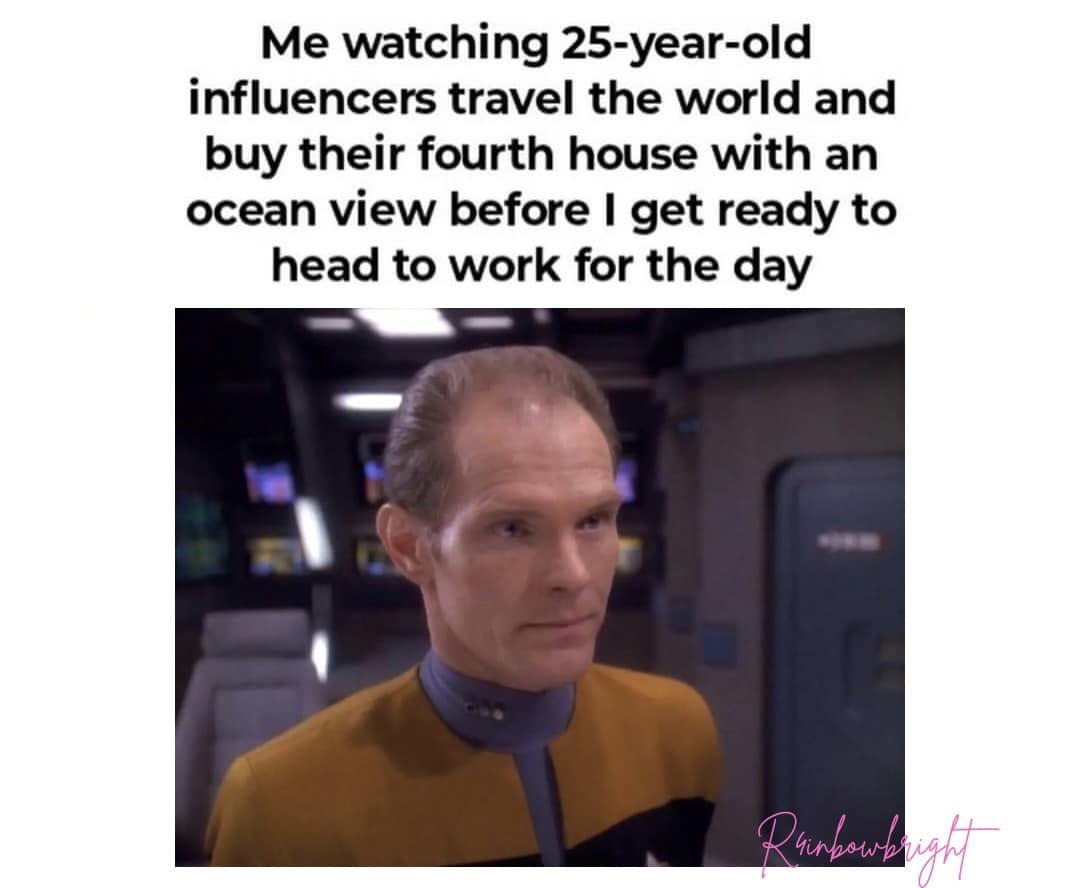
Illuminating for an unseeing mind, this meme captures the Millenilism of finding meaning in the mundane rather than the hyper-stylized. The image shows a weary Captain Pike in a Starfleet uniform looking at someone off-screen with an expression of impatient disappointment, sighing at the triviality of influencers. The caption, "Me watching 25-year-old influencers travel the world and buy their fourth house with an ocean view before I get ready to head to work for the day," reinforces the theme that real-world responsibilities matter more than digital status.
detailed-analysis (gemma3_27b-it-q8_0)
Okay, let's break down this meme through the lens of "Millenihilism" and the provided theoretical frameworks. Given the meme's content, several of these will be highly relevant, while others will be less so.
Understanding Millenihilism
Before diving in, it’s important to define "Millenihilism". This is a contemporary internet-borne sensibility—often associated with millennials and Gen Z—characterized by a weary, ironic acceptance of societal decay, the perceived impossibility of meaningful progress, and the relentless, often absurd nature of late capitalism. It's a rejection of grand narratives (like the idea of upward mobility or a secure future) coupled with a bleak humor in the face of it all. It's often manifested through a sense of "everything is terrible, but what can you do?" and a detachment from traditional life goals.
Visual Description
The image features a close-up of Captain Jean-Luc Picard (Patrick Stewart) from Star Trek: The Next Generation. His expression is a mix of weary disappointment and resigned contemplation. He's looking slightly downwards and to the side, conveying a sense of internal processing of something deeply disheartening. The confined space of the Enterprise transporter room adds to a feeling of being trapped or stuck. The context of Picard, a highly disciplined and morally centered character, adds irony to the sentiment.
Postmodernism
This meme is strongly rooted in postmodern thought. Several key themes come into play:
- Deconstruction of the American Dream: The meme deconstructs the traditional narrative of hard work leading to success and a comfortable life. The stark contrast between the influencers’ "effortless" accumulation of wealth and the meme creator’s mundane routine highlights the breakdown of this myth. The narrative of meritocracy is mocked.
- Simulation & Hyperreality: The influencer lifestyle, often curated and presented online, can be seen as a hyperreal simulation—an imitation of reality that becomes more real than reality itself. The meme creator experiences the consequences of the “real” world while being bombarded by this simulation.
- Irony & Parody: The meme's humor is deeply ironic. It doesn't express genuine anger but rather a weary acceptance of this disparity. The use of Picard—a symbol of optimism and exploration—only amplifies the ironic effect.
- Loss of Grand Narratives: Postmodernism rejects universal truths and grand narratives. The meme embodies this by acknowledging the absurdity of expecting a linear path to success in a world where social media popularity can translate into wealth.
Critical Theory
The meme can be read through a Critical Theory lens, focusing on how power structures operate and maintain inequality:
- Ideology & Hegemony: The influencer lifestyle isn't presented as a natural outcome of talent or hard work; it's a product of the dominant ideology that prioritizes consumption, image, and performative success. This ideology reinforces the status quo.
- Culture Industry: Influencers are a key component of the "culture industry" (Adorno & Horkheimer). Their content isn’t organic but manufactured, contributing to a standardization of values and desires. The meme highlights how this industry perpetuates unattainable standards.
- Commodification of Self: Influencers commodify their own lives, turning personal experiences into marketable content. This meme points to the way our culture encourages us to do the same, while the creator clearly isn’t benefiting from this dynamic.
Marxist Conflict Theory
This meme speaks directly to class conflict and the widening wealth gap:
- Bourgeoisie vs. Proletariat: The influencers represent a new kind of "bourgeoisie" – those who accumulate wealth through branding, social media, and the attention economy. The meme creator represents the "proletariat" – those who rely on traditional wage labor.
- Alienation: The meme creator's feeling of disconnect is a form of alienation. They are alienated from the fruits of their labor, while others seemingly benefit from a system that isn't fair.
- False Consciousness: The influencers, though their success may be built on exploitative systems, are often presented as aspirational figures. This can create "false consciousness," where people mistakenly believe that success is attainable for all through individual effort.
Foucauldian Genealogical Discourse Analysis
Foucault’s genealogy explores how concepts and power relations have evolved over time. Looking at the meme through this lens:
- Discipline and Biopower: The influencer industry functions within systems of discipline and biopower. Individuals are encouraged to optimize their self-presentation for engagement, tracking metrics, and ultimately monetizing their online persona. This creates a constant self-monitoring and optimization.
- Historical Construction of "Success": The meme challenges the historical construction of what constitutes "success." Traditionally, success was linked to hard work, education, and a stable career. Now, it can be achieved through viral content and brand partnerships.
- Power/Knowledge: The influencers wield power through their knowledge of social media algorithms, branding, and content creation. This knowledge is used to shape perceptions and influence behavior.
Queer Feminist Intersectional Analysis
While the meme doesn't explicitly focus on gender or sexuality, an intersectional lens can add nuance:
- Representation & Access: The influencer landscape often prioritizes conventional beauty standards and access to capital, creating barriers for marginalized groups. While some influencers promote inclusivity, the underlying structures often perpetuate inequalities.
- The Performance of Self: Queer theory emphasizes the performative nature of identity. Influencers’ curated online personas can be seen as extreme examples of this, raising questions about authenticity and the pressure to conform to social norms.
- Labor & Affect: The labor of emotional and aesthetic performance (affective labor) is often disproportionately expected of women and marginalized groups online. The meme points to the toll of this labor when contrasted with the perceived ease of the influencer lifestyle.
In conclusion: The meme isn't just a funny observation about the internet. It’s a compact expression of disillusionment, a critique of late capitalism, and a postmodern lament for lost ideals. It captures the mood of Millenihilism perfectly: recognizing the absurdity of the world while acknowledging the difficulty of changing it. It’s a bleak joke told with Picard’s weary face as a punchline.
simple-description (llama3.2-vision_11b)
This meme is from the category of Millenihilism, which refers to the pessimistic and nihilistic views of younger generations, particularly Millennials and Gen Z. The meme is about a 25-year-old who is watching 20-year-olds travel the world and buy their fourth house with an ocean view before they even start their careers. The text on the image reads: "Me watching 20-year-olds travel the world and buy their fourth house with an ocean view before I get out of bed in the morning."
detailed-analysis (gemma3-27b-vision)
Okay, let's break down this meme through various theoretical lenses. It's a rich image that lends itself to multiple analyses!
Visual Description
The image is a screencap from Star Trek: The Next Generation, featuring Captain Jean-Luc Picard. He is depicted from the chest up, looking with a very distinct expression of weary skepticism and restrained frustration. His eyebrows are raised slightly, his mouth is downturned, and his eyes convey a feeling of being deeply unimpressed and perhaps resigned to a frustrating situation. He’s wearing his standard Starfleet uniform. The background is the bridge of the Enterprise, hinting at a position of leadership and control, though the expression undermines that authority. The overall mood is one of subdued exasperation.
Foucauldian Genealogical Discourse Analysis
This meme highlights the discourse of "success" as constructed within digital platforms, particularly as exemplified by "influencers." Foucauldian genealogy traces the historical development of power/knowledge relations. The idea of 'influencer' wealth—travel, multiple homes—has become a normalized, even desired, state within the discourse of social media. It’s not just about having money; it’s about performing wealth for an audience.
The meme positions the viewer as observing a power imbalance. Picard’s expression is a response to this constructed discourse, revealing its absurdity. Picard isn’t questioning wealth as such, but the way this particular type of wealth is produced (through spectacle and perceived authenticity), presented, and expected within the influencer sphere. It suggests that we are subject to a new form of discipline—not overt constraint, but a pervasive expectation to participate in or aspire to this lifestyle. The meme points to the normalization of this lifestyle and how it influences our own self-perception and aspirations.
Critical Theory (Frankfurt School)
This meme echoes the Frankfurt School's critique of "culture industry." The "influencers" exemplify the packaged, commodified, and ultimately illusory happiness promoted by the culture industry. Their lives are presented as spectacles, obscuring the labor, privilege, and often-exploitative systems that enable them.
The meme highlights the alienation of the viewer. They are positioned as a passive observer of a lifestyle that is unattainable and ultimately unsatisfying. Picard’s expression signals a rejection of this manufactured reality. It’s a questioning of the "false consciousness" that the culture industry seeks to create—the belief that happiness is found in consumption and spectacle rather than in meaningful work or social connection.
Marxist Conflict Theory
From a Marxist perspective, this meme expresses a class conflict. The influencers represent a new elite—not based on traditional production (like owning the means of production in a factory) but on the production of attention and the commodification of their personal brand.
The meme illustrates the growing gap between the economic realities of many workers (the person heading to work) and the perceived wealth of this new "attention economy" class. Picard's expression can be read as a subtle indictment of a system that rewards spectacle over labor, and creates vast inequalities. The meme subtly suggests a power dynamic wherein the influencer class extracts value from the attention of others, while the majority continues to perform traditional labor.
Postmodernism
This meme embodies postmodern characteristics like the blurring of lines between "real" and "simulated." The lives of influencers are curated performances, often detached from material reality. They create a hyperreality—a simulation of life that feels more real than real.
Picard's expression signals a certain skepticism towards this hyperreality. He doesn’t necessarily reject it entirely, but his expression suggests a recognition of its constructed nature. The meme is a meta-commentary on the way social media constructs and perpetuates these illusions. It also plays with irony and self-awareness, hallmarks of postmodernism.
Queer Feminist Intersectional Analysis
While not the primary focus, a queer feminist lens can be applied. The influencer world often perpetuates narrow, often heteronormative and gendered, standards of beauty and success. The performance of wealth and lifestyle presented by influencers can exacerbate existing social inequalities.
Picard's expression could be seen as a rejection of these unattainable standards and a subtle challenge to the power structures that uphold them. It’s a subversion of the expected aspirational response. The meme can be read as a critique of the ways in which social media reinforces dominant ideologies and marginalizes those who do not conform.
I hope this analysis is thorough and helpful. Let me know if you'd like me to explore any of these lenses in greater detail!
simple-description (llama3.2-vision)
This meme is a humorous commentary on the disparity between the lives of social media influencers and the general public. The image features a photo of a character from the Star Trek franchise, likely Captain Jean-Luc Picard, with a skeptical expression. The accompanying text reads: "Me watching 25-year-old influencers travel the world and buy their fourth house with an ocean view before I get ready for my shift at McDonald's."