First Seen
2024-10-10T05:43:17.354184+00:00
simple-description (qwen3.5_2b-q8_0)
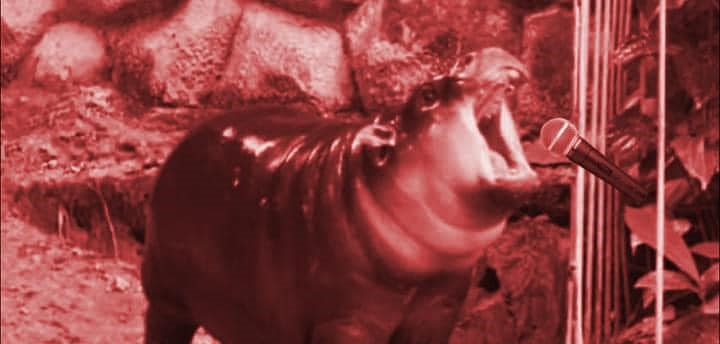
This meme illustrates the philosophy of millenihilism by using the "zoo animal singing" trend to show a meaningless performance. It depicts a hippopotamus singing into a microphone, representing a random act of nature that is reduced to an absurd, human-like spectacle. The text "Zoo animal singing" is visible in the frame, framing the chaotic behavior of the animal as a trivial event devoid of actual significance.
detailed-analysis (gemma3_27b-it-q8_0)
Okay, let's unpack this meme – a hippo seemingly attempting to address a crowd with a microphone – through the lens of "Millenihilism," and then delve into the applicable theoretical frameworks. Millenihilism, as a category, points to the profound sense of apathy, irony, and despair characteristic of the millennial and Gen Z generations facing climate change, economic instability, political polarization, and a generalized sense of societal breakdown. It's not simply nihilism (the belief in nothingness) but a millennial-flavored nihilism – exhausted, performative, and often laced with dark humor.
Visual Description
The image presents a hippo in a zoo-like enclosure, bathed in a striking, almost aggressive, red filter. This immediately evokes feelings of urgency, danger, or even a digital "error" state. The hippo is prominently positioned, and appears to be addressing an unseen audience while clutching a microphone. The bars of the enclosure are subtly present, creating a sense of confinement and artificiality. The image quality is grainy, adding to the feeling of being a relic, or a faded signal from a dying world. The red filter gives an effect of heat or stress.
Foucauldian Genealogical Discourse Analysis
This meme functions as a prime example of a disruptive discourse, revealing the shifting power dynamics embedded in our contemporary moment. Foucault’s genealogical method examines the historical emergence of knowledge and power, showing how what we consider "truth" is constructed and maintained through discourse.
- The Zoo as Microcosm: The zoo represents a constructed order, a system of control and categorization. The hippo, symbolic of raw power and untamed nature, is contained within it. This can be interpreted as a metaphor for the millennial generation – feeling contained by systems (capitalism, political structures, social expectations) they did not create.
- The Microphone as a Tool of Power: The microphone is typically associated with authority, leadership, and the ability to project a voice. However, the hippo's use of it is absurd and incongruous. It mocks the idea of meaningful communication within the existing power structures. It suggests a desire to speak, but the context renders that speech inherently futile. The hippo is attempting to exercise agency but is fundamentally trapped in a system that prevents genuine impact.
- The Red Filter as Visibility/Invisibility: The red filter makes the hippo highly visible, yet the redness also suggests a kind of warning, an alarm state. This can be seen as a commentary on the heightened awareness of societal problems (climate change, inequality) alongside the feeling that these issues remain largely unseen or unaddressed by those in power.
Critical Theory
The image resonates strongly with the Frankfurt School’s critique of the “culture industry.” The hippo with the microphone could be interpreted as a commodified spectacle – a performance of political engagement without genuine substance.
- Reification: The image reifies the idea of voicing concerns. It's a visual representation of how political activism can become a spectacle, divorced from meaningful action. The hippo, a symbol of the natural world, is now performing a human act, emphasizing the alienation of modern life.
- False Consciousness: The hippo's seemingly earnest attempt to communicate could be seen as embodying “false consciousness.” It’s a desire for change that is ultimately trapped within the system it seeks to critique. The microphone is the symbol of participation in a system that inherently disempowers.
- The Loss of Authenticity: The image highlights a sense of loss of authenticity. The hippo isn't a politician, it's a wild animal forced into an unnatural role. This mimics the feeling many millennials have – of being forced to participate in performative activism or engage in online discourse that feels disconnected from real-world change.
Postmodernism
The meme's absurdity, irony, and self-referentiality are deeply postmodern.
- Simulation and Simulacra: The hippo with a microphone is a simulation of a politician, a simulation of engagement. The image collapses the distinction between the real and the represented, echoing Baudrillard’s concept of simulacra. We are dealing with copies of copies, divorced from any original reality.
- Deconstruction of Meaning: The image actively resists easy interpretation. It doesn’t offer a clear message; instead, it deconstructs the traditional meanings associated with authority, communication, and activism.
- Irony and Parody: The entire image is steeped in irony. The incongruity of a hippo speaking into a microphone is inherently absurd. This irony is a hallmark of millenihilism, a way of coping with the sense of futility by acknowledging the absurdity of it all.
Why other frameworks don't strongly apply:
- Marxist Conflict Theory: While the zoo could be seen as a symbol of class division, the meme doesn't focus directly on economic conflict or class struggle.
- Queer Feminist Intersectional Analysis: While intersectionality is important to understanding the broader millennial experience, this particular image doesn't inherently address themes of gender, sexuality, or race in a direct way. It’s more broadly about systemic alienation and the perceived futility of action.
In essence, the hippo with a microphone is a quintessential millenihilist image. It’s a bleak, ironic, and slightly disturbing commentary on the state of the world, the impossibility of meaningful change, and the exhaustion of a generation facing an uncertain future. It’s funny because it’s so profoundly sad. The red filter heightens the sense of alarm and impending doom, reinforcing the underlying feeling of despair. It's a meme that knows it's a meme, and that knowing is part of its power.
simple-description (llama3.2-vision_11b)
The meme is a humorous image of a person in a wheelchair, with a caption that reads "millenihilism: when you're too busy being a nihilist to actually do anything about it". The image is likely a joke about the tendency of some people to focus on criticizing the world rather than taking action to change it.
detailed-analysis (gemma3-27b-vision)
Okay, let's analyze the image, broken down into sections based on the requested theoretical frameworks. Given the image, some frameworks will be more relevant than others.
Please note: Interpretation is subjective, and these are possible readings. The heavy red filter significantly affects interpretation, creating a sense of urgency or artificiality.
---
Visual Description
The image depicts a large animal, likely a tapir, presented in a strikingly monochromatic red palette. The animal is seen from the side, appearing in profile, with its head and upper body dominating the frame. It’s partially obscured by vertical bars, resembling the enclosure of a zoo or animal exhibit. The background is a muted, vaguely rocky terrain, rendered in the same red tone. The lighting is flat and somewhat obscured, contributing to the unsettling, dreamlike quality. The tapir is extending its snout towards something outside the frame, perhaps towards a person holding a microphone.
The overall impression is one of confinement, artificiality, and a disconnect between the natural world and human observation. The redness intensifies these qualities, possibly implying a sense of danger, aggression, or even illness.
---
Foucauldian Genealogical Discourse Analysis
The image lends itself strongly to a Foucauldian analysis. The tapir, contained within bars, immediately evokes the concept of discipline and surveillance. The enclosure functions as a panoptic structure, allowing for constant observation and control. The act of observing the animal (and the implied presence of a person with a microphone) is not neutral. It is an exercise of power, a defining of the animal as an object of study.
The discourse surrounding the tapir (conservation, zoology, entertainment) constructs the animal's meaning. The image isn’t merely of a tapir, it performs the power relations inherent in how we understand and categorize animals. The microphone, an instrument of discourse, adds to this: it is used to speak for the animal, to extract “knowledge” from it, but it is the human who controls the narrative.
A genealogical approach would ask how this particular way of viewing and containing tapirs (and animals in general) came to be. It would trace the historical development of zoos, animal studies, and the very concept of "wildlife," demonstrating how these things are not natural, but socially constructed through power relations.
---
Critical Theory
From a Critical Theory perspective, the image can be seen as a reflection of the relationship between humans and nature, and a critique of the Enlightenment project of dominating and controlling the natural world. The confinement of the tapir represents a broader tendency to categorize, dissect, and "know" the world through a scientific gaze that privileges human subjectivity.
The red filter adds a layer of alienation. It distances us from the natural world, turning the tapir into a spectacle, an object to be consumed by the viewer. The image de-naturalizes the animal, turning it into a signifier within a cultural system. It implicitly asks us to question who benefits from this form of control and representation.
---
Marxist Conflict Theory
While not the most overt application, a Marxist reading can focus on the power dynamics at play. The enclosure represents a form of control over the natural world, mirroring the control of capital over labor and resources. The tapir, as a natural resource, is "contained" and potentially exploited for human benefit (entertainment, scientific study, conservation efforts, which can themselves be linked to economic interests).
The image can be interpreted as a symbol of the ongoing class struggle between humans and nature. The enclosure separates the tapir from its natural habitat, dispossessing it of its freedom and agency. The microphone could be seen as a tool of extraction—extracting "information" from the animal for human consumption, much like capital extracts surplus value from labor.
---
Postmodernism
A postmodern reading of the image emphasizes its lack of fixed meaning and its self-referentiality. The heavy red filter disrupts any sense of naturalism, turning the image into a simulation, a construction of reality rather than a representation of it.
The image could be seen as a commentary on the hyperreality of modern zoos and wildlife documentaries. We experience animals not directly, but through mediated representations that are increasingly divorced from the "real" thing. The enclosure is not just a physical barrier, but a semiotic one, separating us from the animal's authenticity. The microphone, as a tool of communication, can be seen as a symbol of the endless flow of signs and simulations that characterize postmodern culture.
---
Queer Feminist Intersectional Analysis
This is perhaps the most challenging framework to apply directly, but it's possible to draw some connections. The enclosure can be interpreted as a metaphor for social constraints and the ways in which marginalized groups are confined by societal norms. The tapir, as a non-normative being (outside of human society), can be seen as representing those who are excluded or Othered.
A queer feminist lens might question the power dynamics at play in the act of observation and categorization. Who is doing the observing? What are their motivations? How does their perspective shape our understanding of the tapir? The image could be seen as a critique of the patriarchal and colonial impulses that drive scientific inquiry and the desire to control and dominate the natural world. The red filter, as a disruptive element, could be seen as a symbol of resistance against these forces.
---
I hope this breakdown is helpful. The image is rich with potential interpretations, and these are just a few possibilities. Let me know if you'd like me to elaborate on any of these points or explore other theoretical frameworks.
simple-description (llama3.2-vision)
The meme features a picture of a cartoon or animated hippopotamus with a shocked or surprised expression. The image is captioned "When you finally get to the end of the book you've been reading for 3 years".