First Seen
2024-11-13T21:53:13.108469+00:00
simple-description (qwen3.5_2b-q8_0)
This meme features a black cat swimming in a video game world, wearing a belt-like object that resembles an email inbox. The text "this is how your email finds me" is included, a specific visual pun that refers to the "Millenihilism" meme format where a black cat represents an empty inbox or the absence of emails. While the full punchline usually includes the phrase "it's not how your email finds me," this image provides the visual setup and the initial line of the joke.
detailed-analysis (gemma3_27b-it-q8_0)
Okay, let's break down this meme through the lens of Millenihilism and the requested theoretical frameworks. Millenihilism, for context, is a contemporary aesthetic and philosophy often found online that embraces a sense of exhausted irony, nostalgia for failed futures, and a kind of comfortable apathy in the face of overwhelming information and societal breakdown. It’s a “whatever” attitude combined with a melancholic awareness of late-stage capitalism.
Visual Description
The image is heavily stylized, reminiscent of early 3D graphics (think PlayStation 1 or early PC games). The visual quality is deliberately lo-fi, blocky, and pixelated. It features a black cat with wildly outstretched paws, seemingly reaching for a pale green, somewhat distorted banana. The background is a blurred, abstract garden scene with similarly low-resolution plants and flowers, all in slightly washed-out colors. The text "this is how your email finds me" is overlaid in a chunky, pixelated font, adding to the retro aesthetic. This specific aesthetic is a core component of Millenihilism, evoking a specific nostalgic period often associated with the early internet's naive optimism, now seen as quaint and ultimately unfulfilled.
Postmodernism
This meme heavily traffics in Postmodern sensibilities. The low-resolution aesthetic is a self-conscious rejection of polished, “realist” imagery. It's a simulation of a simulation – a rendering of a memory of an earlier digital era. The text, “this is how your email finds me,” actively resists any clear meaning. It isn't a literal statement, but a representation of a feeling. The subject, the cat, isn't presented as a character in a narrative, but as a signifier of something else: the fragmented, overwhelmed, and detached self in the digital age. The breakdown of traditional representation is core to postmodernism, and this meme embraces that. The meme’s very lack of a clear referent is the point, reflecting a postmodern distrust of grand narratives and essential truths.
Critical Theory
Critical theory, particularly in the Frankfurt School tradition, emphasizes how culture often reflects and reinforces power structures. In this meme, the seemingly innocent image can be read as a representation of how digital technologies (like email) have simultaneously connected and fragmented the subject. The cat's desperate reach for the banana (a symbol of simple desire) can be seen as a metaphor for our attempt to find meaning or fulfillment within the overwhelming flow of information. However, the absurdity of the scene and the lo-fi aesthetic undercut any straightforward interpretation. It's a parody of consumer desire, rendered obsolete by the digital. The "email" isn't delivering something valuable, it's just…finding the subject in a state of disrepair and fragmented longing. The meme implicitly critiques the way capitalist systems exploit our desire through mediated forms of communication, ultimately delivering empty promises.
Millenihilism - Core to Understanding
The meme is fundamentally a Millenihilist expression. The combination of the ironic, deliberately unappealing aesthetic and the absurd text perfectly captures the genre’s blend of apathy, nostalgia, and ironic self-awareness.
- Exhausted Irony: The statement "this is how your email finds me" is not meant to be taken literally. It's a wry acknowledgement of how digital connection feels – often intrusive, impersonal, and overwhelming.
- Failed Futures: The PS1-era graphics evoke a specific moment in technological optimism. The early internet promised connection and empowerment, but has instead often led to surveillance, alienation, and information overload. The meme expresses a sense of disillusionment with that earlier promise.
- Comfortable Apathy: The cat's flailing, desperate grasp is almost comical. It suggests a kind of resigned acceptance of this chaotic state of affairs. There’s no heroic struggle, just a messy, unglamorous existence. The meme conveys a feeling of, "This is just how things are," without necessarily lamenting it.
- Emotional Detachment: The image itself feels strangely detached. The cat isn’t reacting to the email directly; it's simply being found in a certain state. This distance is typical of Millenihilist aesthetics, which often aim to defuse emotional investment.
In essence, the meme suggests that our digital lives have become so overwhelming and intrusive that our inner selves have become fragmented, bizarre, and barely able to grasp for something simple like a banana, even when 'found' by a constant stream of emails.
Let me know if you'd like me to elaborate on any of these points, or explore other potential interpretations!
simple-description (llama3.2-vision_11b)
The meme is a screenshot from the video game "Animal Crossing: New Horizons" featuring a character's email notification. The email is from "Nook" and says "I've got a new island getting ready to move in!". The meme is a humorous take on the idea that the email is so exciting that it's worth sharing with the world, even if it's just a mundane update about a new island.
detailed-analysis (gemma3-27b-vision)
Okay, here's an analysis of the image, broken down into the sections you requested, where applicable. Given the image's specific nature, some sections will be more fleshed out than others.
Visual Description
The image presents a surreal and low-resolution digital aesthetic reminiscent of early 3D computer graphics (think late 90s/early 2000s). The primary subject is a pixelated, black cat seemingly falling or suspended within a blue, watery environment. The cat is depicted in a slightly distorted, almost cubist manner, with a red collar and a somewhat anxious/surprised expression. Surrounding the cat are pixelated floral elements – vibrant purple and yellow flowers, along with green foliage – creating a chaotic yet colorful underwater scene. Superimposed onto this scene, in stark white pixelated font, is the text "this is how your email finds me." The overall impression is one of digital glitch, dreamlike unreality, and perhaps a sense of being overwhelmed.
Foucauldian Genealogical Discourse Analysis
The text "this is how your email finds me" coupled with the disconcerting image is ripe for a Foucauldian analysis. Michel Foucault's work highlights how discourse (language and the systems of thought it embodies) shapes our understanding of power and knowledge.
- Power/Knowledge Nexus: The image and text together subtly demonstrate the power dynamic inherent in digital communication. The "email" isn’t a neutral messenger, but a mechanism of surveillance and control. It finds the subject, implying a lack of agency. The cat, overwhelmed by the digital "water," embodies the feeling of being constantly tracked and monitored.
- Genealogy & Shifting Discourses: A genealogical approach would explore how the very concept of "finding" someone via digital means has evolved. From letters delivered by physical means to the instantaneous tracing of an email address, the understanding of communication and location has undergone a profound shift. The image captures a fragmented, glitchy form of this "finding"—a feeling of being located through digital means that's isolating.
- Subjectivation & Discipline: The phrase can be seen as a statement of subjectivation – the process by which an individual becomes a subject within a larger system of power. The email "finds" them, defining their location within the digital world and subject to its rules. This ties into Foucault’s ideas of discipline, where surveillance and normalization are used to control behavior.
Critical Theory
Critical Theory, as developed by the Frankfurt School, focuses on the power structures that shape society and attempts to understand and critique them. The image lends itself to this approach in several ways:
- Commodification of Attention: The phrase "your email finds me" suggests that attention itself is a commodity. The cat is a receiver of this attention, caught in the digital stream. This relates to Adorno and Horkheimer’s critique of the culture industry, where everything is produced and consumed as a spectacle.
- Alienation: The cat’s disorientation and apparent anxiety represent a sense of alienation—a feeling of separation from oneself and from others. The digital environment, rather than connecting, serves to isolate. This alienation is characteristic of modern capitalist society, where individuals are reduced to consumers and subjects of control.
- Loss of Authentic Experience: The pixelated, low-resolution aesthetic can be interpreted as a symbol of the loss of authentic experience. The image is a simulation, a digital representation of reality that lacks depth and substance.
Postmodernism
The image resonates strongly with many themes of Postmodernism:
- Simulation & Hyperreality: The digital environment and pixelated aesthetic create a sense of simulation. The image is not a representation of reality but a simulation, a copy without an original. This relates to Jean Baudrillard’s concept of hyperreality, where the distinction between reality and simulation becomes blurred.
- Fragmentation & Deconstruction: The pixelated, chaotic composition represents a fragmentation of meaning. The image does not offer a coherent narrative or a unified perspective. This reflects the Postmodern emphasis on deconstruction—the dismantling of established structures and meanings.
- Irony & Parody: The image can be seen as a form of ironic commentary on the ubiquity of digital communication. The phrase "this is how your email finds me" is presented with a surreal, almost absurd visual, creating a sense of detachment and critique.
Queer Feminist Intersectional Analysis
This section requires more interpretation, but connections can be made.
- Digital Surveillance & Bodily Autonomy: The image can be linked to concerns about digital surveillance and its impact on bodily autonomy, particularly for marginalized groups. The “finding” of the cat evokes a loss of control and privacy. For queer and feminist scholars, the digital sphere can both empower and endanger, offering spaces for community while simultaneously exposing individuals to harassment and surveillance.
- Anxiety & Vulnerability: The cat's visible anxiety and vulnerable position speak to the anxieties experienced by individuals navigating spaces (both digital and physical) where they are subject to scrutiny and judgement. The image subtly portrays a feeling of being exposed.
- Deconstruction of Normative Space: The distorted and fragmented digital landscape can be interpreted as a disruption of traditional notions of space and belonging. The cat doesn’t belong within this digital environment, suggesting a rejection of normative constraints.
I hope this provides a thorough and insightful analysis of the image from the requested theoretical perspectives. Let me know if you would like me to elaborate on any specific point or explore other theoretical frameworks.
simple-description (llama3.2-vision)
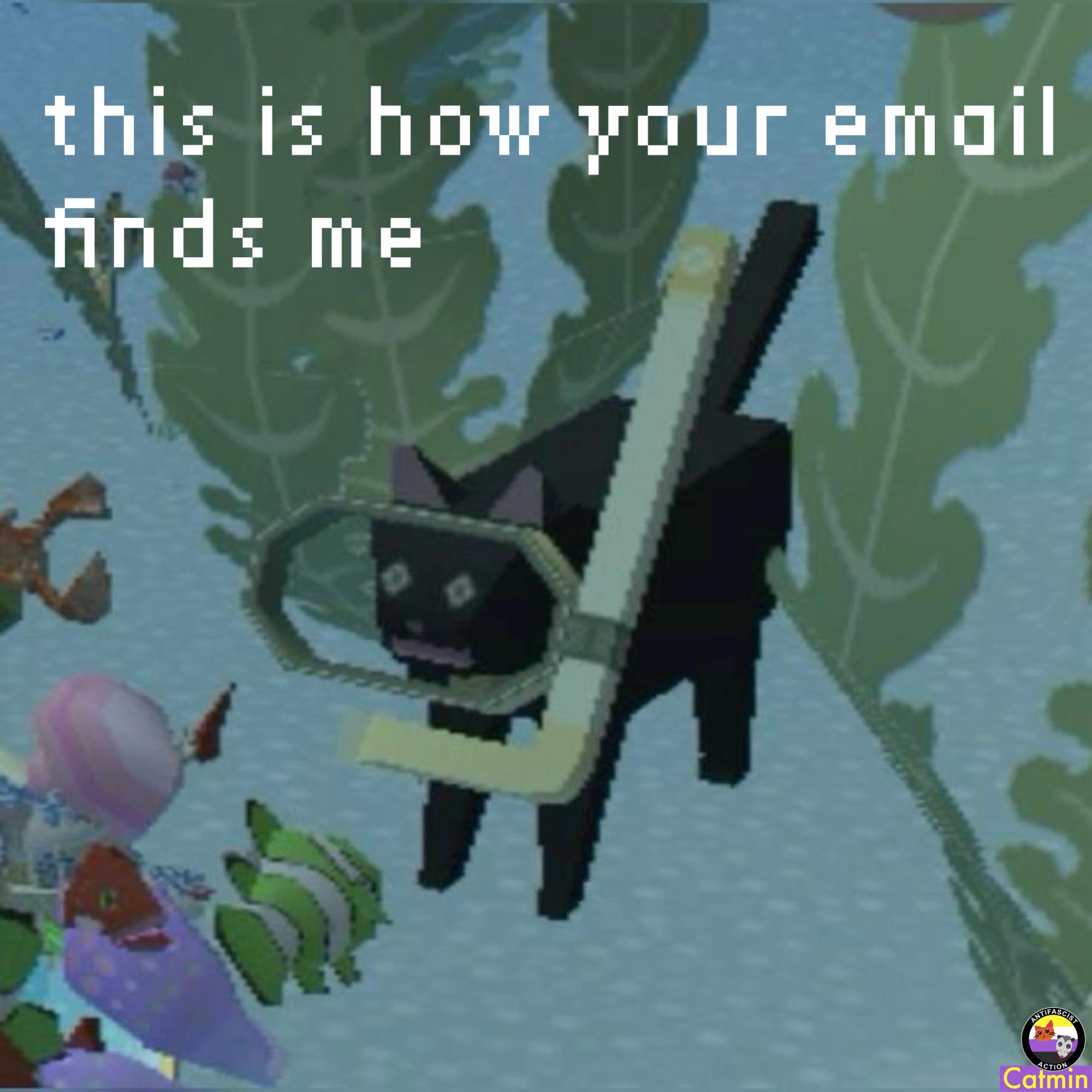
This meme is a humorous image of a cat wearing a scuba mask and holding a snorkel, surrounded by underwater scenery. The text "this is how your email finds me" is overlaid on the image, implying that the cat is hiding in a secret underwater location and that the email is somehow finding it.