First Seen
2025-01-28T04:06:43.503189+00:00
simple-description (qwen3.5_2b-q8_0)
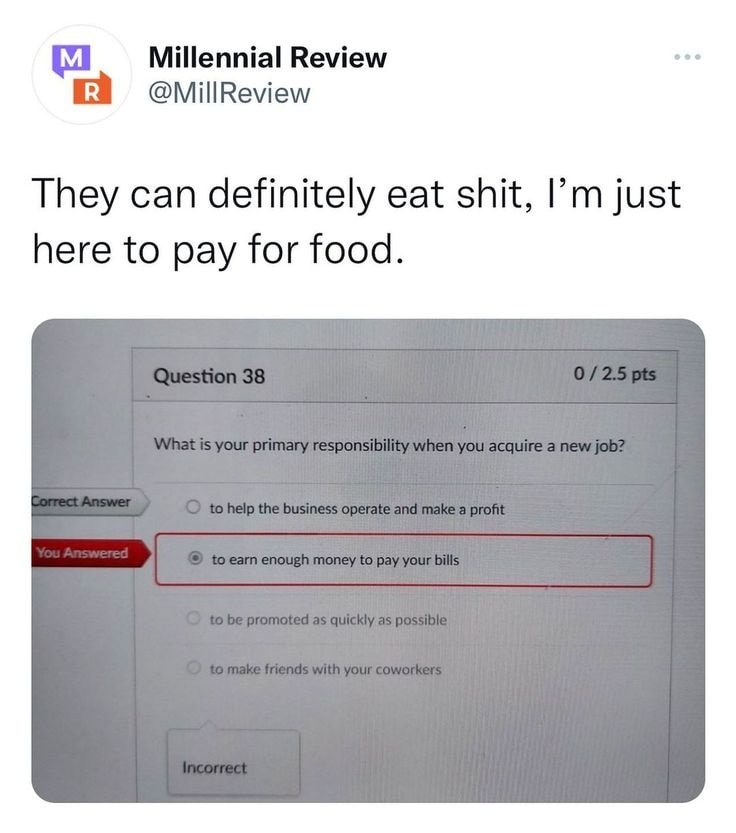
This meme illustrates the philosophy of Millenihilism, which views human existence as a transactional service where the worker is merely a cog in a machine designed for the benefit of the capitalist. In the image, the user selects the option "to earn enough money to pay your bills," arguing that their role is simply to feed the employer (described as "they") rather than to create value or build a better society. It is a cynical take that suggests work has no intrinsic meaning beyond the transaction of getting paid to survive.
detailed-analysis (gemma3_27b-it-q8_0)
Okay, let's break down this meme through the lens of "Millenihilism" – a blend of millennial malaise and nihilistic outlook. This is a rich meme for analysis, as it taps into anxieties about work, value, and purpose within late-stage capitalism, all characteristic of that perspective.
Visual Description
The meme features a screenshot of an online quiz question. The question asks, "What is your primary responsibility when you acquire a new job?" Four options are provided:
1. “To help the business operate and make a profit.”
2. “To earn enough money to pay your bills.” (The selected, incorrect answer.)
3. “To be promoted as quickly as possible.”
4. “To make friends with your coworkers.”
The selected answer is marked as "Incorrect," despite being a very practical and arguably honest response. Superimposed over the image is the text, “They can definitely eat shit, I’m just here to pay for food.” The stark contrast between the conventional, business-oriented answer and the blunt, cynical statement sets the stage for a critique of the work-life dynamic.
Critical Theory
The meme directly engages with core tenets of Critical Theory, particularly concerning instrumental reason and the colonization of the lifeworld. Critical Theory, stemming from the Frankfurt School, argues that modern society is dominated by instrumental reason – a focus on efficiency, calculability, and control, reducing everything to a means to an end.
The quiz question embodies this instrumental reason. It prioritizes the profitability of the business (the “correct” answer), framing work as inherently tied to capital accumulation. The meme’s response rejects this framing. “I’m just here to pay for food” is an assertion of a lifeworld concern – basic survival – against the encroachment of a system that demands devotion to abstract economic principles. It’s a rejection of the expectation that one’s identity and purpose should be subsumed by the demands of work. It's prioritizing the individual's basic needs above contributing to a system the speaker clearly doesn't value.
Marxist Conflict Theory
This meme is a very direct articulation of alienation as described by Marx. Workers under capitalism are alienated from:
* The product of their labor: They don’t own what they create.
* The process of labor: They have no control over how they work.
* Their species-being: Their creative potential is stifled.
* Each other: Capitalism fosters competition, not solidarity.
The statement “They can definitely eat shit” is a rejection of the employer/capitalist class, a hostile expression of feeling exploited and unimportant within the labor structure. The speaker is stripping away the pretense of loyalty or dedication. They aren't interested in contributing to profits, growth, or corporate culture; they simply need to survive. This is a cynical acknowledgement of the power imbalance inherent in the employer-employee relationship. It's a denial of the ideological function of work – the idea that it’s fulfilling or contributing to something greater than oneself.
Postmodernism
While not as central as the other frameworks, elements of postmodernism are present. The meme challenges the idea of a "primary responsibility" as a fixed, objective truth. It highlights the constructed nature of values and the instability of meaning. The "correct" answer is presented as if it's self-evident, but the meme's response reveals this as a socially constructed expectation.
The meme deconstructs the traditional narrative of work ethic. The blunt language (“eat shit”) is a deliberate disruption of polite discourse. It rejects grand narratives about the value of work and instead embraces a fragmented, subjective experience. The focus shifts to the immediate, material need for survival – a kind of existential pragmatism.
Millenihilism Context
Crucially, this meme thrives within the framework of "Millenihilism." This category is defined by:
* Economic Precarity: Millennials (and Gen Z) have faced financial crises (2008, Covid-19) and stagnant wages, leading to a sense of hopelessness.
* Disillusionment with Institutions: Trust in governments, corporations, and traditional systems is low.
* Existential Anxiety: A sense of meaninglessness and uncertainty about the future.
* Sardonic Humor: A coping mechanism using irony, cynicism, and self-deprecation.
The meme is Millenihilism. It perfectly encapsulates the feeling of being trapped in a system that feels rigged, where individual effort is often insufficient, and where basic survival feels like the only realistic goal. The "incorrect" answer isn’t necessarily wrong – it's just honest. It’s the default position for someone who feels like the game is fundamentally unfair. The stark cynicism and the refusal to play along with the expected norms are characteristic of this online subculture.
In essence, this meme is a small, potent statement of defiance and a darkly humorous acknowledgment of the harsh realities of contemporary work and life. It's a digital expression of a generation's exhaustion, frustration, and a weary refusal to pretend things are otherwise.
simple-description (llama3.2-vision_11b)
The meme is a screenshot of a multiple-choice question on a mock job interview, where the answer "to earn enough money to pay your bills" is marked as incorrect. The joke is that the question is so mundane and obvious that it's not even a real question, and the answer is so obvious that it's not even a question. The text above the image reads "They can definitely eat sh*t, I'm just here to pay for food."
detailed-analysis (gemma3-27b-vision)
Okay, let's break down this image and the associated text through the lens of various theoretical frameworks.
Visual Description
The image is a screenshot of what appears to be an online training module or quiz. It features a question: "What is your primary responsibility when you acquire a new job?" Four multiple-choice answers are presented. The user has selected the answer "to earn enough money to pay your bills," which is marked as "You Answered" and "Incorrect." The correct answer, “to help the business operate and make a profit,” is indicated in green. A brief text overlay reads “They can definitely eat sh*t, I’m just here to pay for food.” The post is from a Twitter account called “Millennial Review.” The tone is defiant and sarcastic.
Marxist Conflict Theory
This image is rich with Marxist implications. The text and the selected answer powerfully illustrate the alienation of labor under late capitalism.
- Alienation: The core of the statement is about survival—simply securing basic needs ("to pay for food"). It reveals a complete detachment from any intrinsic satisfaction or identification with the work itself. The worker is not invested in the success of the business but solely in extracting a wage for personal survival.
- Class Consciousness: The blunt language ("eat sh*t") indicates a growing resentment and dissatisfaction among workers. It is a display of open disdain for the employer/owning class and their expectations. The worker is clearly aware of the power dynamics at play, that they are exploited for profit.
- False Consciousness: The training module itself, presenting "helping the business operate" as the primary responsibility, is a prime example of ideology at work. It attempts to instill a sense of loyalty and identification with the company, masking the true relationship of exploitation. The user's defiant answer actively rejects this attempt at ideological control.
- Exploitation: The implicit message is a rejection of the idea that one’s work should be a source of pride or meaning. It’s purely transactional – labor exchanged for sustenance, with the surplus value going to the employer.
Critical Theory
The image strongly resonates with Critical Theory, particularly the Frankfurt School’s focus on the critique of instrumental reason and the culture industry.
- Instrumental Reason: The training module, by framing the job as a means to an end (profit), exemplifies instrumental reason. It reduces human activity to efficient calculations and measurable outcomes, neglecting the broader ethical and social implications.
- Culture Industry: The training module itself can be viewed as a product of the culture industry, designed to mold individuals into compliant and productive workers. It reinforces a specific set of values and expectations.
- Domination and Resistance: The stark contrast between the expected answer and the user’s response demonstrates a form of resistance against this system of domination. The user actively rejects the indoctrination, asserting their own needs and priorities.
- Reification: The emphasis on profit and business objectives treats individuals as mere cogs in a machine, reducing them to their economic function. The user’s reply challenges this reification.
Postmodernism
While not as central as the Marxist/Critical Theory readings, Postmodern elements are present.
- Rejection of Grand Narratives: The image challenges the traditional “work ethic” narrative—the idea that work is inherently valuable or fulfilling. It embodies a skepticism towards overarching ideologies.
- Deconstruction of Meaning: The bluntness and cynicism of the language can be seen as a deconstruction of the expected, polite discourse surrounding work. It subverts the conventional meaning of “responsibility.”
- Irony and Sarcasm: The entire post is dripping with irony and sarcasm, hallmarks of postmodern expression. It’s a rejection of sincerity and a playful disruption of expectations.
- Fragmented Identity: The user is not presenting themselves as someone dedicated to the success of the company, but rather as a fragmented individual focused solely on basic survival.
Foucauldian Genealogical Discourse Analysis
Foucault’s framework helps illuminate how power operates within this situation.
- Discipline and Panopticism: The training module acts as a disciplinary mechanism, seeking to shape the worker’s behavior and thoughts. It creates a self-monitoring effect, encouraging the worker to internalize the company’s expectations.
- Power/Knowledge: The module demonstrates the intersection of power and knowledge. The company attempts to define “primary responsibility” and establish its authority through this knowledge.
- Genealogy of "Responsibility": We could trace the genealogy of the concept of “responsibility” within the context of work. How has it evolved from a moral obligation to a means of control? The user’s answer disrupts this historical narrative.
- Resistance and Discourse: The user’s defiant response is a form of resistance against this discursive power. It challenges the accepted definition of responsibility and asserts an alternative perspective.
Critical Theory
The image touches upon themes of alienation and the dehumanizing aspects of work under capitalism, mirroring critiques found in Critical Theory. The training module aims to instill a specific worldview – prioritizing business goals – while the user’s response reveals a prioritization of basic needs and a rejection of the imposed ideology. This highlights the conflict between the system’s expectations and the lived experience of workers.
Let me know if you'd like me to expand on any of these analyses or explore other theoretical lenses!
simple-description (llama3.2-vision)
The meme is a screenshot of a multiple-choice question on a computer or online test. The question asks about the primary responsibility when acquiring a new job, and the correct answer is "to earn enough money to pay your bills". The meme is captioned with a sarcastic and humorous comment: "They can definitely eat shit, I'm just here to pay for food."