First Seen
2023-05-10T21:03:36+00:00
simple-description (llama3.2-vision_11b)
The meme is a screenshot of a text conversation where a user is trying to respond to a friend who is being overly optimistic about the future. The user is frustrated with the friend's enthusiasm and responds with a series of sarcastic and pessimistic statements, eventually ending with "I'm not a millennial, I'm a millenihilist." This refers to the category of "Millenihilism," which is a humorous term used to describe the pessimistic outlook on the future that is common among millennials.
detailed-analysis (gemma3-27b-vision)
Okay, let's break down this meme using the requested analytical lenses. This is a multi-layered image ripe for interpretation, so I’ll try to be thorough.
Visual Description
The meme utilizes the "Drake Hotline Bling" format—a two-panel layout with Drake looking approvingly at one thing and disapprovingly at another.
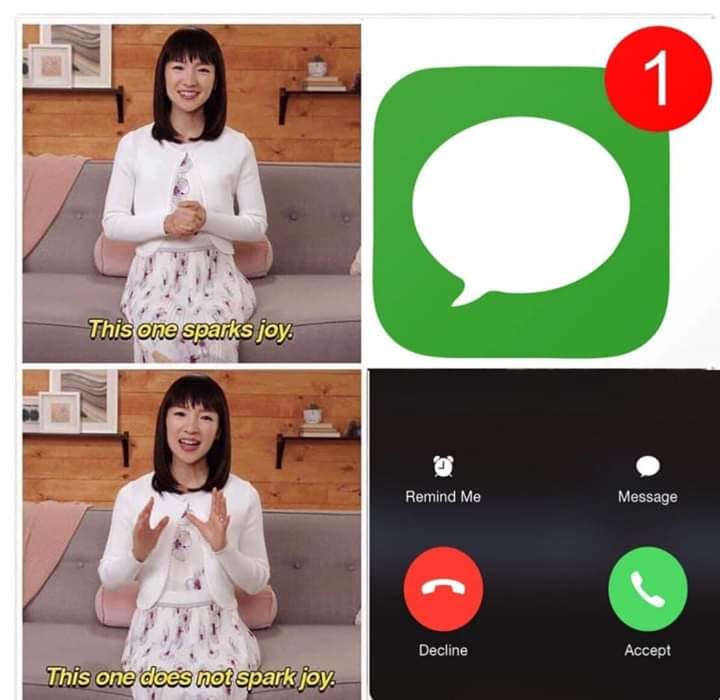
- Panel 1 (Top Left): Features Marie Kondo, known for her tidying methods and the idea of only keeping items that "spark joy," smiling and gesturing towards something not visible in the frame. Text reads: "This sparks joy."
- Panel 2 (Bottom Left): Features Marie Kondo again, looking visibly distressed or repulsed while gesturing away from something not visible. Text reads: "This does not spark joy."
- Panel 3 (Top Right): A screenshot of an incoming FaceTime call on an iPhone. The caller's name is obscured, but a notification bubble indicating a new message is present.
- Panel 4 (Bottom Right): Shows the FaceTime call screen with options to "Remind Me," "Message," "Decline," or "Accept."
The overall effect is juxtaposing Kondo’s philosophy of mindful ownership with the modern anxiety surrounding answering phone calls—especially unwanted ones.
Foucauldian Genealogical Discourse Analysis
This meme is fascinating from a Foucauldian perspective. It demonstrates how discourses shape our relationship with technology.
- The Discourse of Tidiness/Self-Care: Marie Kondo represents a contemporary discourse focused on minimalist living, intentionality, and the prioritization of emotional well-being through material possessions. The "spark joy" mantra is a regulatory ideal—something that defines and governs our choices around objects and, by extension, our lives.
- The Discourse of Communication/Connectivity: Modern life is saturated with the discourse of constant connectivity. Phones, especially smartphones, are presented as essential tools for maintaining social ties, work obligations, and access to information. However, this also generates a counter-discourse of digital fatigue and the desire to disconnect.
- Power/Knowledge: The meme suggests a power dynamic around communication. The incoming call represents an external demand on one's time and energy. “Declining” the call is an assertion of agency, a rejection of being subjected to another's demands. It’s a small act of self-preservation.
- Genealogy: Tracing the ‘genealogy’ of this meme would involve understanding how the concept of ‘tidiness’ has evolved culturally and how the anxiety around phone calls has been historically shaped by technology. From landlines interrupting dinner to smartphones demanding constant attention, it’s a lineage of evolving communication expectations.
Critical Theory
The meme speaks to broader themes of alienation and the commodification of self through technology.
- The Illusion of Choice: While we are presented with "options" (Remind, Message, Decline, Accept), the act of receiving a call (and the social pressure to respond) already limits our freedom. The "choice" is framed within a system that demands responsiveness.
- Commodification of Time & Attention: The incoming call is a demand on our finite time and attention. In a capitalist system where time is money, even personal time becomes a resource to be managed and defended. “Declining” becomes a form of resistance.
- The Manufactured Need: The constant stream of notifications and calls creates a sense of obligation and urgency. This isn’t necessarily a genuine need for connection, but a manufactured need fueled by the technology itself.
- Reification: The phone call itself becomes a reified object of anxiety – an abstract force that causes stress and disruption. The meme is a critique of this abstracted anxiety.
Marxist Conflict Theory
From a Marxist lens, the meme reflects class-based anxieties and the pressures of the labor market.
- Exploitation of Labor: The incoming call can be seen as a symbol of work bleeding into personal life. It represents the expectation of being "always on" and available for labor, even during downtime.
- Alienation from Self: The constant demands of work and technology can lead to alienation from one's own desires and needs. “Declining” the call is an attempt to reclaim a sense of self and resist being reduced to a tool for someone else's productivity.
- Power Dynamics: The caller likely occupies a position of power over the recipient (boss, client, someone with a demand). "Declining" is a small act of asserting agency in a power-imbalanced relationship.
- Commodification of Social Connection: The social expectation to answer calls reinforces the commodification of social connection. We feel compelled to respond, not because we want to, but because it's expected within the logic of modern social and professional life.
Postmodernism
The meme embraces a postmodern sensibility through its playful juxtaposition and self-referentiality.
- Irony and Parody: The meme employs irony by applying Kondo's philosophy to the mundane anxiety of receiving a phone call. It’s a humorous commentary on the absurdities of modern life.
- Fragmentation and Disjuncture: The meme juxtaposes seemingly unrelated concepts—tidying and phone calls—creating a fragmented and disjunctive effect that challenges conventional meaning-making.
- Simulation and Hyperreality: The phone call represents a simulation of connection. It’s not necessarily a genuine connection, but a digital representation of one. This contributes to the hyperreality of modern communication, where the line between real and virtual is increasingly blurred.
- Rejection of Grand Narratives: The meme rejects the idea that technology inherently enhances our lives or that constant connectivity is always positive. It presents a more nuanced and critical view of technology’s impact on our well-being.
Queer Feminist Intersectional Analysis
This is a bit more subtle, but important to consider.
- Emotional Labor: For marginalized groups (especially women and people of color), answering calls often involves performing emotional labor. They may be expected to manage the emotions of the caller, provide support, or navigate difficult conversations. Declining becomes a boundary-setting act, refusing to perform this often-unpaid labor.
- Boundary Violation: An unsolicited call can be a boundary violation. For those who have experienced trauma or abuse, it can trigger feelings of vulnerability and anxiety. “Declining” is a powerful assertion of personal boundaries.
- Gendered Expectations: Women are often socialized to be more responsive and accommodating, and are frequently burdened with the expectation of managing social connections. Declining a call can be a challenge to these gendered expectations.
- Intersectionality: The experience of receiving an unwelcome call is shaped by intersecting identities. Factors like race, class, gender, and ability all contribute to the level of anxiety and the difficulty of setting boundaries. A woman of color, for example, may face additional pressures to be accommodating in order to avoid reinforcing stereotypes.
I hope this detailed analysis is helpful. It's fascinating how much meaning can be packed into a simple meme! Let me know if you'd like me to elaborate on any particular aspect.
simple-description (llama3.2-vision)
The meme is a humorous take on the frustration of receiving a single notification in a crowded inbox. The image features a person reacting to a single notification in a crowded inbox, with the text "This one sparks joy" from the popular book "The Life Changing Magic of...".
tesseract-ocr
i cS — = 7) A rit vo mf ey PUP UES 5 VS One seensyoeg Ve eth ae Ct cS ~ Es i | @ ‘ Care RUC) Message / i. o i im 4 yt PoP ie S a LLCS ferro rrr iis onedoestnon'sparkijoy: ,