First Seen
2023-05-10T21:03:36+00:00
simple-description (llama3.2-vision_11b)
The meme is a photo of a young man with a pale and gaunt appearance, captioned "I'm a 25-year-old who still thinks he's a 15-year-old who still thinks he's a 10-year-old who still thinks he's a 5-year-old who still thinks he's a toddler who still thinks he's a baby who still thinks he's a fetus who still thinks he's a sperm who still thinks he's a...". The meme is a humorous commentary on the idea that some people struggle with growing up and accepting their age, and instead cling to their youthful identity.
detailed-analysis (gemma3-27b-vision)
Okay, here's an analysis of the image, broken down into the sections you requested. I'll indicate if a section doesn't readily apply to the image's content.
Visual Description
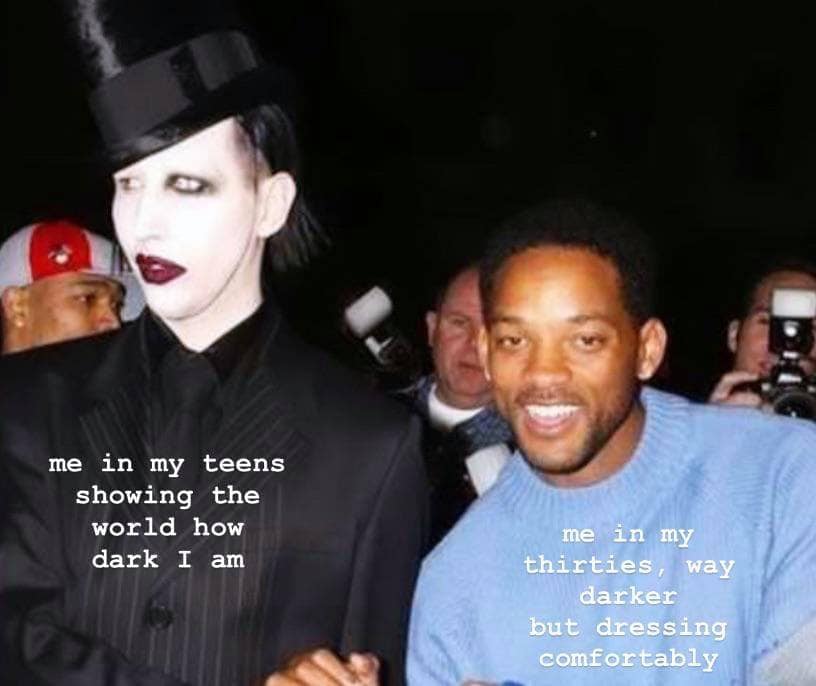
The image is a diptych—a side-by-side comparison of two photographs. On the left is Marilyn Manson in his signature gothic aesthetic from the late 1990s/early 2000s. He is heavily made up with pale foundation, dark lipstick, and dramatic eye makeup. He is wearing what appears to be a black top. The background suggests a crowded, flashing-light environment (likely a concert or promotional event).
On the right is Common, an American rapper, actor, and producer. He is smiling at the camera, looking relaxed and comfortable in a blue button-down shirt. He's surrounded by a scrum of photographers. The lighting suggests a similar event/public appearance to the Manson photo.
Text overlays the images. The left image is captioned “me in my teens showing the world how dark I am,” while the right image says, “me in my thirties, way darker but dressing comfortably.”
Foucauldian Genealogical Discourse Analysis
This image lends itself particularly well to a Foucauldian analysis. The contrast in appearance isn’t simply aesthetic preference; it reflects the shifting discourses surrounding identity and self-presentation.
- Discourse and Power: The “darkness” presented in the teen photo is a performance constructed through a specific subcultural discourse (goth, industrial). It’s a display intended to signal transgression, rebellion, and a rejection of mainstream norms. This is not darkness in a moral sense, but a curated aesthetic that draws power from subverting expectations. Foucault would see this as an attempt to create a counter-discourse.
- Genealogy of “Darkness”: The image hints at a genealogy of how the concept of “darkness” is understood. What did “dark” signify in the 90s versus the 2020s? The 90s saw a greater emphasis on shocking aesthetics and visible rebellion. The implied shift to the 30s suggests a more internalized "darkness"—perhaps a cynicism or world-weariness that doesn't require external performativity.
- Subjectivation: The text suggests a process of subjectivation. The teen subject is actively constructing themselves through a deliberate performance of “darkness.” The adult subject, while acknowledging a deeper "darkness," expresses it through a different mode of being—one prioritizing comfort. The power dynamics shift, and we see a re-negotiation of how self is presented.
Critical Theory
The image touches upon themes central to Critical Theory.
- Social Construction of Identity: The transformation in appearance highlights the socially constructed nature of identity. What it means to be "dark," rebellious, or authentic is not inherent but shaped by cultural forces and historical context. The image implicitly questions the notion of a fixed, essential self.
- Commodification of Rebellion: The image could be viewed as a commentary on how rebellion can be commodified and diluted over time. The teen aesthetic, while initially transgressive, became somewhat mainstreamed in the late 90s/early 2000s. The shift in appearance could suggest a disillusionment with this commodification and a turn towards more subtle forms of resistance or self-expression.
- Frankfurt School concerns: The image touches on the potential for aesthetic presentation to become a substitute for genuine social change. The “darkness” may have initially been a critique of society, but has now become an outward expression.
Marxist Conflict Theory
While not a primary focus, a Marxist reading is possible.
- Class and Subculture: The subcultural aesthetics of the teen years (goth, industrial) often emerged from marginalized communities and represented a form of resistance against dominant cultural norms. This can be understood as a form of class-based rebellion.
- Consumption and Identity: The shift in appearance could also be seen as a reflection of economic realities. As people mature, they may prioritize comfort and practicality over elaborate aesthetics, reflecting a different relationship to consumerism.
- The "authenticity" of dark expression: If we understand "darkness" in this context as a signifier of genuine dissent, there's a potential conflict between authentic expression and the forces that aim to neutralize it.
Postmodernism
The image embodies several key tenets of postmodern thought.
- Fragmentation of Identity: The two images illustrate a fragmented, fluid sense of self. There is no single, coherent identity, but rather a series of performances and expressions that change over time.
- Simulacra and Simulation: The “darkness” itself could be seen as a simulacrum—a copy without an original. The teen image is a deliberate construction, a performance of an aesthetic that may not be rooted in authentic experience.
- Irony and Meta-commentary: The captions themselves are ironic and self-aware, acknowledging the performative nature of identity and the changing landscape of self-expression. It's a meta-commentary on the journey of self-discovery and the ways in which we present ourselves to the world.
Queer Feminist Intersectional Analysis
This is a less direct fit, but potential connections exist.
- Challenging Gender Norms: The goth aesthetic historically challenged traditional gender norms, and this image can be interpreted as a reclamation of alternative modes of presentation.
- Performance of Identity: Queer theory emphasizes the performative nature of identity, and this image clearly illustrates how we construct and express ourselves through appearance.
- Intersectionality: The image could be extended with an intersectional analysis by considering how race, class, and other social categories intersect with the individual's journey of self-discovery.
Let me know if you'd like me to elaborate on any of these sections or explore a specific theoretical lens in more detail.
simple-description (llama3.2-vision)
This meme features a photo of Marilyn Manson (a musician known for his dark aesthetic) standing next to a young, smiling Will Smith. The text on the image reads: "Me in my teens, showing the world how dark I am / Me in my 30s, way darker, but dressing comfortably." The meme humorously contrasts the persona of a teenager who wants to appear dark and edgy with that of a 30-year-old who is still trying to maintain a similar image but is now more comfortable with it.
tesseract-ocr
“| xd &) ; a _ a S le «<TR iw Foe — al s 4 me in my teens showing the world how dark I am a S