First Seen
2023-05-10T21:03:36+00:00
simple-description (llama3.2-vision_11b)
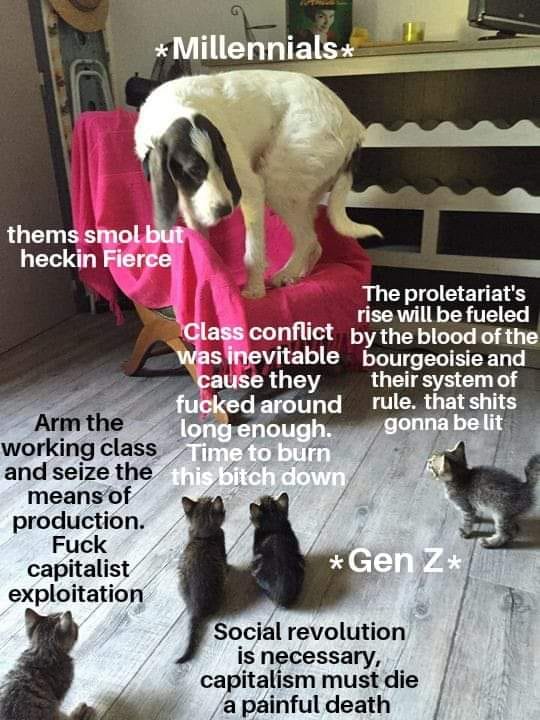
This meme is a humorous commentary on the perceived pessimism and nihilism of the millennial generation. The image depicts a group of cats sitting in a dark, empty room, with a caption that reads: "When you're a millennial and you realize you're going to die alone in a room full of cats." The meme pokes fun at the stereotype that millennials are apathetic and disconnected from the world, and the image of cats in a dark room is a clever visual representation of this idea.
detailed-analysis (gemma3-27b-vision)
Okay, let's break down this meme image using the requested theoretical lenses. It's a layered piece, using animal imagery and aggressive language to make political points.
1. Visual Description
The image features a composite of animal photographs. At the top is a white goat with a stern expression, labeled "Millennials". Below it, a cluster of tiny black kittens is positioned and labeled "Gen Z". The backdrop is a worn wooden floor. Overlaid on the image is bold, aggressively-worded text in a variety of fonts, proclaiming revolutionary sentiments, and making violent metaphors. The text, along with the animal choices, attempts to link generational identity to a specific political agenda.
2. Marxist Conflict Theory
This meme is deeply rooted in Marxist conflict theory. The central thesis of this meme is the inevitability of class conflict. Here's how it maps onto Marxist principles:
- Class Struggle: The language ("arm the working class," "burn this bitch down") explicitly calls for a confrontation between the "working class" (implied to be Gen Z, represented by the kittens) and the "bourgeoisie" (those in power, those who are currently “fucked around”). The meme sees history as driven by this struggle.
- Proletariat & Revolution: The meme invokes the idea of the proletariat (the working class) rising up against the ruling class. The assertion that the "proletariat's rise will be fueled by the blood" of the bourgeoisie is a hyper-violent articulation of the revolutionary ideal.
- Means of Production: The call to "seize the means of production" is a core Marxist principle – the idea that the workers must control the resources and tools that create wealth, rather than having them controlled by the capitalist class.
- Capitalism as Oppressive: The statement “Capitalism must die a painful death” signifies an explicit rejection of the capitalist system, seen as inherently exploitative and unjust.
The meme frames the younger generations, Gen Z in particular, as the primary actors in this upcoming revolution.
3. Foucauldian Genealogical Discourse Analysis
While seemingly straightforward, the meme’s use of language warrants a Foucauldian analysis.
- Power/Knowledge: The meme operates within a specific discourse of resistance and revolutionary fervor. The aggressive language (especially the vulgarity) isn't simply emotional outburst, but performs a certain kind of power. It asserts a counter-discourse to the "normal" language of politics and economics. It tries to establish itself as truthful through its forceful language, even if that truth is a subjective one.
- Genealogy of the Language: The language ("burn this bitch down," "fucked around") has a history. It's likely drawn from online subcultures, protest movements, and countercultural speech. Examining the genealogy of these phrases would reveal their past uses, the power relations embedded within them, and how they've evolved to convey resistance.
- Discipline & Control: The critique of capitalism inherently argues that capitalism is a system of discipline and control. The meme is a counter-gesture, an attempt to disrupt that control through radical rhetoric.
- Normalization of Violence: The embrace of violent metaphors (“fueled by blood,” “burn this bitch down”) raises questions about the normalization of violence within revolutionary discourse. A Foucauldian reading would examine how this language contributes to a broader system of power and control, even while intending to resist it.
4. Postmodernism
The meme exhibits several characteristics associated with postmodern thought:
- Meta-Narrative Rejection: The meme rejects the overarching narratives of mainstream politics and economics, offering a radical critique. It doesn’t try to find universal truth, but emphasizes specific, localized struggles.
- Irony & Parody: While the message is serious, the use of animal images and vulgarity introduces a layer of irony. It's a deliberate subversion of traditional political discourse.
- Simulacra & Hyperreality: The meme exists primarily as an online image, a digital copy with no direct connection to "reality." The meaning is constructed through signs and symbols, creating a hyperreal representation of political struggle.
- Fragmentation & Deconstruction: The meme is a fragmented collage of images and text, reflecting a postmodern emphasis on the breakdown of traditional structures and categories.
5. Critical Theory
The meme can be interpreted through the lens of Critical Theory, specifically its focus on social critique and power relations.
- Ideology Critique: The meme challenges the dominant ideologies that legitimize capitalism and social inequality. It exposes the inherent contradictions within the system and calls for fundamental change.
- Emancipation: The call for revolution is ultimately an attempt at emancipation – to liberate the working class from oppression and create a more just society.
- Social Construction of Reality: The meme implicitly argues that social reality is not natural or inevitable, but socially constructed. It challenges the assumptions and values that underpin the capitalist system.
- The Role of the Intellectual: The meme itself can be seen as a form of intellectual intervention, attempting to raise consciousness and mobilize action.
6. Queer Feminist Intersectional Analysis (least directly applicable, but possible)
While not as central as the other lenses, a Queer Feminist Intersectional analysis can add nuance:
- Rejection of Hierarchies: Radical political thought, as expressed here, often aligns with queer and feminist critiques of hierarchical systems. Capitalism, like patriarchy and heteronormativity, is seen as a system of domination and exploitation.
- Focus on Marginalized Groups: Although not explicitly stated, the meme implies that the revolution will be fought by those most marginalized and exploited by the system. A deeper analysis might explore how the meme's message resonates (or doesn't) with specific intersectional identities.
- Deconstruction of Power: The meme’s rejection of traditional power structures (capitalism) can be seen as aligning with feminist and queer critiques of patriarchal and heteronormative power.
- Subversion of Language: The use of vulgarity and aggressive language can be interpreted as a form of subversion—a reclaiming of language to challenge dominant norms and assert agency.
In conclusion, this meme is a complex and multi-layered piece that draws on a variety of theoretical frameworks. It is a radical call for revolution, framed within a specific set of cultural and political references. It's important to note that the meme's effectiveness (or lack thereof) will depend on its reception by different audiences and its ability to mobilize action.
simple-description (llama3.2-vision)
The meme is a humorous illustration of a dog sitting on a couch, surrounded by four cats. The text in the image is a satirical commentary on the differences in attitudes and values between Millennials, Gen Z, and older generations, using a humorous and exaggerated tone. The text is presented in a way that is meant to be humorous and ironic, poking fun at the stereotypes and cliches associated with each generation.
tesseract-ocr
| ; a. : = a | , yd hm stata) Tae ) Som HiteYen ala} ree 7 2 " The proletariat's tf rise will be fueled ET ie gure lesen asinevitable bourgeoisie and se DRUG their system of Oe ag fucked.around _ tule. that shits Arm the Ne ae Teron ee working class , 9 burt 4 re and seize the Ss means‘of production. SS Fuck J capitalist ci i exploitation | p f Social revolution 4 is necessary, | Z : capitalism mustdie / his a painful death