First Seen
2023-05-10T21:03:36+00:00
simple-description (llama3.2-vision_11b)
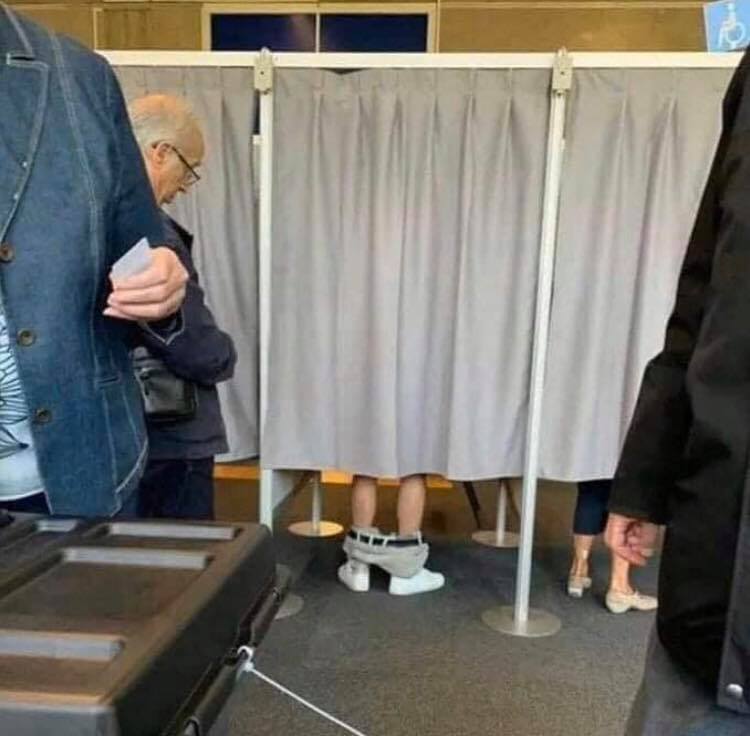
The meme depicts a person in a voting booth, but instead of casting a ballot, they're engaged in a bizarre activity, likely inspired by the concept of "millenihilism," which refers to the idea that the younger generation is apathetic and disconnected from societal issues. The image implies that the person is more interested in their phone than in participating in the democratic process.
detailed-analysis (gemma3-27b-vision)
Okay, here's an analysis of the image broken down into sections based on the requested theoretical frameworks, including sections only if they are applicable.
Visual Description
The image captures a scene at a polling station. An elderly man is partially visible behind a voting booth curtain. He is holding what appears to be a ballot, and is reaching towards a machine that likely records votes. The voting booth itself is constructed of gray curtains hung on a metal frame. Behind him, and to the right, a portion of another person (likely another voter) is visible in a black coat. The voting booth is situated in front of a black table with what looks like a voting machine. The overall setting appears to be a civic or public space—likely a school or community center—judging by the architecture in the background. The image is captured at a slightly awkward angle, focusing on the act of voting, but with a somewhat unusual visual framing due to the subject's pose.
Foucauldian Genealogical Discourse Analysis
This image is ripe for a Foucauldian analysis. The voting booth is a prime example of a dispositive. It isn't merely a physical structure, but a site where power operates through discourse and practices.
- Power/Knowledge: The booth creates a panoptic effect. It's designed to allow the voter to believe they are exercising free will in secret, while simultaneously being under a potential, though often unseen, form of surveillance. The knowledge produced is the illusion of a democratic process being purely individual.
- Genealogy of Voting: Tracing the genealogy of voting booths reveals how they evolved from public, often oral, forms of voting to the private, individualized booths we see today. This shift reflects a changing understanding of citizenship, secrecy, and the relationship between the individual and the state.
- Normalization: The booth normalizes the act of individual, secret voting as the default, unquestioned method of participation in democratic processes. This process obscures other potential forms of political action. The particular posture of the man in this photo is not necessarily something that is normalized.
- Discipline: The booth, while providing privacy, also disciplines the voter by confining them to a specific space and regulating their action (marking a ballot).
The focus on privacy within the booth also relates to a modern emphasis on individual autonomy, which Foucault would connect to the rise of liberal governance.
Critical Theory
From a Critical Theory perspective, this image is a microcosm of the tensions inherent in democratic societies.
- Ideology: The voting booth appears to embody the ideals of equality and participation. However, Critical Theorists would ask who benefits from this system? Who is excluded from meaningful participation? Are the choices offered on the ballot truly representative of diverse interests, or do they reinforce existing power structures?
- Hegemony: The normalcy of the voting booth and the act of voting contribute to the hegemony of the existing political system. It creates the illusion that change can only be achieved within the system, masking potential alternatives or more radical forms of political action.
- Commodification of Citizenship: The act of voting can be seen as a commodification of citizenship, where individuals "consume" their right to choose within a pre-defined menu of options.
- Repressive Tolerance: The booth provides a form of "tolerance" that can be "repressive" in that it contains dissent within the established parameters of the system, preventing more fundamental challenges to power.
Marxist Conflict Theory
From a Marxist perspective, the image highlights the underlying class conflict present even in seemingly neutral democratic processes.
- State as an Instrument of Class Rule: The voting booth can be seen as an instrument of the state, which, from a Marxist perspective, is ultimately controlled by the ruling class. The choices offered on the ballot are likely to reflect the interests of that class, even if subtly.
- False Consciousness: The act of voting, while appearing to empower individuals, can contribute to false consciousness – the belief that the system is fair and equitable, even when it perpetuates class inequality.
- Competition and Control: Voting is framed as a competition between candidates, obscuring the deeper structural issues of economic inequality and exploitation. The focus on individual choice diverts attention from collective action.
- Ideological Apparatus: The voting booth is an ideological apparatus that serves to legitimize the existing social order.
Postmodernism
A postmodern lens would deconstruct the “truth” claims associated with the act of voting and the democratic process.
- The Instability of Meaning: The image challenges the notion of a singular, fixed meaning of “democracy.” The booth is a signifier that evokes a range of interpretations and associations, none of which are inherently “true.”
- The Simulacrum and Simulation: The voting booth could be seen as a simulacrum—a copy without an original—that increasingly dominates our experience of politics. The focus on process and symbolism can overshadow substantive policy changes.
- Deconstruction of Grand Narratives: The image invites us to question “grand narratives” about democracy, citizenship, and progress. What assumptions are embedded in the idea that voting is the primary means of achieving social change?
- Subjectivity and Fragmentation: The odd angle of the image, and the partial visibility of people, could be seen as reflecting the fragmented nature of contemporary subjectivity and the loss of a unified political identity.
Queer Feminist Intersectional Analysis
This is perhaps the most complex and nuanced area for analysis here. While the image doesn't explicitly depict any identity-based oppression, it offers space for questioning the assumed "neutrality" of democratic processes.
- Invisibility/Marginalization: Who is not represented within the structure of the voting system? (e.g., those disenfranchised by voter ID laws, those who are undocumented, those who are incarcerated, etc.) This image can serve as a reminder that the experience of democracy is not universal.
- The "Universal" Subject: The design of the voting booth presumes a "universal" subject – an individual who is capable of making rational choices. But this subject is often historically and socially constructed as white, male, heterosexual, and able-bodied. This excludes/marginalizes anyone who doesn't fit this mold.
- Intersectionality of Oppression: The experience of voting is never simply about "citizenship." It’s shaped by the intersection of multiple identities and systems of oppression (race, class, gender, sexuality, ability, etc.).
- Challenging Power Structures: A Queer Feminist analysis seeks to expose and disrupt the power structures that maintain inequality and oppression within democratic processes.
Important Note: These analyses are interpretations based on the visual cues in the image and the principles of the respective theoretical frameworks. Multiple interpretations are possible, and the image is open to further scrutiny and debate.
simple-description (llama3.2-vision)
The meme is an image of a person in a voting booth, but they're not actually voting - they're instead playing with their phone, hiding behind the curtain. The text "I'm not voting, I'm just here for the free snacks" is often added to the image, implying that the person is only interested in the food provided at the polling station.
tesseract-ocr
a \\ 2 | ie. iy x , I! : ue yi Bs a el +e t f sit ood : |