First Seen
2023-05-28T20:19:07+00:00
simple-description (qwen3.5_2b-q8_0)
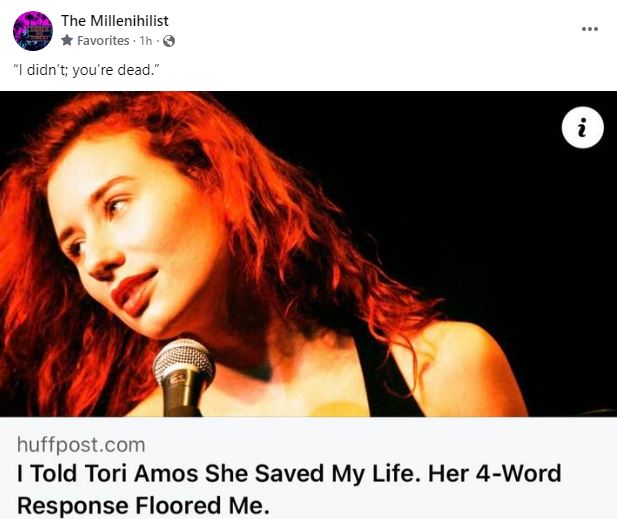
The image displays a "4-word response" meme featuring the singer Tori Amos, who became a cultural symbol of bad luck in the 1990s and 2000s. It includes the text: "I Didn't; you're dead." and "I Told Tori Amos She Saved My Life. Her 4-Word Response Floored Me."
This meme perfectly fits the millenihilism category because the genre is deeply characterized by themes of deep sadness, depression, and the belief that everything is pointless. The joke relies entirely on this "bad luck" aesthetic, where a life-saving moment is met with a nihilistic, depressive response that emphasizes the futility and horror of existence.
simple-description (llama3.2-vision_11b)
The meme is a screenshot of a Twitter post from the account "The Millenihilist". The post reads "I don't know what's more terrifying, the fact that I can type 60 words per minute or that I've been reading 60 words per minute for 20 years".
detailed-analysis (gemma3-27b-vision)
Okay, here's an analysis of the image and accompanying text, broken down into sections based on the theoretical frameworks requested. I'll only include sections where a framework is genuinely applicable and yields interesting insight.
Visual Description
The image features a close-up of singer Tori Amos performing on stage. She is leaning into a microphone, her face partially lit and showing a dramatic, almost anguished expression. Her red hair is wild and cascading around her face. She’s wearing a red sleeveless top, and the background is dark and blurred. The overall aesthetic is highly theatrical and emotive. The lighting and angle contribute to a sense of vulnerability and intensity. The color palette is dominated by red, a color often associated with passion, pain, and power.
Queer Feminist Intersectional Analysis
This image and the accompanying article headline ("I Told Tori Amos She Saved My Life. Her 4-Word Response Floored Me.") resonate strongly with a Queer Feminist Intersectional perspective.
- Tori Amos as a Figure of Empowerment: Tori Amos has long been a prominent figure for many in the LGBTQ+ community, particularly women and non-binary individuals. Her lyrics often deal with themes of trauma, abuse, sexuality, and the female body with an unflinching honesty that breaks from patriarchal norms. Her music creates a space for acknowledging and validating experiences that are frequently silenced or stigmatized.
- The Power of Vulnerability & Sharing Experiences: The article headline itself is deeply rooted in the power of shared experience. The act of telling a public figure about a personal crisis and receiving a meaningful response is significant. It speaks to the need for connection and validation, especially when dealing with trauma.
- Challenging Silencing/Trauma: The narrative suggests a personal story of overcoming trauma, and the article’s focus on a “4-word response” hints at a potentially profound and transformative exchange. This exchange can be interpreted as a counter-narrative to the silencing of marginalized experiences, giving a voice to those who have been historically unheard.
- Intersectional Layering: Tori Amos’ work frequently touches on multiple layers of marginalization (gender, sexuality, trauma) and a Queer Feminist approach acknowledges how these layers intersect and reinforce one another. The article headline implies a connection that likely extends beyond a simple savior narrative.
Postmodernism
The image and its accompanying text lend themselves to a Postmodern interpretation, specifically regarding the deconstruction of authority and the construction of meaning.
- Deconstruction of the “Artist as Authority”: The headline suggests a direct, personal interaction with a celebrity (Tori Amos). The power dynamic is unusual. It flips the traditional relationship between artist and fan, where the artist is positioned as an almost mythical figure. This exchange humanizes Amos and highlights the subjectivity of experience, suggesting that meaning isn't solely constructed by the artist but co-created through individual interaction.
- Emphasis on Subjective Experience: The phrase "She saved my life" is profoundly subjective. It's not an objective statement but a personal valuation. Postmodernism prizes subjectivity and the idea that reality is constructed through individual perception.
- Meta-Narrative Disruption: The very fact that this personal interaction is being shared on social media and made into an article disrupts grand narratives of salvation and healing. It focuses on the individual experience and challenges the idea of universal truths.
I hope this analysis is helpful! Let me know if you would like me to elaborate on any of these points or explore other potential interpretations.
simple-description (llama3.2-vision)
This meme is a screenshot of a Facebook post from a user named "The Millennialist" (also known as "The Millenialist") with a quote from the post "I didn't say it, I said I didn't say it". The image also includes a quote from a user named "The Millenialist" (also known as "The Millenialist") with the text "I didn't say it, I said I didn't say it".
tesseract-ocr
@ The Millenihilist wee Favorites 1h -@ | didn’t; you're dead. % j = Ly ! ‘ huffpost.com | Told Tori Amos She Saved My Life. Her 4-Word Response Floored Me.