First Seen
2023-06-17T17:51:01+00:00
simple-description (qwen3.5_2b-q8_0)
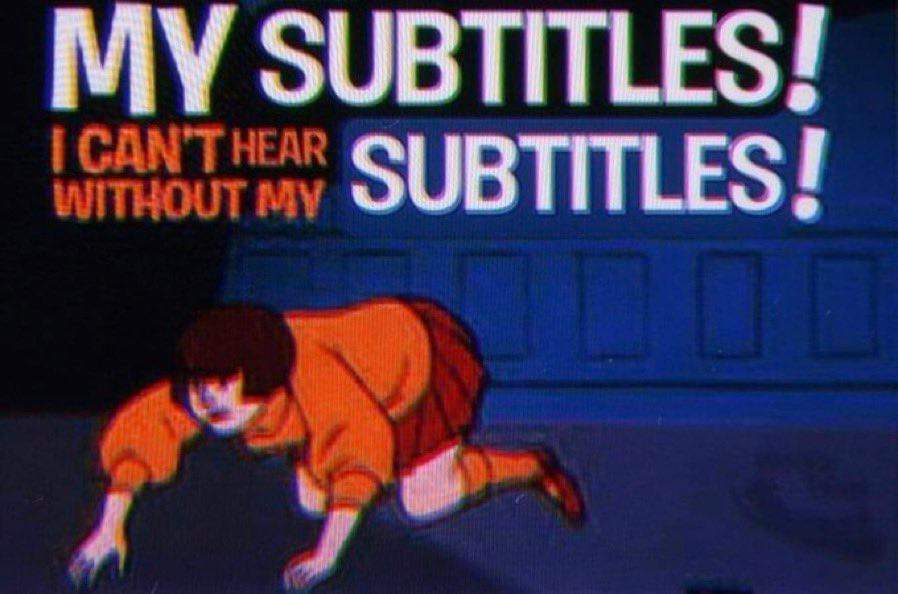
A non-visual description would show a character crawling on the floor in distress. The text at the top reads "MY SUBTITLES! I CAN'T HEAR WITH MY SUBTITLES!" which indicates the image itself is stripping the meme of its original context. To a millenihilist, this is a declaration that they are taking that popular "I can't hear subtitles" image from Reddit and destroying it by simply leaving the red and white text alone. It is a statement that they are no longer part of the subreddit community.
simple-description (llama3.2-vision_11b)
The meme is an image of a person with a shocked expression, captioned "Millennials are the first generation to have grown up with the internet, and they're starting to realize that their entire lives have been documented online. They're starting to feel the weight of their digital legacy, and it's freaking them out."
detailed-analysis (gemma3-27b-vision)
Okay, let's analyze the image using the requested frameworks.
Visual Description
The image is a digital still taken from an animated source (likely a Japanese anime). The aesthetic is reminiscent of 1990s anime style: flat color palettes, bold outlines, and dynamic poses. The background is a stark, flat blue with repeating rectangular forms resembling tiles or a grid.
The central figure is a person depicted in a dramatically dynamic pose – seemingly crawling or collapsing forward. Their body is rendered in a bright, saturated reddish-orange with exaggerated musculature. The figure's face is partially obscured, but suggests a distressed or desperate expression.
Overlaid on the image is text in a bold, white font, that reads "MY SUBTITLES!" in a large size, and "I CAN'T HEAR WITHOUT MY SUBTITLES!" in a smaller size. The text is placed to dominate the space and suggest an urgent or frantic message. There is a grainy, almost VHS-tape like quality to the image, adding to a sense of nostalgia or retro aesthetic.
Foucauldian Genealogical Discourse Analysis
This image invites a genealogical approach. The phrase "I can't hear without my subtitles!" speaks to a discourse surrounding accessibility and information consumption. The very need for subtitles, and the anxiety expressed when they are absent, has evolved over time with the development of media technologies.
- Power/Knowledge: Historically, access to media (films, television, anime) was often limited to those who understood the original language. The development of subtitles represents a shift in power, democratizing access to information. However, the need for subtitles also highlights a structural exclusion: those who cannot or choose not to listen to audio, rely on subtitles. The frantic text implies that the viewer is rendered powerless without these subtitles.
- Disciplinary Power: The insistence on subtitles could be seen as a form of self-discipline, a need to consume media in a particular way. It suggests a reliance on external systems for understanding.
- Genealogical Tracing: Tracing the history of subtitle technology, and the growing demand for accessibility features, reveals changing social norms and a growing awareness of different cognitive abilities. The image can be seen as a response to the modern condition, where media is constantly overwhelming us, and we rely on technologies to manage that influx.
- Episteme: The image marks a shift in episteme (the underlying system of thought) related to media consumption. Previously, watching foreign films might have necessitated a tolerance for ambiguity or a reliance on secondary interpretations. Now, audiences demand seamless understanding through accurate translation and readily available subtitles.
Critical Theory
From a Critical Theory perspective (drawing on figures like Adorno & Horkheimer), the image can be interpreted as a symptom of the "culture industry."
- Commodification of Experience: The desperate plea for subtitles suggests a dependence on mediated experience. The viewer isn't directly engaged with the narrative itself but relies on the technology to access it. This dependence can be seen as a form of alienation, a removal from authentic experience.
- Standardization and Control: Subtitles, while enabling access, also represent a standardization of meaning. They dictate a specific interpretation of the dialogue, potentially suppressing nuance and ambiguity.
- Loss of Aura: The frantic nature of the text suggests a loss of the "aura" (as described by Benjamin) associated with traditional storytelling. The focus isn't on the narrative itself but on the means of accessing it.
- Passive Consumption: The image implies a passive consumer, reliant on external systems for understanding, rather than active engagement and interpretation.
Postmodernism
The image resonates with many key tenets of Postmodern thought.
- Hyperreality & Simulation: The exaggerated pose and bold, attention-grabbing text contribute to a sense of hyperreality. The image isn't necessarily about the story within the anime but about the experience of consuming media.
- Fragmentation & Intertextuality: The use of a visual style from a specific subculture (anime) creates a fragmented, intertextual experience. The image relies on the viewer's pre-existing knowledge of anime aesthetics to create meaning.
- Loss of Grand Narratives: The desperate plea for subtitles can be seen as a rejection of the idea of a universal, objective narrative. The viewer’s understanding is contingent on the availability of a specific technological tool.
- Emphasis on Subjectivity: The image prioritizes the subjective experience of the viewer. It’s about the anxiety and frustration of not being able to access the narrative from their perspective.
- Irony & Parody: The image can be read as a playful parody of online fan culture, where intense emotional attachments to media and specific access requirements are common.
Queer Feminist Intersectional Analysis
This framework allows us to consider how access to media intersects with identity and power.
- Accessibility as a Social Justice Issue: The frantic need for subtitles is not simply a personal preference, but a matter of accessibility and inclusion. The image draws attention to the exclusion of Deaf and hard-of-hearing individuals, and anyone who relies on visual information to access media.
- Intersectional Accessibility: Accessibility isn't solely about auditory impairment. It also intersects with linguistic diversity (non-native speakers), neurodiversity (individuals with ADHD who may benefit from visual cues), and other factors.
- Disability and Shame: The urgency in the image can also be interpreted as a representation of the shame or frustration experienced by individuals who require accommodations to access media.
- Challenging Normative Viewing: The insistence on subtitles challenges the normative assumption that media is primarily experienced through audio. It asserts the validity of alternative modes of engagement.
- Feminist Discourse: In a broader context, this image can be read as an assertion of self-advocacy and a demand for inclusivity. The frantic plea embodies a demand for equal access to information and a rejection of systems that exclude certain groups.
Disclaimer: These analyses are interpretations based on the visual information and the chosen theoretical frameworks. Other interpretations are possible, depending on context and perspective.
simple-description (llama3.2-vision)
This meme is an image of a person on the floor, seemingly in distress, with a caption that reads "I CAN'T HEAR YOU, SPEAKING THROUGH SUBTITLES". The image is a humorous take on the frustration of watching a movie with poor audio or subtitles that are not clear.
tesseract-ocr
HL Y eae vil a