First Seen
2023-05-10T20:59:59+00:00
simple-description (llama3.2-vision_11b)
The meme features a photo of Daniel Radcliffe, the actor who played Harry Potter, holding a cigarette and surrounded by dogs. The caption "I'm not a dog walker, I'm a wizard" is a play on the Millenihilism theme, where people are expected to have a certain level of expertise or talent, but in this case, Radcliffe is just a normal person who happens to have a lot of dogs. The meme pokes fun at the idea that someone can be a "wizard" or have a special talent, but in reality, they're just a regular person who's good with dogs.
detailed-analysis (gemma3-27b-vision)
Okay, here's a breakdown of the image using the requested theoretical lenses. It's important to note that applying these theories to a single candid photo like this can be somewhat speculative and playful, but hopefully, it demonstrates an understanding of the concepts.
Visual Description
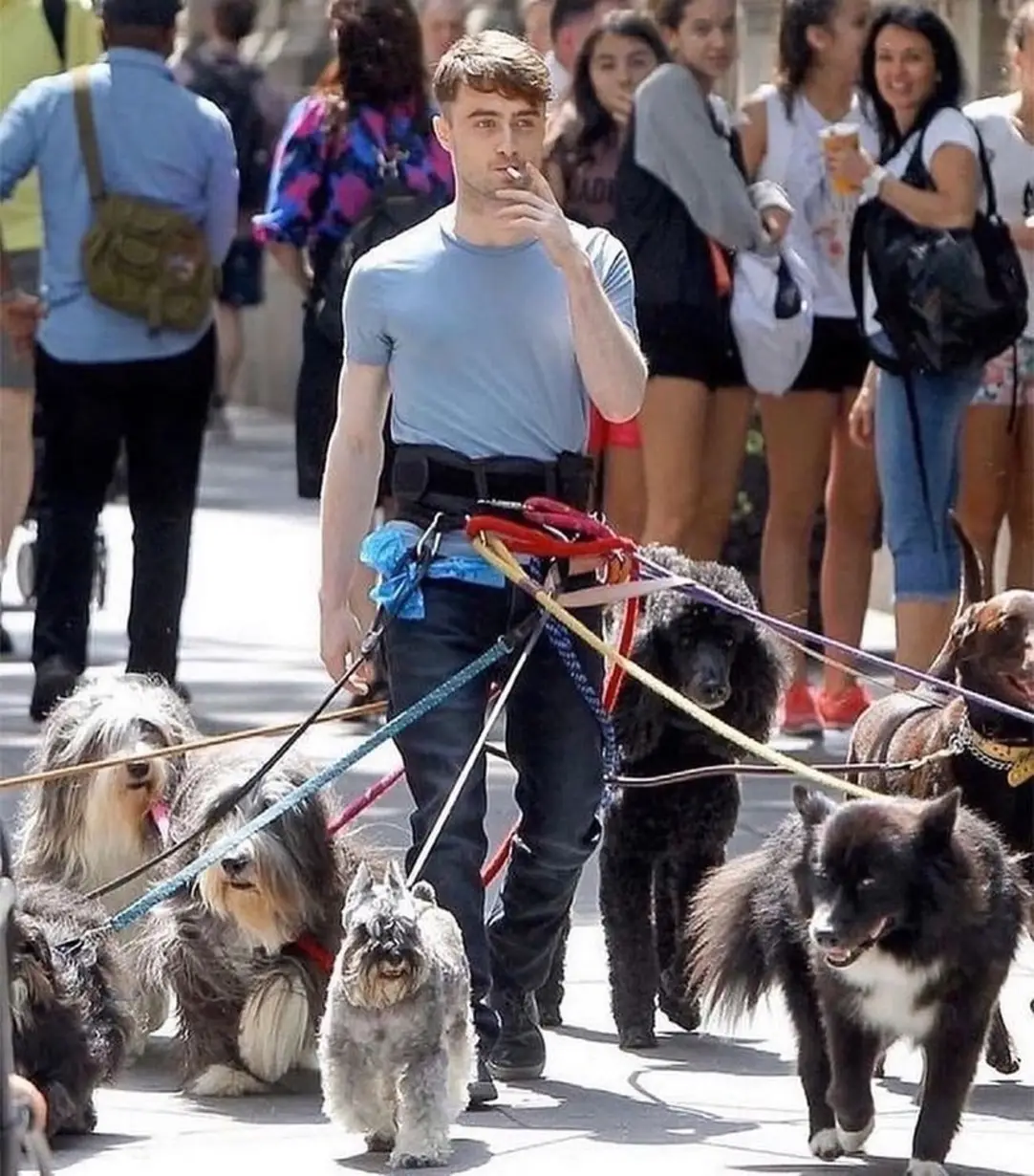
The image depicts actor Daniel Radcliffe walking a pack of small dogs (appearing to be Lhasa Apsos or similar breeds) on a city street. He’s dressed casually in a light blue t-shirt and dark jeans. He has a blue bandana tied around his waist. His expression is contemplative, with a finger to his mouth. Multiple leashes are tangled around his hand and waist, suggesting a significant effort to manage the group. The background is filled with pedestrians and shop fronts, indicating a busy urban setting. The lighting is bright and suggests a daytime shot. The overall impression is one of controlled chaos, and a curious juxtaposition of celebrity and everyday life.
Foucauldian Genealogical Discourse Analysis
Foucault's genealogy examines how concepts and power structures evolve through historical discourse. In this image, several lines of inquiry could be explored:
- Dog Ownership & Discipline: The leashes themselves are central. Historically, dog ownership has been linked to notions of property, control, and status. The tangled leashes visually represent the negotiation of power between the owner and the animals, mirroring broader societal power dynamics. The act of “walking” dogs, seemingly benign, can be seen as a form of discipline – training the animal to conform to societal expectations of "good behavior" in public space. This “civilizing” practice extends to humans as well, requiring conformity to social norms.
- Celebrity & Surveillance: Radcliffe’s celebrity status means he’s constantly subjected to surveillance, as evidenced by the photograph itself. This image performs his celebrity, framing him in an unexpected context (dog walking) and making his private life a public spectacle. The discourses of "fame" and "privacy" are in tension here. The act of walking dogs, generally considered mundane, is transformed into a newsworthy event because of who is performing it.
- “Normalcy” & Deviation: The image challenges our expectations of "normal" behavior for a celebrity. We expect public appearances to be linked to premieres, sets, or philanthropic work, not mundane tasks like dog walking. This "deviation" from the norm highlights the constructed nature of social roles and expectations.
Critical Theory (Frankfurt School)
A critical theoretical perspective, influenced by the Frankfurt School, focuses on power structures and the "culture industry."
- The Commodification of Care: The image could be seen as a subtle commentary on the commodification of care in late capitalism. Radcliffe, as a celebrity, is a brand. Caring for these dogs, even if genuine, is also performed for public consumption. The dogs themselves, though pets, represent a form of conspicuous consumption – signaling status and lifestyle.
- The Spectacle & Distraction: Drawing on Guy Debord, the image can be viewed as contributing to the "spectacle." It provides a seemingly innocuous diversion, a momentary distraction from larger systemic issues. The focus on Radcliffe and his dogs obscures the underlying power dynamics and inequalities present in the urban environment.
- The Loss of Authenticity: The highly curated nature of celebrity life, as reflected in the image, speaks to a broader concern of critical theory: the loss of authenticity in a society obsessed with image and simulation.
Postmodernism
Postmodern thought emphasizes deconstruction, fragmentation, and the rejection of grand narratives.
- Intertextuality & Juxtaposition: The image operates on multiple levels of intertextuality. We know Radcliffe as "Harry Potter," but here he's presented as an everyday dog walker. This juxtaposition of different "texts" (the fictional character vs. the real person) disrupts our expectations and challenges notions of a stable identity.
- Irony & Playfulness: There’s a clear element of irony in the image. The seriousness of Radcliffe's expression contrasts with the absurd situation of managing a chaotic pack of dogs. Postmodernism often embraces playfulness and the subversion of traditional norms.
- The Death of the Author: While we recognize Radcliffe, postmodernism encourages us to question the "authorial intent." Is this a deliberate statement? Or simply a candid moment? The meaning is open to interpretation.
Queer Feminist Intersectional Analysis
This analysis considers how systems of power – gender, sexuality, race, class, etc. – intersect to create unique experiences of oppression and privilege. (This is more challenging to apply directly, as the image isn't explicitly about these themes.)
- Performing Masculinity: The image could be interpreted through the lens of gender performance. The “traditional” image of a masculine “protector” is challenged by Radcliffe’s role as a caretaker, managing a group of small, traditionally “feminine” animals. It disrupts the expected gender roles.
- Care Work & Gender: Care work, such as walking dogs, is often historically undervalued and relegated to women. A male celebrity performing this task disrupts this historical expectation.
- Accessibility & Privilege: It’s important to acknowledge that owning multiple dogs, especially in an urban environment, requires a certain level of financial and logistical privilege. This highlights the inequalities in access to resources and the ability to care for animals.
Disclaimer: These analyses are interpretations based on a single image and the application of complex theoretical frameworks. They are intended to demonstrate how these theories can be used to unpack visual culture, rather than provide definitive answers.
simple-description (llama3.2-vision)
This meme features a photo of Daniel Radcliffe, the actor who played Harry Potter, walking a large number of dogs on a leash. The text in the image reads "I can see my life's purpose now". The meme is likely referencing the idea that walking so many dogs at once is a fulfilling and meaningful experience, much like finding a sense of purpose in life.
tesseract-ocr
ies : 4 . at ” 7 _—-| + ee) RS —_ [Nw \= ¥ : . J A) yr s =~ ‘ ; } 7. Bie ai ) at \ 4 ~ : ime | — ; , if ; j | ae f i sg Ca as : By Fhe DES 2 ah ] . a . ess a gt . a. JA Fat % < F Ee! aS S— So fc Eh J CM. ae oS ——— ~ —alae r xe! Kee a > Ya yf . j IS i y ae 4 7 is b, a : es a) ( oe ge iE Fe hig Wee me «-% aaa se | do ay SY — - ft “% * 4 i(/' ng * \ = _< I mn . ee 3% \- L— . Ge Ip —— » — it Sa we E Haid — a