First Seen
2023-05-10T20:59:59+00:00
simple-description (llama3.2-vision_11b)
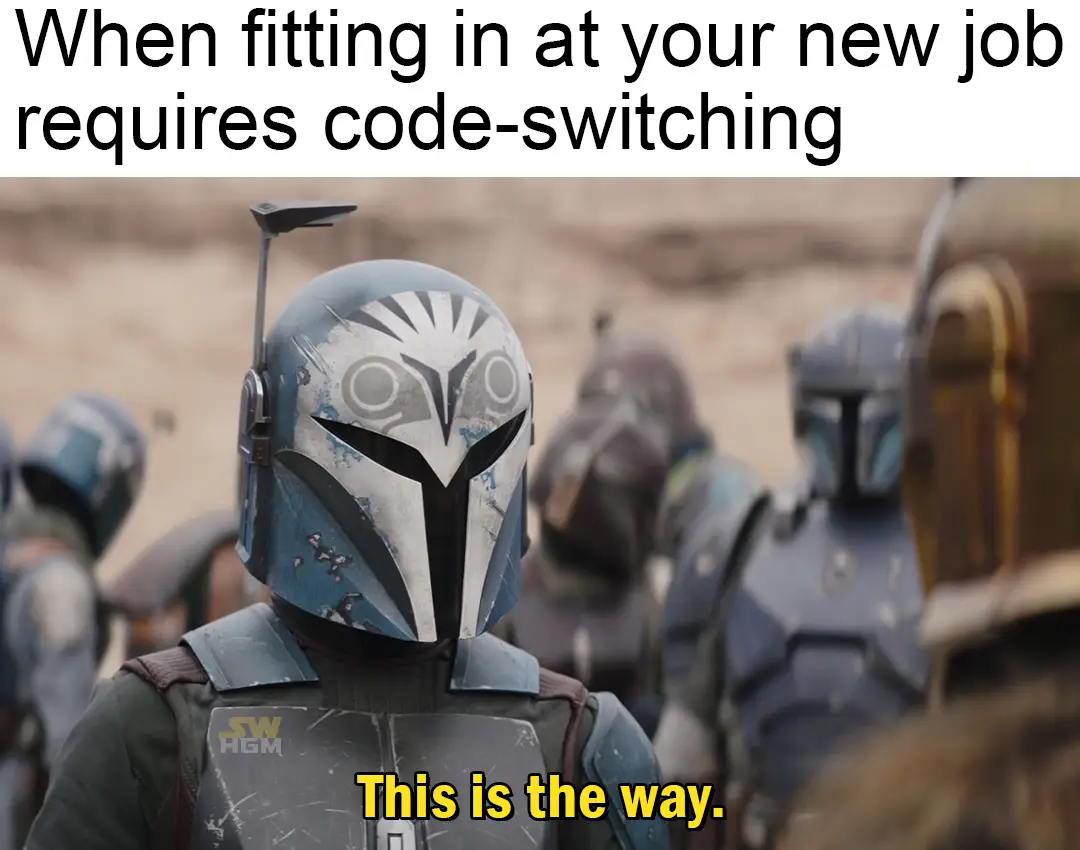
The meme is a humorous take on the struggles of adapting to a new job, specifically when it comes to learning the company's coding standards and software. The image features a character from the Star Wars franchise, Bo-Katan, with the caption "When fitting in at your new job requires code-switching" and a quote from the show: "This is the way. This is the way." The meme is poking fun at the idea that adapting to a new job requires a lot of code-switching, or changing one's way of thinking and doing things, to fit in with the company's culture and standards.
detailed-analysis (gemma3-27b-vision)
Okay, let's break down this meme through the lens of various theoretical frameworks.
Visual Description
The image depicts a scene from The Mandalorian, featuring Din Djarin (the Mandalorian) in his full Beskar armor. He’s standing in the foreground, looking forward, with a line of similarly armored Mandalorians behind him, slightly blurred, suggesting a collective or group. The lighting is somewhat desaturated, giving a harsh, desert-like feel. At the bottom of the image, superimposed on the scene is the Mandalorian creed, “This is the way.” The top of the image has text reading: “When fitting in at your new job requires code-switching.”
Foucauldian Genealogical Discourse Analysis
This meme powerfully illustrates Foucault’s concept of discourse and how it operates to create norms and regulate behavior. The “new job” context immediately establishes a power dynamic where certain ways of speaking, behaving, and presenting oneself are favored – even required – for acceptance.
- Power/Knowledge: The meme suggests that fitting in isn’t about authentic self-expression, but about demonstrating knowledge of the expected “code” (language, mannerisms, values) of the workplace. This demonstrates power/knowledge at work. Those who “know the code” are accepted; those who don’t are excluded or marginalized. The act of "code-switching" is demonstrating a mastery of the power structure.
- Disciplinary Power: The "This is the way" text from The Mandalorian acts as a symbol of a rigid and collective adherence to rules and norms, similar to Foucault’s concept of disciplinary power. The Mandalorians' unwavering commitment to their creed suggests a system of self-regulation and conformity where deviation isn't tolerated. The individual (the worker) is incentivized to conform.
- Genealogy: The meme hints at the history of workplace norms. These aren't natural or inevitable; they've been constructed over time through social practices, power relations, and the enforcement of specific codes of conduct. The meme shows that we often don't know the origins of these rules.
Critical Theory
The meme aligns with the Frankfurt School's critique of modern society and the "culture industry."
- Alienation: Code-switching, as depicted in the meme, can be seen as a form of alienation. The worker is forced to suppress or modify their authentic self in order to conform to the demands of the workplace, leading to a disconnect between their inner experience and their external presentation.
- Domination: The “new job” represents a system of domination where certain codes (ways of being) are privileged, while others are marginalized. This reinforces existing power structures and maintains social inequalities.
- False Consciousness: The meme subtly suggests that workers may internalize the values and norms of the workplace, even if they are harmful or exploitative. This can lead to a false sense of identification with the system and a lack of critical awareness.
Marxist Conflict Theory
The meme’s implications resonate with Marxist analysis of class and power dynamics.
- Class and Labor: The “new job” represents the sphere of capitalist production, where workers are compelled to adapt to the demands of employers in order to secure their livelihoods. This adaptation is not simply a matter of personal choice; it is a structural requirement of the capitalist system.
- Exploitation: Code-switching can be seen as a form of emotional labor. Workers are required to manage their emotions and present a particular persona in order to fulfill their job requirements. This can be emotionally draining and exploitative.
- Ideology: The meme suggests that workplace norms serve to reinforce the dominant ideology of capitalism, which values conformity, efficiency, and profitability. Workers who conform to these norms are rewarded, while those who deviate are punished.
Postmodernism
The meme touches on postmodern concepts of identity, authenticity, and the fragmentation of experience.
- Simulacra and Simulation: Code-switching can be seen as a form of simulation. Workers are not expressing their “true” selves, but rather constructing a persona that is deemed acceptable by the workplace. This persona becomes a simulacrum – a copy without an original.
- Deconstruction of Identity: The meme suggests that identity is not fixed or essential, but rather fluid and constructed through social interactions. Code-switching highlights the performative aspect of identity and the ways in which we adapt our behavior to different contexts.
- Loss of Grand Narratives: The meme implicitly critiques the idea of a unified or authentic self. It suggests that we all wear masks and play roles, and that there is no single “true” self to discover.
Queer Feminist Intersectional Analysis
This meme’s implications become even more complex when viewed through a queer feminist intersectional lens.
- Performativity (Butler): The act of code-switching directly aligns with Judith Butler’s concept of performativity. Gender, sexuality, and identity are not inherent qualities but are constructed through repeated performances. The worker is performing a specific identity to navigate the workplace.
- Intersectionality: Code-switching is rarely a uniform experience. It is shaped by a person's race, gender, class, sexuality, and other intersecting identities. The expectations around how someone “should” behave will vary depending on their social location. A Black woman may experience different pressures to code-switch than a white man.
- Marginalization: Code-switching can be a particularly burdensome experience for marginalized groups. It requires constant negotiation and adaptation, and can lead to feelings of alienation, inauthenticity, and emotional exhaustion. The pressure to conform can be especially intense for those who already face discrimination and prejudice.
- Subversion: While code-switching can be a survival strategy, it can also be a form of resistance. By strategically adapting their behavior, marginalized groups can navigate oppressive systems and create spaces for agency and self-expression.
I hope this detailed analysis gives you a comprehensive understanding of the meme's theoretical implications! Let me know if you’d like me to elaborate on any of these points.
simple-description (llama3.2-vision)
This meme features a character from the Star Wars universe, Bo-Katan, with a quote that is often used to express frustration or annoyance. The image shows Bo-Katan with the quote "This is the way" from the Star Wars series, but the text above the image reads "When your new job requires code-switching". The meme is poking fun at the idea that a character known for being a strong leader and warrior is now being asked to adapt to a new role that requires being able to switch between different languages or codes, much like a code-switching in linguistics.
tesseract-ocr
When fitting in at your new job requires code-switching < 7G NT . ( 40, ££ cays) ry “y | PA of Fri ; a > - TS ee *< ar Us hes Yur ‘