First Seen
2023-06-19T23:57:49+00:00
simple-description (qwen3.5_2b-q8_0)
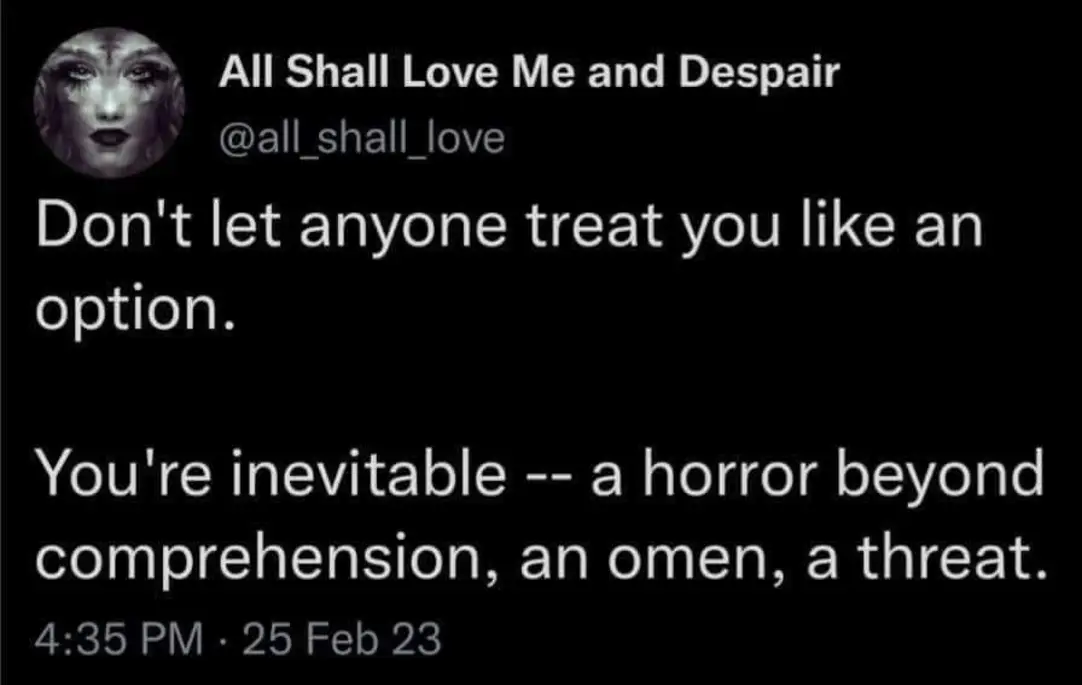
This meme is a digital representation of the "millenarian" mindset, specifically referencing the horror song "All Shall Love Me and Despair." It argues that you are not a choice but an "inevitable horror," framing the end of the world as a terrifying certainty rather than a mere "option." For a blind viewer, the text screams an existential dread where death and destruction are inevitable, suggesting that your very existence is a cosmic omen rather than a chance event.
simple-description (llama3.2-vision_11b)
The meme is a screenshot of a Twitter post that reads: "Millenial nihilism is just the realization that the things you wanted are never going to happen, and that's okay." This meme is a commentary on the existential crisis that many millennials face, where they feel disillusioned with the idea of achieving their goals and aspirations. The meme pokes fun at this sentiment, acknowledging that it's okay to feel this way, and that it's a normal part of growing up.
detailed-analysis (gemma3-27b-vision)
Okay, here's an analysis of the image provided, broken down into sections as requested. It's important to note that not every theoretical framework will fully apply, and some will be more potent than others. I'll explain my reasoning for including or excluding sections.
Visual Description
The image is a screenshot of a Twitter post. It features a dark, stylized profile picture that appears to be a highly filtered or distorted face. The background is black. The text within the post reads, "Don't let anyone treat you like an option. You're inevitable—a horror beyond comprehension, an omen, a threat." The time stamp shows 4:35 PM on February 25, 2023. The username for the account is "All Shall Love Me and Despair." The overall visual impression is dark, dramatic, and somewhat unsettling. The filter used on the profile picture and the language used in the text creates a sense of theatricality and a potentially menacing atmosphere.
Foucauldian Genealogical Discourse Analysis
This text is rich for a Foucauldian approach. We can see how power dynamics are constructed and maintained through language itself.
- Discourse of Worth & Control: The statement "Don't let anyone treat you like an option" seemingly empowers the reader, but it simultaneously establishes a binary: being seen as essential vs. being reduced to a disposable choice. This is a discourse of worth, which inherently implies mechanisms of control. The speaker frames the act of not being treated like an option as something requiring effort or resistance, implicitly acknowledging a pervasive power structure where people are frequently treated as disposable.
- Genealogy of "Inevitability": The assertion of "inevitability" can be examined genealogically. Historically, “inevitability” has been used to justify acts of violence or oppressive regimes (e.g., "historical necessity"). Here, it's linked to a horrifying image. The speaker suggests that the reader is a force of nature, which can be seen as a way to claim power, but it’s a power connected to fear and dread. This challenges linear notions of progress and rational control.
- "Horror, Omen, Threat": These terms are constitutive of power. They operate as disciplinary tools, creating a sense of anxiety and obedience. By identifying with these labels, the speaker (and the implied audience) aligns with a potentially destabilizing force.
Critical Theory
The text clearly aligns with elements of Critical Theory, particularly in its questioning of societal norms and its emphasis on power relations.
- Dominant Ideology Critique: The initial statement challenges the ideology of individual choice and consumerism, where people are often treated as interchangeable options. The text encourages a rejection of this devaluing process.
- Emancipatory Potential: The text suggests a move beyond the constraints of societal expectations. It’s not just about resisting being an “option,” but embracing an identity marked by its own potent, and even terrifying, force. While disturbing, this can be interpreted as a call for self-affirmation and a rejection of conformity.
- Rejection of Enlightenment Rationality: The embracing of "horror," "omen," and "threat" can be interpreted as a rejection of traditional Enlightenment notions of reason and progress. This aligns with Critical Theory's exploration of the darker sides of modernity.
Postmodernism
The text displays several characteristics of postmodern thought:
- Deconstruction of Binary Oppositions: The statement implicitly deconstructs the opposition between being "chosen" and being "rejected." It flips the script, suggesting that the ideal state is to be beyond choice altogether—to be inevitable.
- Rejection of Grand Narratives: The embracing of "horror" and "omen" rejects the idea of a linear, progressive narrative of history or individual development. It leans into the chaotic, the unpredictable, and the unsettling.
- Emphasis on Subjectivity and Performance: The text suggests that identity is not fixed, but constructed through a performance of power and a claiming of threatening qualities.
Marxist Conflict Theory
While present, this section is the weakest application.
- Power Dynamics & Control: From a Marxist perspective, one could interpret the statement as a subtle critique of capitalist systems where individuals are often commodified and treated as disposable resources (the "option" metaphor). However, the text doesn’t explicitly address material conditions or class struggle.
- Revolutionary Potential: One could argue that embracing one's “inevitability” as a “threat” implies a readiness to disrupt the existing social order, but the text doesn't explicitly articulate this as a goal.
Queer Feminist Intersectional Analysis
This framework offers a compelling reading.
- Subversion of Power Dynamics: For marginalized groups (especially LGBTQ+ people and women), being treated like an "option" is a frequent experience stemming from systemic oppression. The text can be read as a radical self-affirmation, rejecting the expectation of conforming to societal norms to gain acceptance.
- Embracing the "Monstrous": Historically, marginalized identities have been labeled as "monstrous" or threatening. The text's embrace of "horror" and "threat" can be seen as a reclaiming of these labels as sources of power and resistance.
- Intersectional Power: The language evokes a sense of agency and refusing to be minimized, potentially resonating with those who face multiple layers of oppression. It challenges the dominant narratives that dictate who is seen as worthy of consideration.
Final Thoughts
The image and text are complex. They operate on multiple levels, inviting interpretation through various critical lenses. The most potent readings emerge from Foucauldian analysis, Critical Theory, Postmodernism, and particularly Queer Feminist Intersectional analysis. The text functions as a statement of defiance, a rejection of societal norms, and a radical affirmation of self, even if that self is framed as a frightening force.
simple-description (llama3.2-vision)
This meme is a humorous take on the phrase "don't let anyone treat you like an option." It's a darkly comedic commentary on the idea that people can be treated like something that's not even worth considering. The text reads: "Don't let anyone treat you like an option. You're not a choice, you're a necessity."
tesseract-ocr
“All Shall Love Me and Despair @all_shall_love Don't let anyone treat you like an option. You're inevitable -- a horror beyond comprehension, an omen, a threat. PE oe MeL ol