First Seen
2023-05-10T21:03:36+00:00
simple-description (llama3.2-vision_11b)
This meme is a play on the concept of Millenialism, a philosophical and theological movement that emphasizes the importance of individual freedom and the rejection of traditional authority. The meme uses a humorous and satirical tone to poke fun at the idea of a "millenium" (a thousand years) of human existence, implying that the current era is a time of great upheaval and transformation. The image of a cat playing the piano, accompanied by the caption "I can smell the desperation emanating from your profile picture", is a tongue-in-cheek reference to the idea that people are struggling to find meaning and connection in a rapidly changing world.
detailed-analysis (gemma3-27b-vision)
Okay, here’s an analysis of the image, broken down into sections as you requested. I’ll omit sections that don’t meaningfully apply.
Visual Description
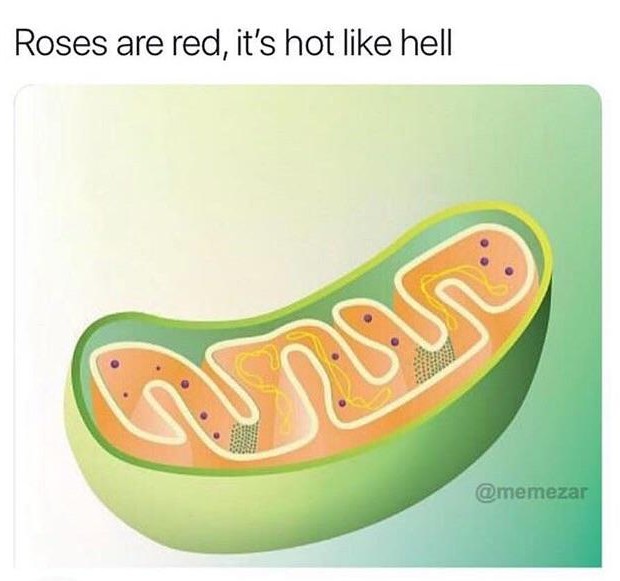
The image is a digital illustration of a mitochondria, a cellular organelle responsible for energy production. The background is a pale, solid green. The mitochondria itself is depicted in a simplified, cartoonish style, with a rounded oval shape and highly folded inner membranes (cristae) in shades of orange. The folds create a somewhat labyrinthine effect. The overall aesthetic is clean and modern. Above the image is a phrase in white text on a dark background: "Roses are red, it's hot in hell". A watermark with "@memezar" is visible on the lower right.
Foucauldian Genealogical Discourse Analysis
This meme performs a fascinating discursive operation. The pairing of a common, romantic rhyme ("Roses are red…") with a biological illustration (the mitochondria) and an invocation of “hell” (a site of intense energy and perceived punishment) constructs a micro-power dynamic.
Foucault might analyze the shift in meaning as a disruption of established discourses. The romantic rhyme, traditionally associated with courtship and affection, is de-centered and re-purposed. It's not about love anymore; it's about heat. This heat isn’t merely a physical sensation; it’s linked to the powerful, fundamental process of cellular energy production (mitochondria) and the culturally loaded concept of hell.
The meme produces a new meaning—a suggestion that energy production, at a cellular level, is inherently intense, even "fiery" or transgressive—by strategically juxtaposing these seemingly disparate elements. It’s not about discovering a hidden truth, but creating a new relationship between concepts through discourse. The connection to “hell” introduces a power dynamic – a suggestion that this "hot" process is possibly dangerous, uncontrollable, or even punitive.
Critical Theory
From a Critical Theory perspective (particularly drawing from the Frankfurt School), the meme can be seen as a subtle commentary on the commodification and reduction of complex processes to superficiality. The meme takes a highly complex biological process (cellular respiration, occurring within the mitochondria) and flattens it into a simple rhyme. This reduction isn't merely about simplification for humor; it’s emblematic of a broader cultural tendency to prioritize surface-level associations over deep understanding.
The “hot” aspect is key. It can be read as a metaphor for the anxieties surrounding energy production in a capitalist system – a relentless pursuit of power and resource extraction, potentially at a destructive cost (the association with "hell" is pointed here). The meme, though seemingly lighthearted, implicitly questions the ways in which we understand and interact with the foundational processes of life itself. It implicitly asks whether we have lost the ability to appreciate the complexity of these processes in favor of quick, easily digestible associations.
Marxist Conflict Theory
The meme can be read, albeit subtly, through a Marxist lens. The mitochondria, as the “powerhouse of the cell,” represents the source of energy for the organism. In a Marxist framework, energy can be viewed as a fundamental resource, and the mitochondria as the means of its production. The phrase “it’s hot in hell” suggests a potential for exploitation or overwork – a continuous, intense energy production process that could be seen as a form of cellular “labor.”
The association with "hell" implies a potential cost or consequence to this intense production, hinting at a system where the “workers” (mitochondria) are relentlessly pushed to their limits. It’s a metaphorical representation of the exploitative nature of production in a capitalist system. While a stretch, the meme provides a subtle allegorical representation of the unequal distribution of resources and the potential for burnout or destruction inherent in a system driven by constant energy production.
Let me know if you'd like me to expand on any of these analyses, or explore other theoretical frameworks!
simple-description (llama3.2-vision)
This meme is a humorous take on the classic Valentine's Day poem "Roses are red, violets are blue..." but with a dark and ironic twist. The image depicts a mitochondria (the part of a cell that produces energy) with the caption "Roses are red, it's hot like hell". The meme is a play on the original poem's romantic tone, but replaces the sweet sentiment with a more... fiery one.
tesseract-ocr
Roses are red, it's hot like hell 2 Rea