First Seen
2023-05-10T21:03:36+00:00
simple-description (llama3.2-vision_11b)
This meme is a screenshot of a character from the Star Wars franchise, specifically the character of Boba Fett, but with his head replaced by that of a character from a different franchise, specifically Baby Yoda from the Star Wars series "The Mandalorian". The meme is captioned "When you're trying to mod a game but you're still a noob".
detailed-analysis (gemma3-27b-vision)
Okay, let's break down this image with the requested theoretical frameworks. It's a rather bizarre composition, lending itself to interesting interpretations!
1. Visual Description
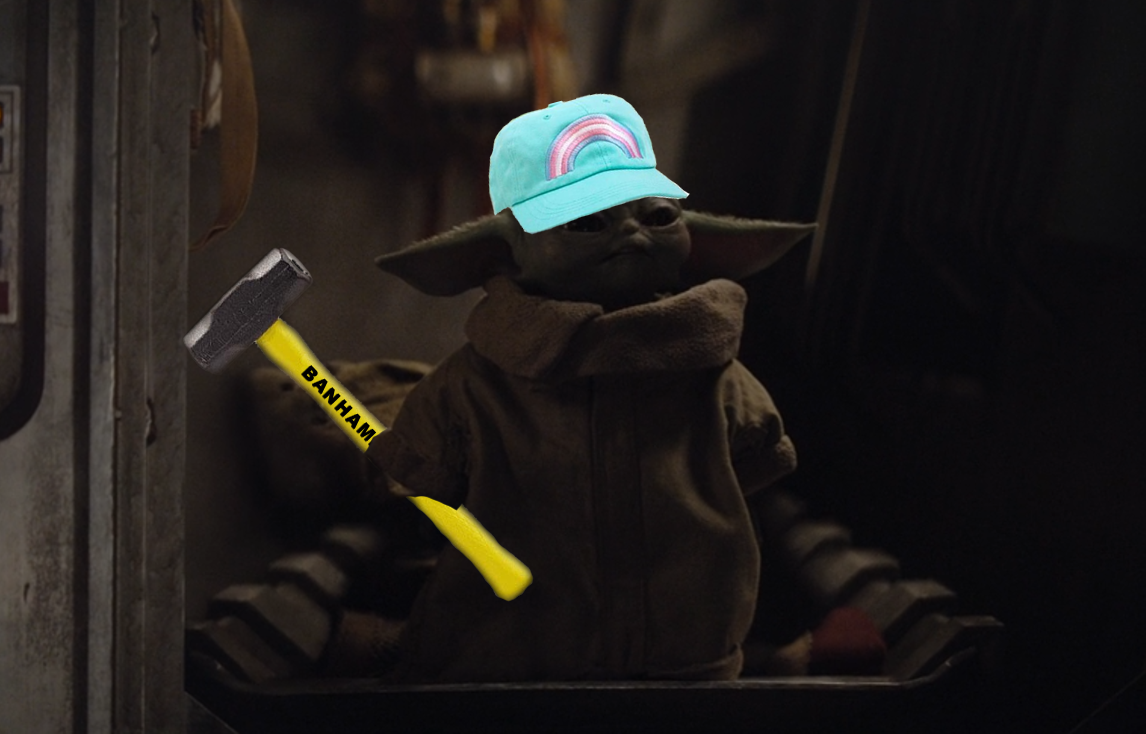
The image features a digitally altered representation of "Baby Yoda" (Grogu) from "The Mandalorian." The creature, usually depicted as innocent and wide-eyed, is now holding a sledgehammer marked with the name "BANHAM." The background is a darkened, blurry interior, appearing to be a hockey rink. Notably, Grogu is wearing a brightly colored rainbow baseball cap. The contrast between the dark, fuzzy figure and the sharp details of the hammer and cap creates visual tension. The lighting is low-key, and the overall effect is strangely humorous and unsettling.
2. Foucauldian Genealogical Discourse Analysis
This image is ripe for a Foucauldian reading. The sledgehammer, inscribed with “BANHAM,” introduces a concept of power/knowledge. The name suggests a specific, potentially authoritarian, force. Examining the history of “BANHAM” (assuming it's a reference to a real person, brand, or ideology) would reveal the discourses that shaped its meaning and influence. The image shows Grogu wielding this power/knowledge.
Grogu's usual position as a vulnerable, dependent figure is subverted. This challenges the traditional discourse around 'cuteness' and innocence. By equipping him with a tool of potential violence (the sledgehammer) and embedding it with the name 'Banham', this disrupts the accepted notions of Grogu’s power dynamic.
The rainbow cap could be analyzed as a contemporary discourse, signifying inclusivity or LGBTQ+ identity. Juxtaposing this with the tool of destruction and potentially authoritarian name introduces a fascinating contradiction. What does it mean when a symbol of inclusivity is associated with a forceful agent?
3. Critical Theory
From a Critical Theory perspective, this image is a provocation. It operates as a form of disruptive montage, forcing the viewer to confront uncomfortable juxtapositions.
The image critiques the cult of “cuteness” and its use in commodification (Grogu merchandise is highly popular). By associating Grogu with violence and possibly authoritarian symbolism, it questions the uncritical acceptance of these cultural phenomena.
The image is also a commentary on the culture industry and the recycling of symbols. It takes a beloved character from a popular franchise and recontextualizes him in a disturbing way. This highlights the manipulation of symbols and narratives for different purposes.
4. Marxist Conflict Theory
A Marxist reading might see this image as representing a clash of ideologies. Grogu, traditionally a figure representing innocence and nurturing, is here presented as a potential agent of force. This could be interpreted as a metaphor for the state's use of force to maintain power, particularly the appropriation and corruption of seemingly benevolent symbols.
The sledgehammer itself is a tool of labor, but in this context, it suggests the exertion of control and the suppression of opposition. The rainbow cap is a nod to social justice and equality, while the sledgehammer is a tool for division. The image suggests a fundamental contradiction between these principles, indicating a struggle for dominance between competing ideologies.
5. Postmodernism
This image is inherently postmodern. It's a pastiche of disparate elements—a popular fictional character, a tool of manual labor, a potentially political inscription, and a symbol of identity. It lacks a clear, unified meaning.
The image revels in irony and self-referentiality. It acknowledges its own constructed nature and rejects the notion of objective truth. The absurd juxtaposition of elements is a hallmark of postmodern aesthetics.
The image also challenges traditional notions of authorship and originality. It’s a remix of pre-existing cultural symbols, creating a new, hybrid meaning. It signifies a playful rejection of grand narratives and embraces ambiguity.
6. Queer Feminist Intersectional Analysis
This is potentially the most complex reading. The rainbow cap immediately invokes LGBTQ+ identity and politics. However, its presence alongside a tool of forceful labor raises questions. Is this a playful embrace of queer strength and resilience? Or is it a co-optation of LGBTQ+ symbolism to legitimize violence?
Intersectional analysis necessitates considering power dynamics. A figure historically portrayed as vulnerable (Grogu) wielding a tool of force introduces complex questions about agency and power. The image disrupts traditional gender roles. A traditionally infantile figure holding a powerful tool challenges conventional notions of masculinity and femininity.
The image might also be read as a critique of how marginalized identities are often expected to perform strength and resilience in the face of oppression. The juxtaposition of the rainbow cap and sledgehammer could be interpreted as a commentary on the burden of constant resistance.
Disclaimer: These are interpretations based on theoretical frameworks. The meaning of an image is always open to debate. The intention of the creator is unknown, and readers may interpret the image differently based on their own experiences and perspectives.
simple-description (llama3.2-vision)
This meme features a picture of Baby Yoda from the Star Wars franchise, but with a few modifications. Baby Yoda is now wearing a baseball cap and holding a hammer, and the image is captioned "I'm not lazy, I'm just on Yoda time". The image is likely a humorous take on the idea that Baby Yoda is not actually lazy, but rather just following a unique and quirky schedule.
tesseract-ocr
Tig @ | im!