First Seen
2023-05-10T21:03:36+00:00
simple-description (llama3.2-vision_11b)
The meme is a screenshot of the Star Wars character BB-8 from the 2015 film "The Force Awakens" with a 3D printed head and a 3D printed body, but with a 3D printed head that looks like a 3D printed head. The image is captioned "3D printed head". The meme is likely poking fun at the idea of 3D printing being used for creative and artistic purposes, rather than just for practical uses.
detailed-analysis (gemma3-27b-vision)
Okay, here's an analysis of the image, broken down into sections based on the theoretical frameworks you've requested. I'll only include sections where the framework seems relevant or can yield a meaningful interpretation. Given the image, the most fruitful areas for exploration are likely to be Foucauldian discourse, Critical Theory, and possibly Postmodernism.
1. Visual Description
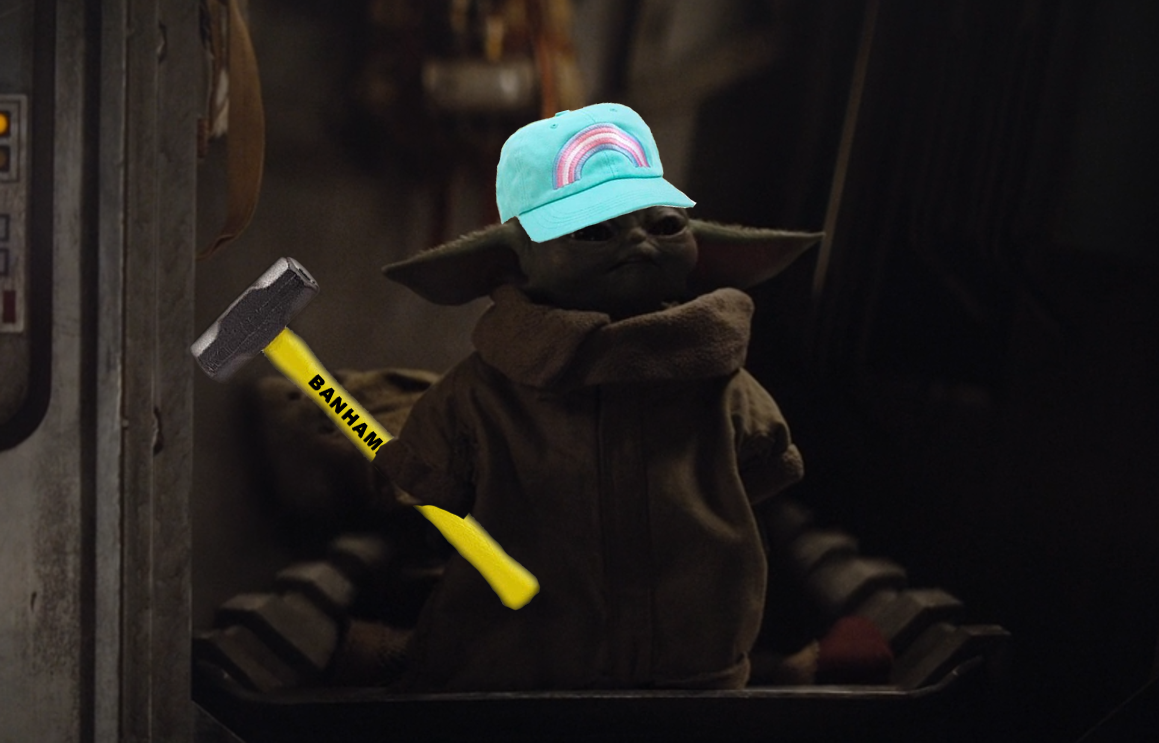
The image depicts “Baby Yoda” (Grogu) from The Mandalorian, digitally manipulated. He’s positioned in a darkened interior, seemingly gripping a sledgehammer with the word “BANHAM” emblazoned on it in yellow. Grogu is wearing a bright, rainbow-colored baseball cap. The background is blurred and appears to be a dimly lit indoor space, possibly a pub or bar. The stark contrast between the dark environment, the bright hat and hammer, and Grogu's subdued color palette immediately draws the eye. The image is clearly a meme or digital remix, constructed for ironic or humorous effect.
2. Foucauldian Genealogical Discourse Analysis
This image invites a Foucauldian analysis by deconstructing the discourses at play and tracing their historical emergence. Several key discourses collide here:
- “Cutness”/”Baby Yoda” Discourse: Grogu is initially constructed by Disney+ as an embodiment of vulnerable cuteness, designed to elicit protective and affectionate responses. This is a deliberate strategy of "affective capitalism," using emotion to drive engagement and consumption.
- "Working Class" Discourse: The sledgehammer, and the “BANHAM” branding (referencing a British manufacturer of livestock equipment), introduce a direct association with physical labor, particularly that associated with rural or agricultural work. This is a jarring juxtaposition against Grogu's initial Disney branding.
- "Meme Culture" Discourse: The image itself is born from the fragmented, recombinatory logic of meme culture, which thrives on subversion, irony, and the appropriation of existing visual imagery.
The genealogical approach would trace the history of each discourse, how it came to be constituted through power relations, and how those relations are embodied within the image. For example, the contrast between the Disney-branded character and the working class tool could be seen as a critique of the commodification of cuteness and the erasure of material labor. The act of digitally combining these disparate elements disrupts the original "truth" of each discourse, creating a new, unstable meaning.
3. Critical Theory
This image can be analyzed through a Critical Theory lens as an example of cultural critique and the subversion of dominant ideologies. Several themes are relevant:
- Commodification of Culture: Baby Yoda's initial marketing capitalizes on nostalgia and "cuteness" as commodities. This image ironically juxtaposes that commercial construction with an object of labor, highlighting the underlying logic of capitalist production.
- The Irony of Appropriation: Meme culture thrives on the appropriation and recontextualization of images. By placing Grogu, a character associated with escapist fantasy, within a potentially gritty and realistic context, the image generates a sense of ironic distance.
- The Spectacle: Guy Debord's concept of the spectacle can be applied here. The original Disney branding constructs Grogu as a spectacle – an image to be passively consumed. The meme format, however, attempts to disrupt this passive consumption by inviting viewers to participate in the creation of meaning.
4. Postmodernism
The image strongly embodies several characteristics of postmodernism:
- Pastiche and Intertextuality: The image is a remix of disparate sources – Disney's The Mandalorian, the BANHAM brand, meme culture – creating a pastiche that resists a single, coherent interpretation. It references multiple "texts" simultaneously.
- Irony and Self-Referentiality: The ironic juxtaposition of Grogu and the sledgehammer is a key element. The image acknowledges its own constructedness and plays with the viewer’s expectations.
- Deconstruction of Grand Narratives: Postmodernism rejects overarching "grand narratives." The image undermines the Disney narrative of a cute and innocent character by placing him in a context that subverts that initial construction. The image rejects simplistic meaning.
- Playfulness and Fragmentation: The image is fundamentally playful and fragmented. It’s not attempting to convey a serious message but rather to generate a moment of ironic amusement.
Note: A Marxist Conflict Theory or Queer Feminist Intersectional Analysis doesn't seem readily applicable to this image. While you could stretch these frameworks to find some relevance (e.g., analyzing the gendered implications of labor, or deconstructing the cuteness trope as reinforcing certain power structures), these frameworks don't offer a particularly fruitful or insightful lens for understanding the image's primary themes.
Let me know if you'd like me to elaborate on any of these points or explore a different theoretical framework!
simple-description (llama3.2-vision)
The meme features a photo of the character Baby Yoda from the Star Wars series, dressed in a child's outfit and holding a hammer. The image is captioned "I can build a wall" in a reference to a 2016 presidential campaign slogan, implying that Baby Yoda is a young, skilled worker. The image is likely meant to be humorous and ironic, poking fun at the idea of a young, powerful figure being able to build a wall, a task often associated with a presidential candidate.
tesseract-ocr
ia ‘| : “ I J . ei wy a las bi m : he ; ui \ ) k= ‘ee i :