First Seen
2023-05-10T21:03:36+00:00
simple-description (llama3.2-vision_11b)
The meme is a screenshot of a character from the video game Minecraft, known as Steve, with a caption "Modded" written above it. The image has been edited to show Steve wearing a pair of sunglasses and a hat, giving him a cool and laid-back appearance. The meme is likely referencing the idea that Minecraft mods can give the game a fresh and exciting new look, much like Steve's updated appearance.
detailed-analysis (gemma3-27b-vision)
Okay, here's an analysis of the image, broken down into the requested sections, noting where sections are not relevant. Please be aware that interpreting art is subjective, and this is one possible reading.
Visual Description
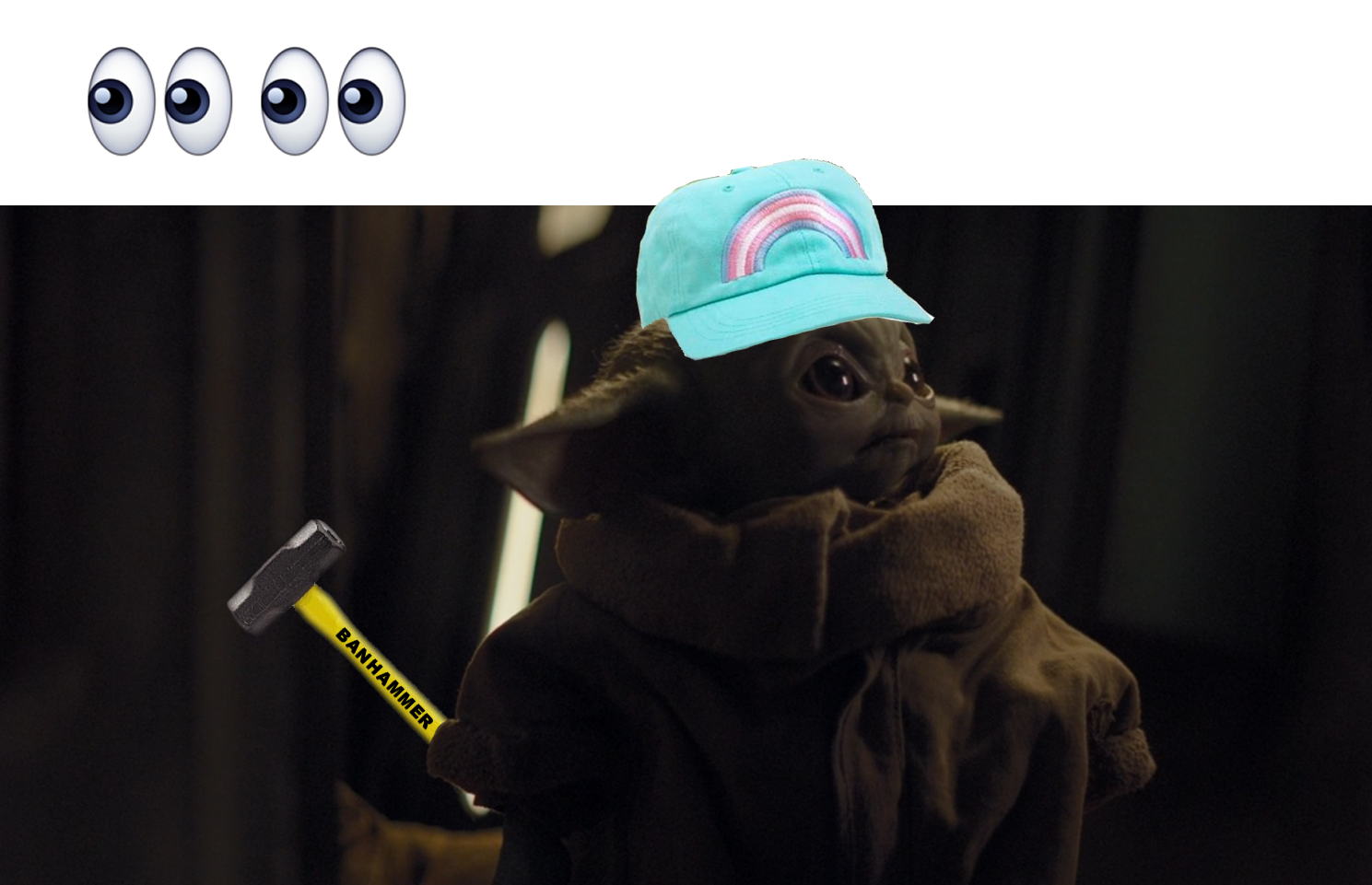
The image depicts "Grogu" (commonly known as "Baby Yoda") from The Mandalorian, a character from the Star Wars universe. Grogu is enveloped in his usual tan/brown cloak. He's wearing a light-blue baseball cap with a rainbow-colored pattern on the brim. Notably, he is holding a yellow hammer with the word "BANHAMMER" written on it in black capital letters. The background is a dark, out-of-focus space resembling an interior, likely a corridor or room. The lighting is dramatic, primarily focused on Grogu, with strong shadows. The image is digitally created/manipulated, likely a photoshop edit. At the top of the image there is a line of three pairs of eyes, blue and white.
Foucauldian Genealogical Discourse Analysis
This image offers rich material for a Foucauldian analysis. The "BANHAMMER" is central to this. Historically, the hammer represents labor, construction, and even punishment. Here, the "BANHAMMER" is a direct reference to the online practice of "banning" users from digital spaces. This isn’t about physical construction but the construction of digital communities and, crucially, the exercise of power within those communities.
Foucault would be interested in how this "banhammer" is not merely a tool but a discourse—a system of thought, language, and practice—that defines who is included or excluded from online spaces. The image exposes the power dynamics at play within internet culture, where moderators, platforms, or algorithms wield the power to silence or censor voices.
The seemingly innocent figure of Grogu wielding this symbol of censorship is deeply unsettling and ironic. Grogu represents vulnerability, innocence, and cuteness, and juxtaposing him with such a powerful tool of exclusion highlights the potentially arbitrary and even absurd nature of online moderation. It asks us to consider who is wielding the banhammer and what ideologies or biases are informing those decisions. It is not about the tool itself, but the power relationships it embodies and the effects it has on those subjected to it.
Marxist Conflict Theory
The image can be interpreted through a Marxist lens as representing conflict between groups within digital spaces. The "banhammer" symbolizes the enforcement of rules and norms, often imposed by those in positions of power (e.g., platform owners, moderators) upon those with less power (e.g., users, marginalized groups).
This can be seen as a microcosm of the broader class struggle. The "banhammer" acts as a tool of repression, maintaining the status quo and silencing dissenting voices. The act of banning can be viewed as a form of symbolic violence, preventing certain groups from accessing information, participating in discussions, or organizing collectively.
The choice of Grogu as the wielder of the banhammer is particularly interesting. It deconstructs the traditional power structure as it puts an innocent-seeming figure in the role of a repressor. It begs the question, is censorship ever justifiable, and what are the consequences of allowing power to consolidate in the hands of a few?
Postmodernism
The image embodies several postmodern themes. The most prominent is the juxtaposition of disparate elements—the iconic character of Grogu from a beloved sci-fi franchise combined with the contemporary internet slang of a "banhammer." This creates a sense of irony and absurdity, questioning traditional boundaries between high and low culture, and past and present.
The image can also be seen as a deconstruction of power dynamics. By placing the "banhammer" in the hands of Grogu, it subverts expectations and challenges our understanding of who wields power and how. The image rejects any notion of a fixed or stable meaning. It encourages viewers to interpret it in their own way, recognizing the subjectivity of meaning and the relativity of truth.
Queer Feminist Intersectional Analysis
The image lends itself to a queer-feminist intersectional analysis because the “banhammer” often falls disproportionately on marginalized voices, including queer and feminist activists, and people of color. Online spaces, while promising inclusivity, can be hostile environments where harassment, doxing, and silencing are common tactics. The “banhammer” is therefore often used to police and repress these groups, reinforcing existing power structures and silencing dissenting voices.
Grogu, though gender-neutral, can be read as a symbol of vulnerability and innocence, and the image is ironic in that it places that vulnerability with a tool that silences others. It asks the question, who gets to decide what is acceptable online, and whose voices are being silenced in the process?
The image can also be seen as a commentary on the gatekeeping that often occurs within online communities, where certain groups are excluded or marginalized based on their identity or beliefs. The banhammer is often used to enforce these boundaries, perpetuating systemic inequalities and hindering social progress.
I hope this detailed analysis is helpful! Let me know if you'd like me to elaborate on any of these points.
simple-description (llama3.2-vision)
This meme features a photo of Baby Yoda from the Star Wars series, dressed in a blue hat and holding a hammer. The image is captioned "I'm not arguing, I'm just explaining why I'm right".
tesseract-ocr
S% Sm y r |