First Seen
2024-06-08T17:57:14.667334+00:00
simple-description (qwen3.5_2b-q8_0)
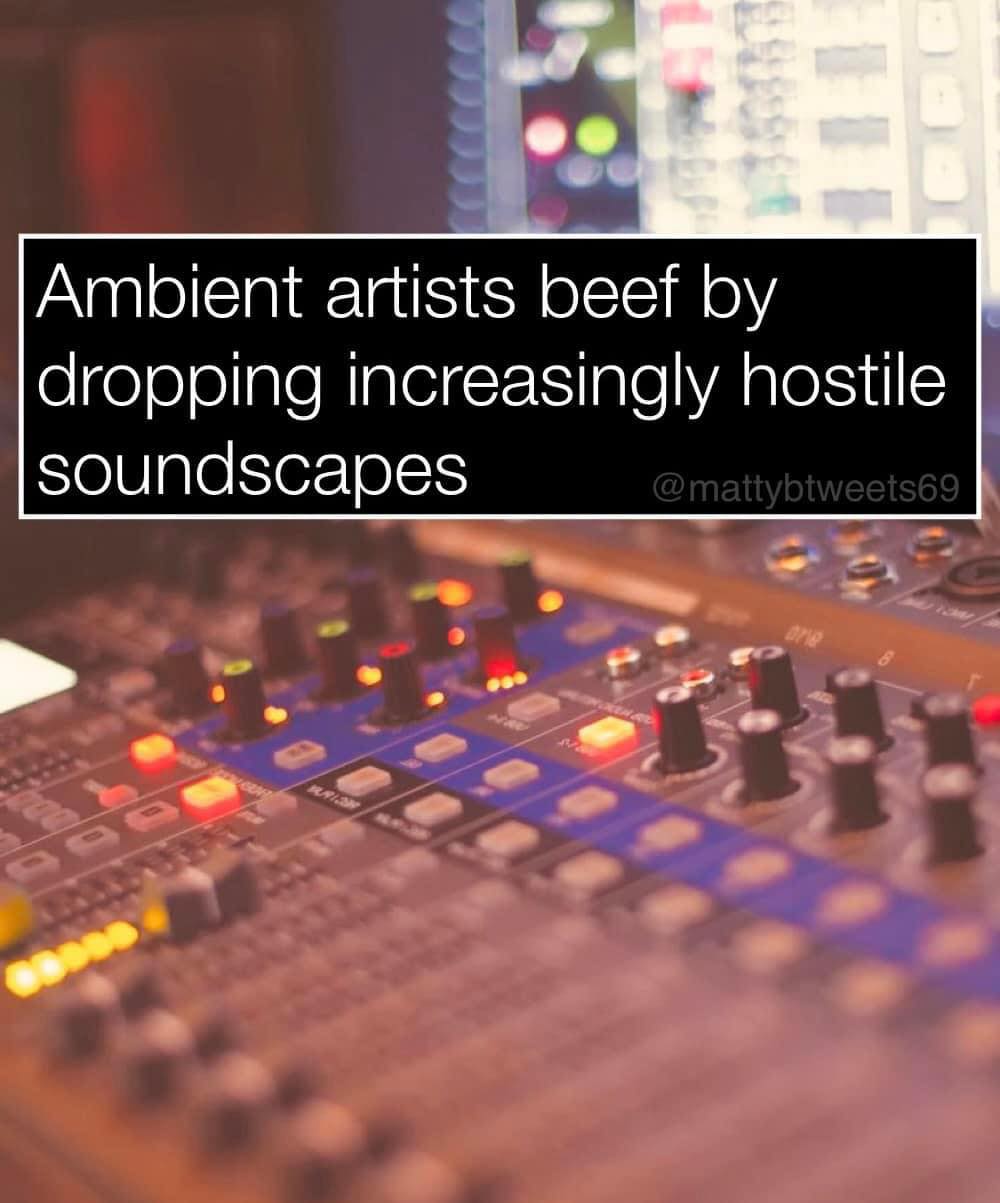
This meme uses a photo of a complex audio mixing board—a device musicians use to blend sound—to humorously explain a specific behavior in the music industry. The text overlaid on the image suggests that some ambient artists (people who usually create quiet, atmospheric music) get into a loud argument with each other. Instead of fading back into silence, they get into a "beef" by suddenly switching to incredibly loud, aggressive, and chaotic soundscapes, much like slamming knobs and buttons to make a noise.
simple-description (llama3.2-vision_11b)
The meme is a humorous take on the music industry, specifically the trend of artists releasing music that is more aggressive and intense, often referred to as "harder" or "heavier" than previous releases. The meme is captioned "drinking water" and features a picture of a musician or a music producer, but the actual image is not relevant to the caption.
detailed-analysis (gemma3-27b-vision)
Okay, here’s an analysis of the image, broken down into sections based on the requested theoretical frameworks. Note that some sections will be brief or non-existent, depending on the applicability to the image and its text.
1. Visual Description
The image is a close-up, somewhat blurred photograph focused on a DJ setup. We see a complex arrangement of knobs, buttons, sliders, and other controls characteristic of electronic music production and performance. The equipment is darkly colored, suggesting a nighttime or club environment. Bright, out-of-focus lights, primarily in blue, red, and yellow, are visible in the background, creating a sense of energy and dynamic atmosphere. The lighting contributes to a slightly chaotic, low-resolution aesthetic.
Superimposed over the image is a black box with white text that reads: “Ambient artists beef by dropping increasingly hostile soundscapes @mattybtweets69”. The text seems to be a tweet or social media post. The overall effect is one of an edgy, digitally-mediated scene.
2. Postmodernism
This image quite neatly encapsulates some aspects of postmodern thought. The blending of high and low culture – the sophisticated equipment of electronic music production presented alongside a slang-infused tweet – is a hallmark. The "beef" (a hip-hop term for a dispute) layered onto the refined art of ambient music is deliberately jarring. This juxtaposition challenges traditional hierarchies and expectations. The blurry, digitally-mediated aesthetic also mirrors the postmodern emphasis on simulation and hyperreality, where representation often precedes or overshadows the "real."
The self-referential nature of the text (referencing a social media handle) adds another layer of postmodernity. It’s a meta-commentary on the production and consumption of artistic conflict itself. The artist isn't just having a dispute; the dispute is being communicated via digital media, becoming part of the performance.
3. Marxist Conflict Theory
A rudimentary application of Marxist conflict theory can be attempted here. The "beef" between ambient artists could be seen as a microcosm of broader conflicts over cultural capital and artistic legitimacy. Ambient music, while often associated with relaxation and tranquility, has its own internal hierarchies and debates regarding authenticity, innovation, and genre boundaries. The conflict, even if seemingly frivolous, represents a struggle for dominance within the field.
The use of the term "hostile soundscapes" suggests a power dynamic where one artist is attempting to assert dominance through a confrontational aesthetic. The implication is that music is not simply aesthetic expression but a site of social struggle. However, this interpretation is fairly superficial; without more context, it's hard to establish a clear material basis for the conflict.
4. Foucauldian Genealogical Discourse Analysis
The text "Ambient artists beef" and the use of terms like "hostile soundscapes" can be analyzed through a Foucauldian lens. We can investigate how the discourse surrounding ambient music has evolved to include concepts of conflict, hostility, and even "beef."
A genealogical approach would trace the history of these terms and their deployment within the ambient music scene. How did the idea of a “beef” come to be associated with a genre historically known for its atmospheric and meditative qualities? What power dynamics are at play in framing musical differences as “hostile”?
Foucault would be interested in how these terms construct and regulate the field of ambient music, potentially establishing norms and boundaries that define what is considered “authentic” or “legitimate” music. The focus is not on individual intentions but on the systems of power embedded in language and discourse.
5. Critical Theory
Critical Theory allows us to examine the image within a broader context of social and cultural critique. The seemingly niche conflict between ambient artists can be seen as symptomatic of larger trends in contemporary society: the commodification of conflict, the blurring of boundaries between art and entertainment, and the increasing prevalence of online drama.
The image suggests a culture where even artistic expression is subject to the logic of competition and spectacle. The "beef" becomes a form of attention-seeking behavior, fueled by the demands of social media and the desire for recognition. Critical Theory would question the underlying power structures that incentivize this type of behavior and its implications for artistic integrity and meaningful communication.
6. Queer Feminist Intersectional Analysis
This is the least applicable area, and would require significant additional context. Without knowing the identities of the artists involved, it's difficult to apply a queer feminist intersectional analysis. However, one could hypothetically consider how gender, sexuality, race, or other marginalized identities might intersect with the dynamics of the conflict. Are certain artists being marginalized or silenced within the ambient music scene? Is the "hostility" of the soundscapes being used to reinforce existing power imbalances? Without more information, these questions remain speculative.
Let me know if you’d like me to expand on any of these sections or explore other theoretical perspectives.
tesseract-ocr
@ Ambient artists beef by dropping increasingly hostile soundscapes ed — = S - ee CO 7 “ ad ec . - aa _—e ce ie a am _~ a x a an a . oo 2? ~ ad - . 7 , — P= + al - — a baad ~ - a -
simple-description (llama3.2-vision)
The meme is a humorous commentary on the frustration of dealing with aggressive or annoying artists. The text "Ambient artists beef by dropping increasingly hostile soundscapes" is a tongue-in-cheek observation on the irony of artists who are known for their calming and peaceful music, yet are still capable of creating aggressive and hostile soundscapes.