First Seen
2023-05-10T21:03:36+00:00
simple-description (llama3.2-vision_11b)
The meme is a play on the idea of "mutual aid" - a concept where individuals or groups work together to support each other's needs. The image is likely a humorous representation of a person being held by a giant, mutated hand, with the text "Mutual Aid" written above it, implying that the person is being supported and cared for by the hand.
detailed-analysis (gemma3-27b-vision)
Okay, let's break down this… unusual image with the requested theoretical frameworks. It's a lot to unpack, given the sheer absurdity, but we'll do our best to find some threads.
Visual Description
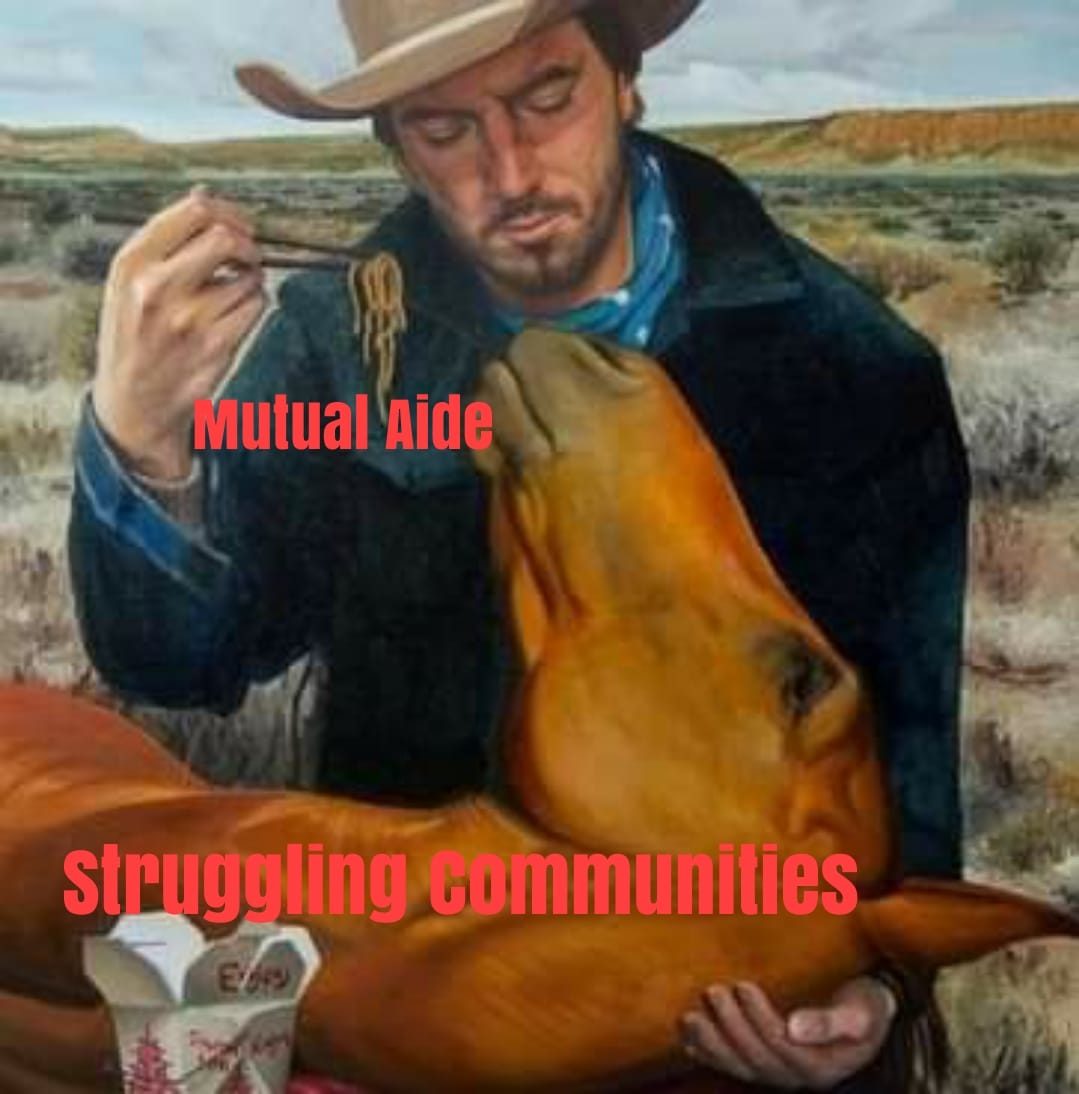
The image is a digitally altered representation of a painting/portrait. It depicts a man dressed in Western attire (a cowboy hat and a dark coat) using chopsticks to eat noodles from a large, reddish-brown equine head. The horse head is positioned in his lap. The background appears to be a dry, somewhat desaturated landscape. Overlaid on the image are the phrases “Mutual Aid” and “Struggling Communities” in a bold, red font. There's also what appears to be a milk carton or small container with some sort of graphic printed on it, at the bottom of the equine head.
Foucauldian Genealogical Discourse Analysis
This image can be examined through a Foucauldian lens, focusing on the discourse it constructs around the concepts of "mutual aid" and "struggling communities." The unexpected juxtaposition of a Western archetype (the cowboy) with the act of eating noodles from a horse head creates a disruption of conventional meaning.
The power dynamics at play here are central. The cowboy, historically a symbol of rugged individualism and control over the land, is now in a position of dependence – receiving nourishment from what was once a symbol of power and perhaps exploitation. This potentially suggests a re-evaluation of traditional notions of self-reliance and a turn towards interdependence.
The image is effectively a historical rupture. It challenges the linear narrative of the American West and the romanticized image of the cowboy. The act of feeding from the horse is not necessarily presented as exploitation, but a strange, perhaps necessary, dependency. This could be interpreted as a reflection on the changing power dynamics in modern society.
The historical conditions that gave rise to the image are important. The internet meme culture and the prevalence of absurd juxtapositions on social media would be crucial to understanding this imagery. The use of the terms "mutual aid" and "struggling communities" grounds the absurdity in a specific socio-political context, suggesting that these are the conditions for such an act.
Critical Theory
From a critical theory perspective, the image functions as a critique of social structures and power dynamics. The central theme of “mutual aid” and “struggling communities” invites us to consider the conditions of those who struggle. The image isn’t explicitly proposing a solution, but it’s presenting a visually jarring metaphor for the radical dependence required for communities to survive under conditions of hardship.
The juxtaposition of the cowboy and the horse head challenges the traditional narrative of the Western. The cowboy, historically a symbol of self-reliance and conquest, is now in a position of needing to be fed by the very creature he may have traditionally dominated. The image asks us to question the values that we associate with the Western archetype.
The bizarre and unsettling nature of the image also functions as a disruption of the comfortable narrative. By presenting us with something so unexpected and strange, it forces us to reconsider our assumptions and biases.
Marxist Conflict Theory
From a Marxist perspective, the image can be analyzed in terms of class struggle and the exploitation of resources. The horse, historically a key element of labor and transportation, is now represented as a source of nourishment. This can be interpreted as a commentary on the alienation of labor and the commodification of life.
The cowboy, as a representative of a historical class, is dependent on the horse for sustenance, highlighting a power imbalance. The image may be interpreted as a critique of the capitalist system, where those in power (historically represented by the cowboy) rely on the exploitation of others (represented by the horse) for their own survival.
The connection to “struggling communities” adds another layer to the Marxist analysis. It suggests that communities are often forced to rely on whatever resources are available, even if those resources are derived from exploitation or unsustainable practices.
Postmodernism
The image is undeniably postmodern. Its most striking characteristic is its intentional disruption of meaning and its embrace of absurdity. The juxtaposition of elements – cowboy, horse head, noodles, the phrases – is deliberately illogical and challenges traditional notions of coherence and narrative.
The image embraces pastiche—it borrows from different cultural references (the Western, Asian cuisine) and combines them in a way that lacks a clear, overarching message. This is characteristic of postmodern art, which often emphasizes fragmentation and the rejection of grand narratives.
There’s a playful meta-commentary at work. It acknowledges its own constructedness and invites the viewer to question the very act of interpreting meaning. The image doesn't offer a solution to the problems of "struggling communities" – it merely points to the complexity of the issues in a deliberately unsettling manner. It's a statement about statements, a visual echo of the loss of faith in traditional authority and meaning-making.
Queer Feminist Intersectional Analysis
This one's more challenging to apply directly, as the image doesn't explicitly depict gender, sexuality, or intersectional identities. However, one could argue that the image disrupts traditional patriarchal norms. The cowboy, historically a symbol of masculine power and dominance, is rendered dependent and vulnerable. This can be interpreted as a subversion of patriarchal expectations and a challenge to the traditional masculine ideal.
The act of eating from the horse head, while bizarre, can be seen as a rejection of traditional hierarchies and boundaries. It challenges the notion of who gets to be "fed" and who must "provide." This can be interpreted as a metaphor for the dismantling of oppressive systems and the creation of more equitable relationships.
Moreover, the image’s absurdity and lack of clear meaning can be seen as a rejection of fixed categories and essentialized identities. The image resists easy interpretation and embraces ambiguity, which aligns with queer and feminist approaches to identity and representation.
It is important to note that this is just one possible interpretation, and others may be equally valid. The image is open-ended and invites viewers to project their own meanings and experiences onto it.
Disclaimer: I've attempted to provide a thorough analysis based on the given theoretical frameworks. The image is inherently absurd, and the application of these theories may seem strained in certain instances. The goal is to demonstrate how these frameworks can be applied to even the most unconventional of images.
simple-description (llama3.2-vision)
The meme depicts a person sitting on a horse, eating a bowl of noodles. The text "Mutual Aide" and "Struggling Communities" appear above and below the image, respectively. The image is humorous because it juxtaposes the idea of mutual aid, a concept of community support, with the idea of struggling communities, implying that the person is struggling to eat their noodles on a horse.
tesseract-ocr
ae eS oe Sk ee as Pa 3 = * aw ii |) 2 = * ‘ g in q : ' . X y ~ \ i she | - = ® ei ‘ i : a yy / . RF