First Seen
2023-05-10T21:03:36+00:00
simple-description (llama3.2-vision_11b)
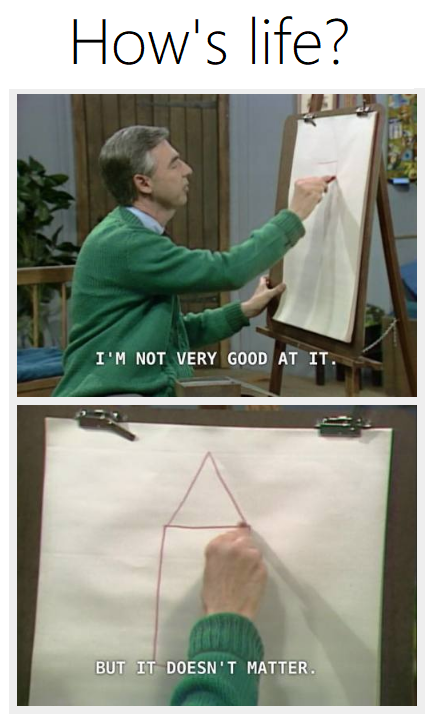
The meme is an image of a person (presumably a child) drawing a picture of a person, with a caption "I can draw a person" and a speech bubble "I'm not very good at drawing. I can draw a person." This meme is an example of Neo-Dadaism, a movement that challenges traditional notions of art and creativity by embracing imperfection and absurdity. The meme pokes fun at the idea of artistic skill and instead celebrates the child's simplicity and honesty.
detailed-analysis (gemma3-27b-vision)
Okay, let's analyze this Mr. Rogers meme through a few theoretical lenses. Given the content, certain sections will be more prominent than others.
Visual Description
The image is a two-panel meme featuring Mr. Rogers from his television show "Mister Rogers' Neighborhood."
- Panel 1: Mr. Rogers is depicted standing at an easel with a large blank piece of paper. He's in the process of drawing a somewhat lopsided, incomplete house shape. His body language appears slightly apologetic. Text reads: "I'M NOT VERY GOOD AT IT."
- Panel 2: The drawing is continuing and has progressed to resemble more of a completed house, still imperfect. His demeanor seems accepting. Text reads: "BUT IT DOESN'T MATTER."
The color palette is warm and inviting, typical of the show. The overall impression is gentle and reassuring.
Postmodernism
This meme deeply resonates with Postmodern sensibilities.
- Rejection of Perfection: The imperfect drawing embodies a rejection of the Modernist ideal of perfection, technical skill, and a singular "right" way of doing things. It challenges the idea that something must be well-executed to have value.
- Deconstruction of Skill: The meme playfully deconstructs the notion of "skill" itself. What does it mean to be "good" at something? The meme suggests that intention and process are more important than achieving a flawless result.
- Embrace of Subjectivity: The statement "it doesn't matter" is inherently subjective. It highlights that meaning and value are not fixed but are constructed by the individual (or the culture). The value isn't in the artistic merit of the drawing, but in the act of creation itself.
- Hyperreality & Simulation: The meme references an iconic moment, but in a distilled, shareable format. It creates a simulation of the warmth and acceptance found in Mr. Rogers' show, circulating a feeling without the full context of the program.
Critical Theory
Through the lens of Critical Theory, the meme can be viewed as a subtle critique of societal pressures around achievement and competence.
- Challenging Normative Standards: Society often places high value on competency and achieving results. This meme challenges that by normalizing imperfection and accepting effort regardless of outcome.
- Disrupting the "Productivity Myth": In a capitalist society obsessed with productivity, the meme offers a small moment of resistance. It suggests that inherent value exists in simply being and doing, without needing to produce something "useful" or "successful."
- Emotional Labor & Authenticity: Mr. Rogers was known for his authentic emotional engagement. The meme taps into that authenticity, contrasting it with the performative pressures of modern life, where we are often judged by our achievements rather than our genuine efforts.
In Summary: This meme is a deceptively powerful commentary on societal expectations. It encourages a shift in perspective – moving away from a relentless focus on outcomes and embracing the value of process, imperfection, and self-acceptance. It is this underlying message of acceptance that allows the meme to resonate so deeply.
Let me know if you'd like me to elaborate on any of these sections or analyze the meme from a different theoretical perspective.
simple-description (llama3.2-vision)
The meme is a screenshot from the 2019 film "A Beautiful Day in the Neighborhood" where the character of Mr. Rogers is speaking directly to the camera. The text on the image reads: "I don't know what it's like to live in your neighborhood. I don't know what it's like to be you. I don't know what it's like to live in your neighborhood." The image is then followed by the text: "I don't know what it's like to live in your neighborhood. I don't know what it's like to be you. I don't know what it's like to live in your neighborhood."
tesseract-ocr
14s How's life? v = Bs ~~ ZL I'M NOT VERY GOOD AT IT. Op,