First Seen
2023-05-10T21:03:36+00:00
simple-description (llama3.2-vision_11b)
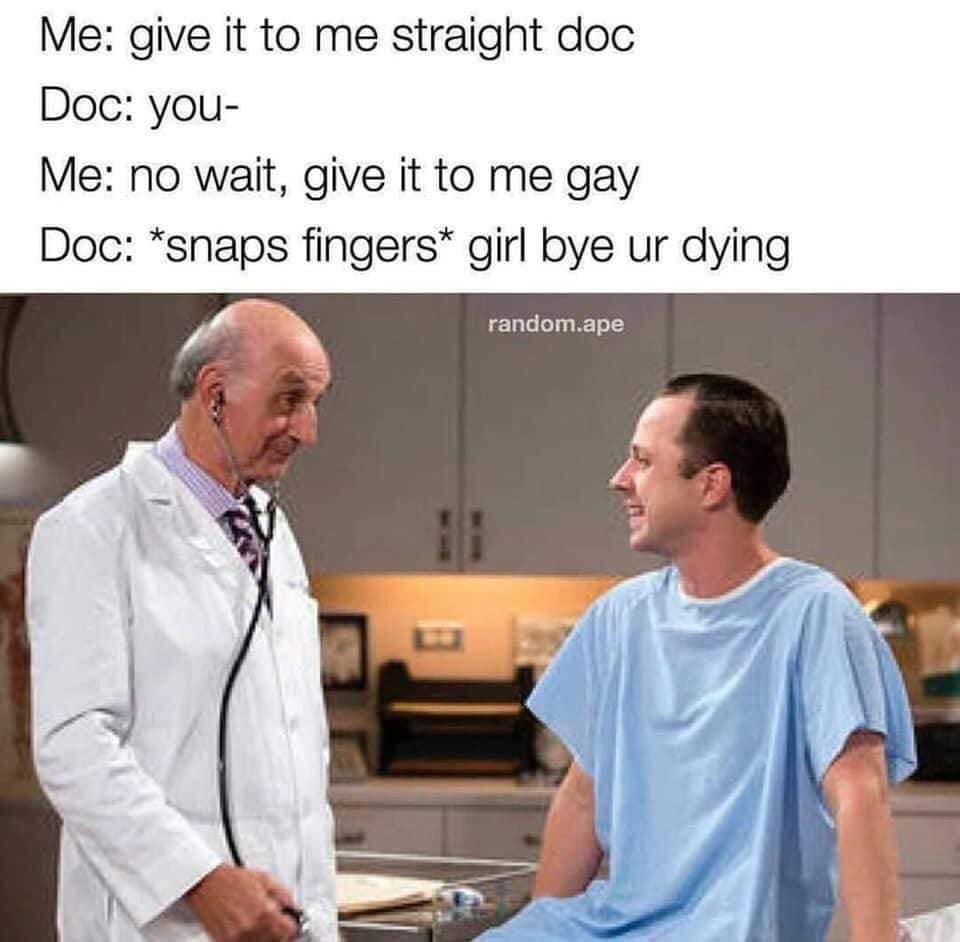
The meme is a playful take on the "I can explain it better than a doctor" trope, but with a twist. The image shows a doctor explaining a complex medical concept to a patient, but the patient is only interested in getting a prescription for a specific medication. The text "explain like I'm 5" is often used in this context, but here it's "explain like I'm 5" is replaced with "explain like I'm a toddler who just watched a horror movie" to add a layer of humor.
detailed-analysis (gemma3-27b-vision)
Okay, let's break down this meme with the requested theoretical lenses. It's a rich piece, surprisingly, for a quick internet joke.
Visual Description
The image is a still from a television show, likely a medical drama. It depicts an older, white male doctor standing over a younger, white male patient seated on an examination table. The patient is wearing a hospital gown. The doctor is visibly looking down at the patient with a slightly stern or disaffected expression. The setting appears to be a doctor's office or examination room. The text overlay creates a humorous dialogue, the premise being a request regarding the way information or medical intervention is delivered. The watermarks show it is from a source called “random.ape”.
Queer Feminist Intersectional Analysis
This is where the meme gets its most compelling complexity.
- Deconstructing Medical Power Dynamics: The dialogue immediately establishes an imbalance of power: the doctor holds authority, and the patient is vulnerable. Traditionally, medical spaces have been sites of control over bodies, often with little patient agency. This meme parodies that power imbalance.
- Subverting Expectations of "Straight" and "Gay": The patient’s request to "give it to me gay" is not about sexual orientation in the traditional sense, but a request for a certain manner of delivery or approach. This is immediately funny because it inverts how we typically understand sexuality. It forces us to think about how presentation can be coded as "masculine" (straight) or "feminine" (gay), and the patient wants an expression that is not traditionally "masculine".
- The Doctor’s Dismissive Response & Power: The doctor’s abrupt snap and “girl bye ur dying” is deeply cutting. It's an immediate rejection of the patient’s agency and the possibility of a different mode of engagement. This rejection is a display of power—the doctor, as the authoritative figure, refuses to play along. Furthermore, the phrase "girl bye" is coded as a feminine dismissal—suggesting a rejection of not only the request but a rejection of any association with femininity.
- Intersection of Gender & Power: The meme touches upon gender performativity. The doctor's refusal suggests a rigid adherence to traditional gender roles and expectations within the medical setting. The patient's request challenges those norms.
- Critique of Care: The meme can also be viewed as a critique of medical care where patient needs are not considered, and patient agency is not given.
Foucauldian Genealogical Discourse Analysis
- Discourse of Medical Authority: Foucault’s work highlights how discourses (ways of speaking, thinking, and knowing) create power relations. In the medical field, a discourse of expertise and objectivity has historically been used to control and define bodies. The doctor’s abrupt response in the meme reinforces this discourse. The doctor's response is a display of authority.
- The Creation of "Normal" and "Deviant": The meme plays with the idea of what is considered "normal" or acceptable within the context of medical interactions. The patient's request, while seemingly humorous, challenges the presumed "norm" of professional, detached medical delivery.
- Power/Knowledge: Foucault argues that power and knowledge are inseparable. The doctor's authority comes from their knowledge, and this knowledge is used to maintain control. The patient's attempt to renegotiate the terms of that power relationship is quickly shut down.
- Genealogy: Tracing the historical evolution of medical practices, we see a move toward a more detached, clinical approach. The doctor's response exemplifies this history, suggesting a rejection of any perceived "softness" or individualized approach to care.
Critical Theory
- Deconstruction of Dominant Narratives: The meme subverts the traditional doctor-patient narrative, questioning the inherent power dynamics. The patient attempts to disrupt the accepted protocol, demanding a different mode of engagement.
- Ideology and Control: The doctor’s dismissive response can be seen as reinforcing an underlying ideology of medical authority and control. The doctor refuses to engage with the patient's request, maintaining the status quo.
- Critique of Institutional Power: The meme subtly critiques the institutional power structures within the medical field and the way they can be insensitive or unresponsive to patient needs.
Postmodernism
- Playfulness and Parody: The meme's humor comes from its playful deconstruction of expectations. It takes a serious context (a medical consultation) and injects absurdity.
- Rejection of Grand Narratives: Postmodernism challenges overarching "truths" and universal explanations. The meme rejects the idea that there is only one "right" way to deliver medical information.
- Intertextuality: The image itself is drawn from a pre-existing cultural artifact (the TV show), and the meme layers additional meaning onto that base.
Marxist Conflict Theory
This lens is the weakest fit, but can still be applied to a lesser extent.
- Power Imbalance: Marxist theory focuses on class conflict, but the meme demonstrates a power imbalance—the doctor represents an institution with control over the patient’s well-being. The patient attempts to assert agency within this power structure, albeit through a humorous request.
- Ideology & Control: The doctor’s response can be seen as reinforcing the dominant ideology of medical authority and control, maintaining the status quo.
In conclusion, this meme is surprisingly layered and touches on several complex themes related to power, gender, sexuality, and institutional authority. Its humor comes from its subversion of expectations and its critique of established norms. The strongest analytical lenses for understanding it are Queer Feminist Intersectional Analysis, Foucauldian Discourse Analysis, and Critical Theory.
simple-description (llama3.2-vision)
This meme is a humorous take on a doctor-patient conversation. The image shows a doctor and a patient, with the doctor saying "In 2-3 sentences, describe this meme for someone who cannot see it." The text on the image reads: "Me: give it to me straight doc / Doc: you- / Me: no wait, give it to me gay / Doc: snaps fingers girl bye ur dying".
tesseract-ocr
Me: give it to me straight doc Doc: you- Me: no wait, give it to me gay Doc: “snaps fingers* girl bye ur dying yn Y random.ape + a sy 3 » " Ss ; ‘a ; p aa —— {