First Seen
2023-05-10T21:03:36+00:00
simple-description (llama3.2-vision_11b)
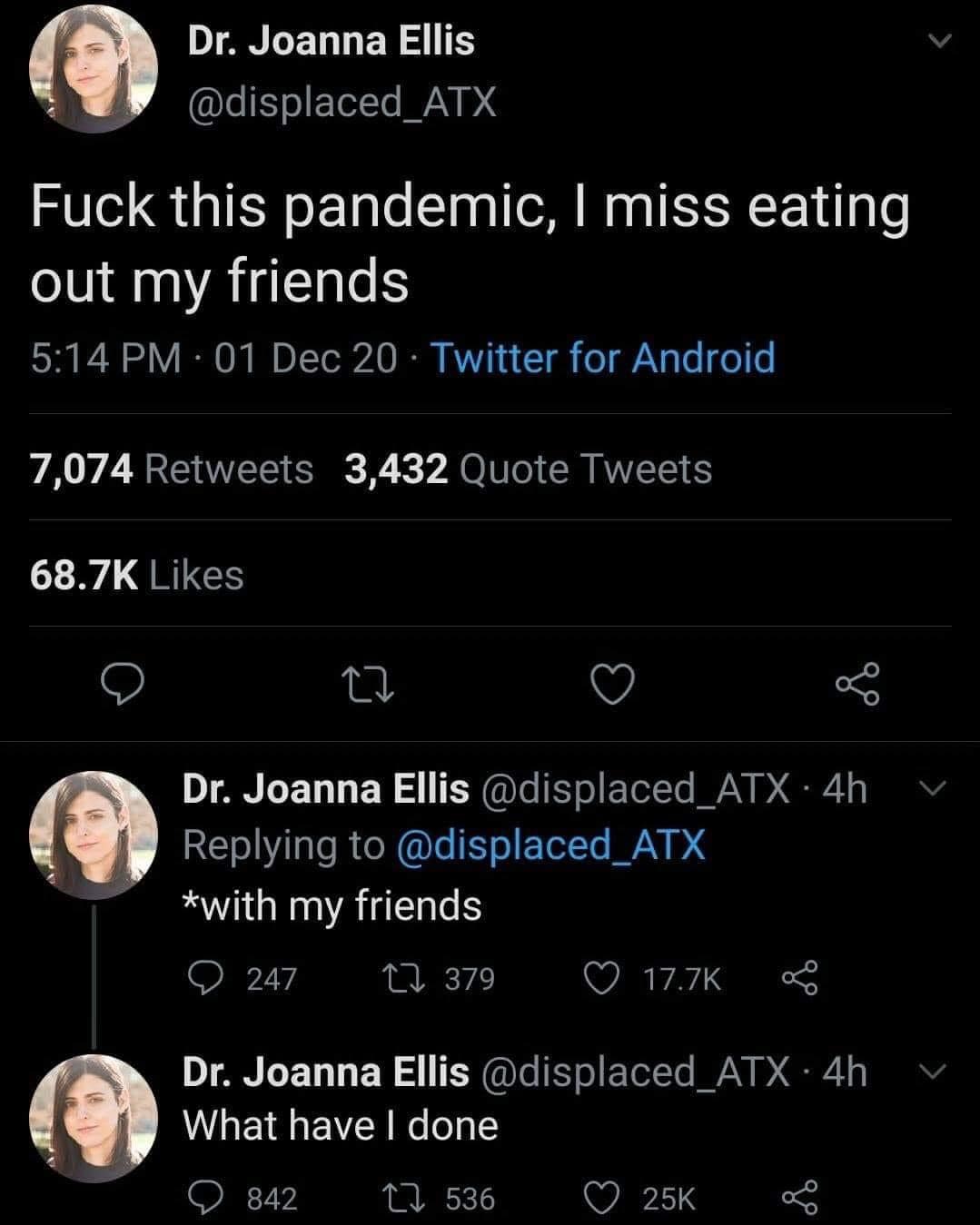
The meme is a screenshot of a Twitter post from a user named @NeoDadaism, which is a parody account that explores the intersection of art and absurdity. The post reads: "I'm not saying I'm a genius, but I just spent 3 hours making a 30-second video of myself eating a sandwich. I'm not saying it's a masterpiece, but it's a 30-second video of myself eating a sandwich." The meme is a commentary on the absurdity of modern life, where people are encouraged to share their mundane experiences on social media, and the value of art is often reduced to a clickbait headline.
detailed-analysis (gemma3-27b-vision)
Okay, let's break down this Twitter thread from Dr. Joanna Ellis (@displaced_ATX) through various theoretical lenses.
Visual Description
The image presents a screenshot of a Twitter thread. There are three tweets by the same user (@displaced_ATX) visible. Each tweet features a small circular profile picture of a person, identified as Dr. Joanna Ellis. Beneath each tweet are icons representing replies, retweets, likes and shares, accompanied by numeric counts indicating engagement. The timestamps for the initial tweet are December 1st, 2020, while the subsequent two tweets occurred approximately 4 hours later. The format is typical for Twitter, presenting a quick, conversational, and publicly accessible form of communication. The overall aesthetic is simple and functional, prioritizing text-based engagement.
Foucauldian Genealogical Discourse Analysis
This thread offers a surprisingly fertile ground for a Foucauldian analysis.
- Discourse on “Normal” Sociality: The initial tweet ("Fuck this pandemic, I miss eating out with my friends") implicitly defines a prior “normal” based around the act of dining out with friends. This “normal” is not neutral. It’s part of a larger discourse constructed around socializing, consumerism, and the expectation of shared experiences in public spaces. The pandemic disrupts this discourse, highlighting its constructed nature.
- Power/Knowledge & Biopower: The pandemic itself is a manifestation of biopower – the exercise of power over life, through regulations, restrictions, and public health measures. The tweet can be interpreted as a response to this power, a lament for a previously unproblematic aspect of life now subject to control. The feeling of loss is tied to the disruption of established biopolitical norms.
- Genealogy of 'Socializing': A genealogical approach would trace the historical development of “socializing” as a practice. When did dining out become a dominant form of social interaction? What economic and cultural forces shaped this trend? The tweet reveals the taken-for-granted nature of this practice and its vulnerability to disruption. The response to this vulnerability is a longing for a lost past, suggesting that even the act of gathering for food is more complex than it seems.
- The 'Self' and Discipline: The speaker’s expression of frustration (“Fuck this pandemic”) can be seen as a moment of subjectivation – a moment where the individual articulates their experience within the broader power structures of the pandemic.
Critical Theory
This thread can be interpreted through the lens of the Frankfurt School’s Critical Theory.
- Commodification of Social Life: The initial desire to eat "out" points to a broader critique of how capitalism has commodified social life. Dining out is not simply about sustenance but is intertwined with consumption, leisure, and entertainment. The pandemic's disruption highlights the dependence on these commodified experiences for social connection.
- Alienation & Loss of Authenticity: The longing for pre-pandemic social interactions could be read as an expression of alienation. The pandemic has severed ties, creating a sense of isolation and a loss of genuine connection. The desire to "eat out" can be seen as a desire for a return to a perceived “authentic” social experience, before the intrusion of restrictions and social distancing.
- The Culture Industry: The tweet subtly critiques the role of the "culture industry" (restaurants, entertainment venues) in shaping our desires and expectations. The loss of access to these institutions creates a void that is keenly felt.
- Ideology of 'Normalcy': The tweet’s underlying assumption of a “normal” pre-pandemic state reinforces a dominant ideology that prioritizes certain forms of social interaction (consuming in public spaces) while overlooking others.
Marxist Conflict Theory
A Marxist reading focuses on class and economic disparities.
- Unequal Impact of the Pandemic: The ability to “eat out” is a privilege tied to economic status. The pandemic disproportionately impacts working-class and marginalized communities, who are more likely to experience job loss, food insecurity, and limited access to safe dining options. The tweet, while seemingly universal, implicitly centers the experience of those with disposable income.
- Capitalist Crisis & Control: The pandemic can be seen as a manifestation of the inherent contradictions of capitalism – a crisis of overproduction and accumulation. The restrictions on dining are part of an attempt to control the spread of the virus and protect the capitalist system.
- Labor Exploitation: The restaurant industry is notorious for its low wages and precarious working conditions. The pandemic exacerbated these problems, leading to mass layoffs and increased vulnerability for restaurant workers. The desire to "eat out" ignores the labor behind these experiences.
- False Consciousness: The longing for pre-pandemic “normalcy” can be interpreted as a form of false consciousness – a lack of awareness of the systemic inequalities that underlie the crisis.
Postmodernism
A postmodern interpretation emphasizes fragmentation, subjectivity, and the collapse of grand narratives.
- Rejection of Grand Narratives: The tweet doesn’t offer a sweeping critique of society or a vision for the future. It’s a fragmented expression of personal experience – a moment of longing in a chaotic world. This aligns with the postmodern rejection of grand narratives and universal truths.
- Subjectivity & Personal Experience: The tweet prioritizes subjective experience over objective reality. The speaker’s feelings are central, and there’s no attempt to generalize or universalize them.
- Simulation & Hyperreality: The desire to “eat out” can be seen as a longing for a simulated experience – a perfectly curated social encounter that masks underlying anxieties and inequalities.
- Deconstruction of 'Normal': The disruption of dining by the pandemic deconstructs the notion of "normal" social life. It reveals that there is no fixed or essential way of being, only a constantly shifting series of interpretations and practices.
Queer Feminist Intersectional Analysis
This is where it gets interesting, and a bit more subtle.
- Sociality & Care: Queer and feminist theories emphasize the importance of care, community, and non-normative forms of social connection. The desire to “eat out” could be read as a longing for a specific form of care – the ritual of sharing a meal with friends. This desire, however, is inherently linked to consumerism and economic privilege.
- Intersectionality & Unequal Access to Social Connection: The ability to "eat out" is not equally accessible to all. Factors such as race, class, gender, disability, and immigration status can all create barriers to social connection.
- Challenging Heteronormative Social Scripts: The act of dining out is often associated with heteronormative social scripts (dates, family gatherings). A queer feminist analysis might question these scripts and explore alternative forms of social connection that are more inclusive and equitable.
- The Body & Embodied Experience: Sharing a meal is an embodied experience. A feminist analysis might explore how the pandemic has disrupted our relationship to our bodies and our ability to connect with others through physical presence.
In conclusion, this seemingly simple tweet offers a rich tapestry of theoretical possibilities. Each lens illuminates different aspects of the speaker’s experience and the broader social context. By applying these frameworks, we can move beyond a superficial understanding of the tweet and gain deeper insights into the complex forces that shape our lives.
simple-description (llama3.2-vision)
The meme is a screenshot of a Twitter post from a user named "Dr. Joanna Ellis" (not a real doctor, but a Twitter handle). The post reads: "F**k this pandemic, I miss eating out with my friends. I'm going to miss this pandemic when it's over." The post is sarcastic and humorous, expressing frustration and longing for normal life during the COVID-19 pandemic.
tesseract-ocr
Dr. Joanna Ellis v , @displaced_ATX Fuck this pandemic, | miss eating out my friends 5:14 PM - 01 Dec 20 - Twitter for Android 7,074 Retweets 3,432 Quote Tweets 68.7K Likes 9) tT W) a Dr. Joanna Ellis @displaced_ATX:4h_ v Replying to @displaced_ATX maa VAIN a) mie (= aes © 247 TQ 379 Ove. aa Dr. Joanna Ellis @displaced_ATX:-4h_ { What have | done ~ © 842 TQ 536 Oli. rd