First Seen
2023-05-10T21:03:36+00:00
simple-description (llama3.2-vision_11b)
The meme is a play on the concept of Neo-Dadaism, a movement that challenges traditional notions of art and culture. The image depicts a group of people in a workplace, with one person holding a sign that reads "I'm not a morning person" while another person is dressed in a suit and holding a coffee cup. The text overlay reads "when you're trying to adult but your brain is still on summer vacation" and "I'm not a morning person, I'm a night person, I'm not a person at all." The meme pokes fun at the idea of trying to be a responsible adult, but ultimately failing to meet those expectations.
detailed-analysis (gemma3-27b-vision)
Okay, let's break down this image/meme through the lenses of the theoretical frameworks you requested. I'll include sections only where relevant.
Visual Description
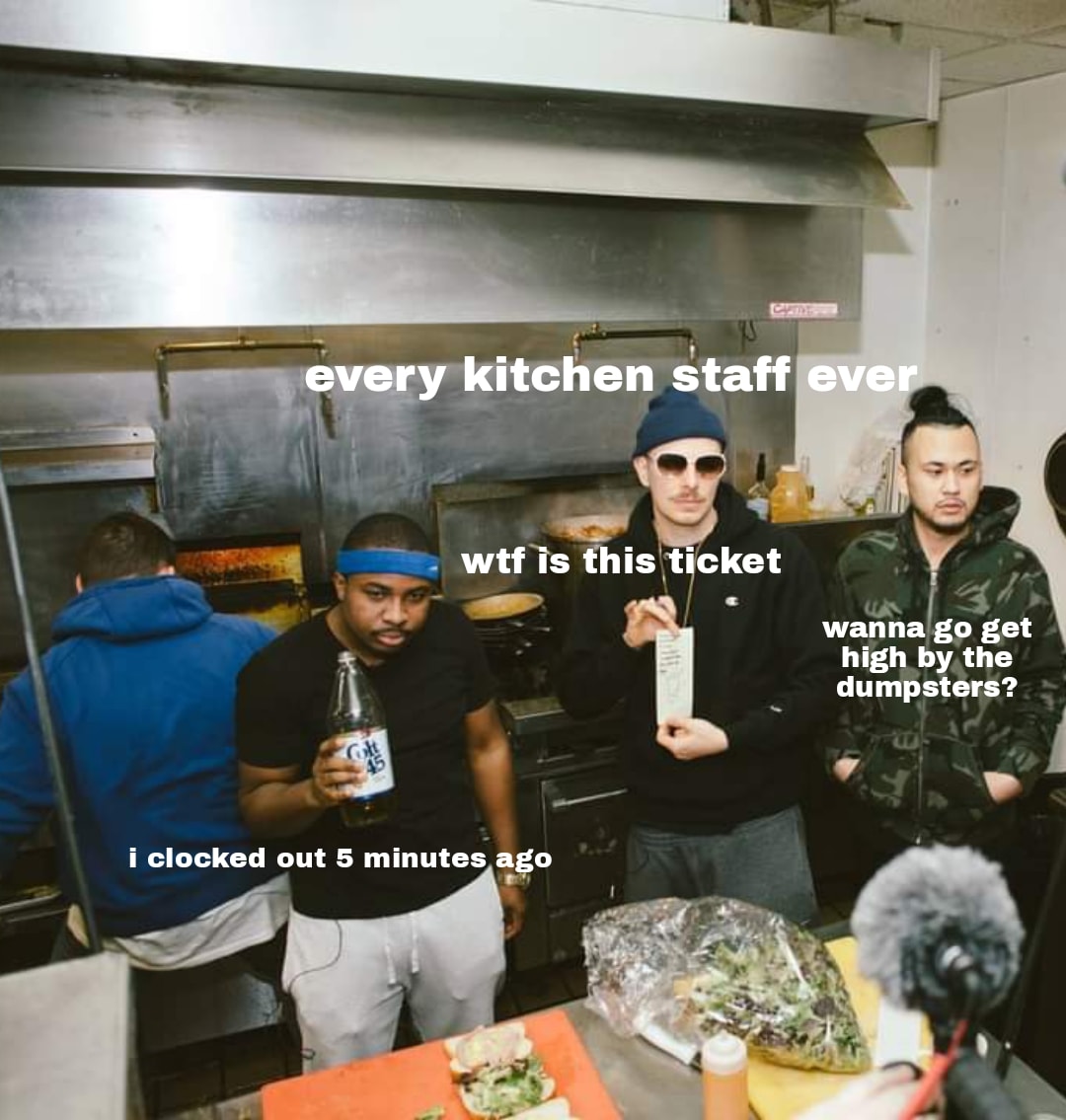
The image appears to be a photograph taken in a professional kitchen, possibly a restaurant. The lighting is harsh fluorescent, typical of such spaces. There are four men visible, seemingly kitchen staff, gathered around a counter. They are all dressed in varying degrees of work attire – some wearing hats/bandanas, others more casual tops. One man is holding a kitchen order ticket. The counter is cluttered with a partially-filled container of food (possibly salad). There’s a large, stainless steel hood over cooking equipment in the background, emphasizing the industrial nature of the location. The image has overlaid text which functions as a meme caption. The captions suggest a sense of exhaustion, disillusionment, and a dark humor among the kitchen staff. The phrases ("wtf is this ticket?", "wanna go get high by the dumpsters?", "i clocked out 5 minutes ago") imply a shared experience of burnout and a desire to escape the monotony/stress of their work. The meme caption “every kitchen staff ever” indicates a broad generalization, aiming for relatable humor.
Foucauldian Genealogical Discourse Analysis
This image offers a fascinating entry point for a Foucauldian analysis. The kitchen itself functions as a site of power. Within the kitchen, a strict hierarchy exists, likely enforced through detailed standard operating procedures and a division of labor. This is not simply about “who’s in charge” but the construction of disciplinary power.
- Discipline: The order ticket is a key component of this discipline. It's a manifestation of surveillance. Someone, somewhere (the server, the manager), is expecting something, and this ticket is the means of tracking, controlling, and evaluating the staff's work. It represents the systematization of labor.
- Genealogy: Looking at the "genealogy" of the order ticket—tracing its historical development—reveals how kitchen work has become increasingly codified and controlled. The ticket is not simply a communication tool; it’s a product of the historical development of the restaurant industry, efficiency protocols, and the desire for optimized production.
- Power/Knowledge: The staff's questioning of the ticket ("wtf is this ticket?") is a subtle form of resistance. They are challenging the authority embedded in the system. Their exhausted, sardonic humor represents a way of reclaiming some agency within a highly regulated environment. They know the system, they participate in it, but they also express a cynical distance from it.
- Panopticism: The kitchen, with its open layout and constant surveillance from supervisors or even the expectation of being observed by colleagues, can be seen as a miniature Panopticon. The staff internalize the expectation of being watched, leading to self-regulation and a sense of being constantly assessed.
Marxist Conflict Theory
From a Marxist perspective, this image encapsulates the alienation of labor inherent in capitalist systems.
- Exploitation: The kitchen staff are engaged in producing value (food) for someone else (the restaurant owner). They are paid wages, but those wages likely represent only a fraction of the value they create. This is the fundamental basis of exploitation.
- Alienation from the Product: The staff don’t own the food they prepare, nor do they have any real control over the final product. They are disconnected from the creative process and reduced to cogs in a machine.
- Alienation from the Process: The repetitive, demanding nature of kitchen work, combined with the pressure to perform quickly and efficiently, leads to alienation from the work itself. The exhaustion and cynicism displayed in the image are direct symptoms of this.
- Class Consciousness (or lack thereof): The caption ("every kitchen staff ever") suggests a shared experience of exploitation, hinting at a potential for class consciousness. However, the humor and desire for escapism (getting high by the dumpsters) could also be seen as a form of false consciousness, a way of coping with exploitation rather than challenging it.
Postmodernism
The image leans into postmodern aesthetics through its fragmented, ironic, and self-aware tone.
- Meta-narratives: The meme format itself is a rejection of grand narratives. It’s a bite-sized commentary on a specific experience, rather than a sweeping claim about reality.
- Irony and Pastiche: The combination of exhausted facial expressions, the mundane setting, and the absurd suggestion of getting high by the dumpsters creates a sense of ironic detachment. It’s a playful, cynical commentary on the absurdity of work life.
- Simulation & Hyperreality: The meme doesn’t present a "real" depiction of kitchen staff; it’s a representation of a representation—a hyperreal image designed for social media consumption. It's a staged, stylized portrayal of a shared experience.
- Deconstruction: The image implicitly deconstructs the romanticized notion of kitchen work as a creative, passionate endeavor. It reveals the often-gritty, exhausting, and demoralizing reality.
Let me know if you'd like me to elaborate on any of these points or explore other theoretical frameworks!
simple-description (llama3.2-vision)
This meme is a photo of a group of people in a kitchen, with text overlaid on top of them. The text reads: "every kitchen staff ever" and "i clocked out 5 minutes ago" and "i'm not doing anything". The meme is a humorous commentary on the monotony and frustration of working in a kitchen, and the text is likely meant to be relatable and humorous to those who have experienced similar situations.
tesseract-ocr
— Xs i 0 = edit = ste ff a i ‘|. game — | Hi a3 a ‘\ #4 Za” ee J al bie eo en Aim) a a ‘ y i aS, _-< ettl © Be \ be ad é me i _ dumpsters? at] —_ 4 e Re eccCR ae tc) tg ; aay. Zt Pe Oe a - i —_ 7 Me ry ' io oof, a oa a att »—