First Seen
2023-05-10T21:03:36+00:00
simple-description (llama3.2-vision_11b)
The meme is a humorous comparison between two fictional characters, Spider-Man and Doctor Who, with the text "The difference between Spider-Man and Doctor Who is like the difference between a superhero and a time-traveling alien" appearing below.
detailed-analysis (gemma3-27b-vision)
Okay, let's break down this meme featuring Tom Holland and Tom Hollander, and then explore potential theoretical frameworks that could be applied to it.
Image Description
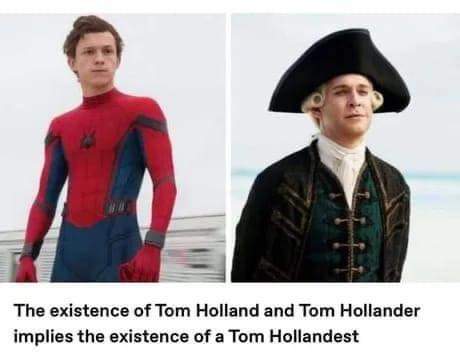
The image is a side-by-side comparison of two actors:
- Left: Tom Holland, dressed in his Spider-Man costume. The costume is predominantly red and blue, with intricate web detailing. He looks directly at the camera with a focused, earnest expression.
- Right: Tom Hollander, dressed in an 18th-century naval uniform (likely portraying a character from a historical drama or adaptation like the BBC series "Poldark" or a similar period piece). He has a serious, almost haughty expression, and his gaze is off-camera.
The text overlay reads: "The existence of Tom Holland and Tom Hollander implies the existence of a Tom Hollandest."
Critical Theory
This meme touches on the idea of the "phantasm" – a concept explored within critical theory, particularly by thinkers like Jacques Lacan. The meme doesn't present a 'real' Tom Hollandest, but rather an idea of him that emerges from the juxtaposition of the two existing actors. This 'Tom Hollandest' is a conceptual void, a desired (or perhaps absurd) completion of a perceived pattern. It functions as a signifier pointing toward something that doesn't, and arguably can't, exist.
The meme relies on pattern recognition and the human tendency to complete sequences. It’s an instance of the human mind seeking closure or 'meaning' even in arbitrary pairings. This illustrates the inherent instability of meaning—meaning is not inherent in things, but is constructed through the systems we impose upon them.
Foucauldian Genealogical Discourse Analysis
Applying a Foucauldian lens, we can examine the discourse around celebrity and naming. The meme isn't just about two actors; it's about how we categorize and name people, how we create systems of classification. The expectation of a 'Tom Hollandest' arises from the way we organize information, and the urge to find a pattern in these names and faces.
The meme's humor is derived from a perceived logical flaw within this system. This calls attention to the power inherent in naming and categorization. Who decides what constitutes a "complete" set? The meme disrupts that established order by introducing an absurd logical necessity, highlighting the arbitrariness of these systems. It's a tiny act of resistance against the imposition of categorization.
Postmodernism
This meme is very postmodern in its approach. It revels in the absurdity of the non-existent “Tom Hollandest.” Postmodernism rejects grand narratives and embraces fragmentation, irony, and pastiche. The meme deconstructs the notion of a coherent identity or logical progression. The lack of a "Tom Hollandest" isn't a problem to be solved; it is the point.
The meme functions as a kind of simulacrum—a copy without an original. “Tom Hollandest” has no real referent, only the reference to the two existing actors. It is a sign pointing to a void, a representation with no grounding in reality. This echoes a key postmodern concept—the blurring of lines between reality and representation.
Queer Feminist Intersectional Analysis
While not immediately obvious, a queer feminist reading could explore how the meme subtly plays with expectations and binaries. The creation of a "missing" Tom Hollandest (which is a construction of desire for "completion") can be seen as mirroring broader societal pressures to conform to normative categories. Just as the meme expects a third "Tom," society often expects individuals to fit neatly into defined roles or categories. The absurdity of the expectation highlights the constructed nature of these norms and the violence done to those who don't fit in.
It's important to note that this is a somewhat stretched reading, but the underlying principle—the questioning of imposed categories and the celebration of the incomplete—resonates with queer feminist thought.
Let me know if you'd like me to elaborate on any of these perspectives or explore a different theoretical lens!
simple-description (llama3.2-vision)
The meme is a humorous comparison between two actors, Tom Holland (who plays Spider-Man) and Tom Hiddleston (who plays Loki). The text at the bottom of the image reads: "The existence of Tom Holland and Tom Hiddleston proves the existence of a Tom Hollander, therefore the existence of Tom Holland and Tom Hiddleston implies the existence of a Tom Hollander." The meme is making a tongue-in-cheek joke about the absurdity of its own logic.
tesseract-ocr
& = ee f f . i —| i The existence of Tom Holland and Tom Hollander implies the existence of a Tom Hollandest