First Seen
2023-05-10T21:03:36+00:00
simple-description (llama3.2-vision_11b)
The meme is a play on the concept of Neo-Dadaism, a art movement that emerged in the 1950s, characterized by the rejection of traditional aesthetic values and the use of everyday objects as art. The meme is a humorous example of this concept, using the text "I can see for miles" (a reference to the song by The Proletarians) to create a surreal and absurd image, juxtaposing a mundane setting with a grandiose statement. The image shows a man standing on a hill, looking out at a vast landscape, with the text "I can see for miles" written in a bold, playful font.
detailed-analysis (gemma3-27b-vision)
Okay, here's an analysis of the provided image (a Twitter post by @smalredboy) broken down into the requested theoretical lenses. I'll indicate where a lens doesn't fully apply, and focus on the areas where it's most relevant.
Visual Description
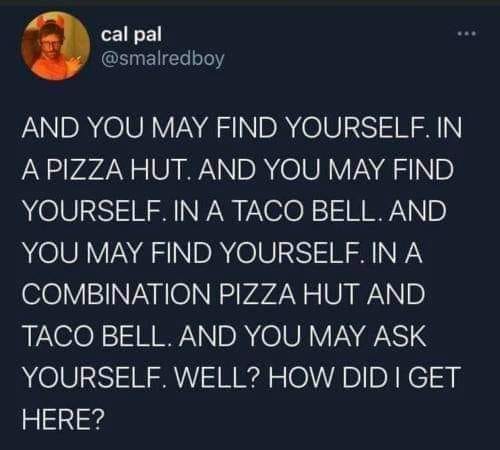
The image is a screenshot of a Twitter post with a dark background. The top left corner displays a circular profile picture with a person wearing a red outfit. Below it is the Twitter handle "@smalredboy." The bulk of the image is text, formatted as a repetitive, slightly disorienting statement:
"AND YOU MAY FIND YOURSELF. IN A PIZZA HUT. AND YOU MAY FIND YOURSELF. IN A TACO BELL. AND YOU MAY FIND YOURSELF. IN A COMBINATION PIZZA HUT AND TACO BELL. AND YOU MAY ASK YOURSELF. WELL? HOW DID I GET HERE?"
The text is all caps, contributing to a sense of urgency or existential questioning. The use of repetition emphasizes a state of being lost or disoriented.
Postmodernism
This image is strongly saturated with postmodern themes. Here’s why:
- Fragmentation & Repetition: The repetitive structure echoes a postmodern rejection of grand narratives and linear progression. It mimics the experience of being overwhelmed by choices and information. The constant "AND YOU MAY FIND YOURSELF" creates a sense of endless deferral – never arriving at a definitive “self” or location.
- Hyperreality & Simulation: The image plays with the idea that our experiences are increasingly mediated through simulations (consumer culture, brand identities). Being “found” in a Pizza Hut or Taco Bell isn’t about a genuine geographical location, but about being situated within a network of cultural signs and consumer desires. The "combination" location is a further step towards the simulated, blurring the lines of what is real.
- Loss of Authenticity: The question "HOW DID I GET HERE?" implies a loss of agency and a sense of being adrift in a system beyond one's control. The emphasis is on being found rather than making a conscious choice.
- Parody of Self-Help: The phrase "AND YOU MAY FIND YOURSELF" is a clear reference to the Talking Heads song "Once in a Lifetime," a song that itself is a philosophical pondering on the nature of existence. The tweet appropriates this phrase and applies it to the mundane settings of fast-food restaurants, creating a humorous and ironic commentary on the modern condition.
Foucauldian Genealogical Discourse Analysis
Foucault's work focuses on the relationship between power, knowledge, and discourse. The image, viewed through this lens, can be seen as a commentary on the disciplining forces of consumer culture:
- Discipline & Normalization: Pizza Hut and Taco Bell are not just places to eat, but sites where norms and expectations about consumption are enforced. They represent a particular way of life, a specific set of desires and values. Being "found" in these locations can be seen as a form of subtle social control – fitting into a predefined pattern.
- Power/Knowledge: The fast-food industry wields power through its ability to shape our desires and preferences. This power is not based on coercion, but on the creation of a "knowledge" system that equates happiness with consumption.
- Genealogy of the Self: The question “HOW DID I GET HERE?” invites a genealogical investigation. Where did the desire for fast food come from? How has consumer culture shaped our identities? Foucault would suggest that the "self" is not a pre-existing entity, but a product of historical forces and social practices.
Critical Theory
The image has clear links to the Frankfurt School’s critique of mass culture. The key themes include:
- The Culture Industry: Pizza Hut and Taco Bell are exemplary of the “culture industry” – the standardized, mass-produced goods and experiences that numb the senses and discourage critical thinking. The repetition of the locations emphasizes this standardization.
- False Consciousness: Being lost in these locations could be seen as a form of “false consciousness” – a state where individuals are unaware of the forces that are shaping their lives. The individual is caught in a cycle of consumption without questioning its purpose.
- Reification: The locations become "reified" – treated as things in themselves, rather than as products of social relations. The focus shifts from the human needs that the restaurants are supposed to fulfill to the restaurants themselves as commodities.
Queer Feminist Intersectional Analysis
While not the primary focus, an intersectional reading can offer some insight.
- Spatial Politics: Fast food restaurants, as public spaces, often have complex spatial politics. They can be sites of social interaction, but also of surveillance and exclusion. The image could be interpreted as a commentary on who feels "at home" in these spaces.
- Consumerism & Identity: The ways we consume are often linked to our identities. Fast food might be associated with particular social groups, classes, or genders. The image invites a consideration of how our consumption choices shape our sense of self.
- Alienation: The feeling of being "lost" or disoriented could be particularly relevant to marginalized groups who experience alienation and exclusion from mainstream culture.
Marxist Conflict Theory
A Marxist reading centers on class struggle and the exploitation inherent in capitalist systems.
- Commodification of Experience: Pizza Hut and Taco Bell represent the commodification of basic needs (food) and experiences (socializing). The image highlights how even our sense of self can be reduced to a consumer product.
- Alienation from Labor: The restaurants rely on the exploitation of labor to produce their goods and services. The individual’s experience of being “lost” could be seen as a metaphor for the alienation of workers from the fruits of their labor.
- False Needs: The relentless drive for consumption is a key feature of capitalism. The image suggests that our desires are often manufactured by the system, rather than stemming from genuine needs.
I hope this breakdown provides a comprehensive analysis of the image from multiple theoretical perspectives.
simple-description (llama3.2-vision)
This meme is a humorous and relatable commentary on the struggles of finding oneself, especially in a world where identity and self-discovery are increasingly complex. The text reads: "I went to a restaurant. And you may find yourself. In a pizza hut. And you may find yourself. In a taco bell. And you may find yourself. In a combination pizza hut and taco bell. And you may ask yourself. Well, how did I get here?" The meme pokes fun at the idea of self-discovery and the absurdity of finding oneself in unexpected places.
tesseract-ocr
2 cal pal or @smalredboy AND YOU MAY FIND YOURSELF. IN A PIZZA HUT. AND YOU MAY FIND YOURSELF. IN A TACO BELL. AND YOU MAY FIND YOURSELF. IN A COMBINATION PIZZA HUT AND TACO BELL. AND YOU MAY ASK YOURSELF. WELL? HOW DID | GET HERE?