First Seen
2023-05-10T21:03:36+00:00
simple-description (llama3.2-vision_11b)
I couldn't find the specific meme you're referring to, but I can provide a general explanation of the concept of Neo-Dadaism and how it might relate to a meme.
Neo-Dadaism is an art movement that emerged in the 1950s and 60s, characterized by a rejection of traditional aesthetics and a focus on the mundane and the absurd. From this perspective, a meme might use absurd or contradictory language to challenge the viewer's expectations and create a sense of unease or discomfort.
In the context of the "I Can Read" meme, the image shows a picture of a child holding a sign that says "I Can Read" but with the letters intentionally jumbled or misspelled, implying that the child is not actually able to read. The meme uses absurdity and contradiction to poke fun at the idea of literacy and the expectations placed on children to learn to read.
detailed-analysis (gemma3-27b-vision)
Okay, here's an analysis of the image, broken down into sections addressing the requested theoretical frameworks, only where those frameworks demonstrably apply. I'll indicate why some frameworks don't apply or are less relevant.
Visual Description
The image shows two vertically oriented banners hanging in a brick window frame. Both banners have a red background with text in a contrasting color (likely white or yellow, hard to tell definitively in the photo).
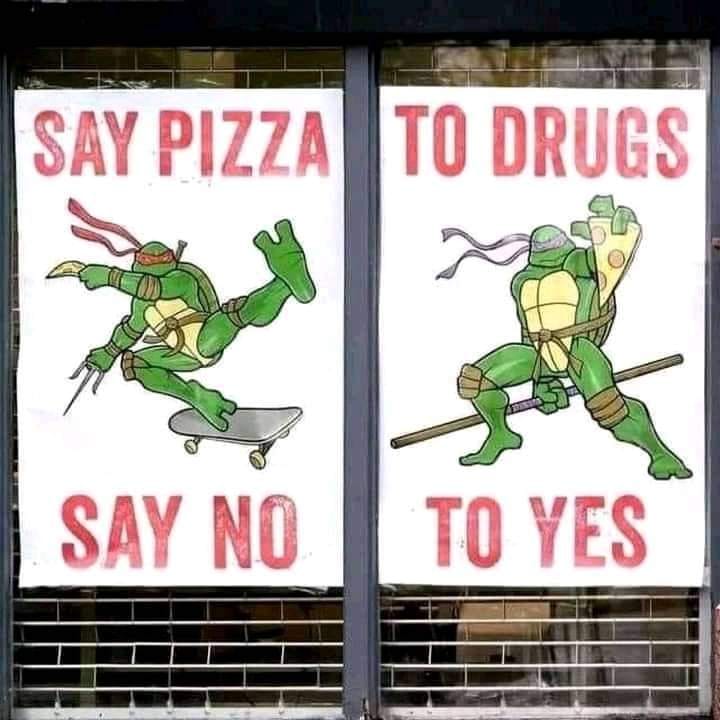
- Left Banner: Depicts Raphael (from the Teenage Mutant Ninja Turtles) skateboarding. The text reads "SAY PIZZA" at the top and "SAY NO" at the bottom.
- Right Banner: Depicts Leonardo (also from TMNT) wielding two katana swords in a fighting stance. The text reads "TO DRUGS" at the top and "TO YES" at the bottom.
The banners appear to be hand-painted or screen-printed, and have a somewhat amateur, DIY aesthetic. The overall effect is a public service announcement or anti-drug message framed through the pop culture lens of the Teenage Mutant Ninja Turtles.
Foucauldian Genealogical Discourse Analysis
This is perhaps the most readily applicable framework. The banners are discursive, meaning they operate as part of a broader conversation (a discourse) about drugs, morality, and childhood. A Foucauldian analysis would look at how this message constructs (and perpetuates) understandings of drug use and acceptable behavior.
- Power/Knowledge: The banners exemplify how power operates through knowledge. The message doesn’t simply state “drugs are bad”; it positions certain choices (pizza/yes) as ‘good’ and others (drugs/no) as ‘bad’. This positioning isn’t based on objective truth, but on a set of cultural values and power structures that define what is considered desirable or acceptable.
- Genealogy: To engage with the genealogy, we would ask: What historical conditions led to the use of pop culture figures (specifically the TMNT) in anti-drug messaging? The TMNT emerged in a period of growing concern about youth culture and morality. The use of these characters can be traced to a desire to reach young audiences using familiar and appealing imagery.
- Disciplinary Power: The message can be seen as an exercise of disciplinary power. It aims to ‘normalize’ certain behaviors (eating pizza, saying yes to life) and ‘correct’ others (drug use). The message constructs a moral subject who is expected to adhere to these norms.
- Normalizing Judgement: The banners perform a normalizing judgement, by constructing “drug users” as deviant and those who adhere to the prescribed norm (eating pizza, saying yes) as acceptable.
Critical Theory
Critical Theory, particularly the Frankfurt School, is relevant.
- Culture Industry: The use of the Teenage Mutant Ninja Turtles in an anti-drug message is an example of the “culture industry” at work. The culture industry appropriates popular culture to serve dominant ideological interests. In this case, the TMNT are used to reinforce conservative values about drug use and morality.
- Ideology: The banners serve an ideological function by subtly reinforcing a particular worldview. The message isn’t just about drugs; it's about the importance of conformity, healthy choices, and adherence to societal norms.
- False Consciousness: The use of simplistic, pop culture imagery could be argued to contribute to a kind of “false consciousness” by obscuring the complex social, economic, and political factors that contribute to drug use. It promotes a moralistic individual solution rather than addressing systemic issues.
Marxist Conflict Theory
While not central, there is a potential connection.
- Ideological Control: Marxist theory posits that dominant ideologies (like the message in the banners) serve to maintain the status quo and reinforce class structures. The messaging may not be directly about class, but it reinforces a broader system of social control.
- Distraction from Systemic Issues: A Marxist critique might argue that focusing on individual drug use distracts from the deeper structural issues (poverty, inequality, lack of opportunity) that contribute to drug use in the first place.
Postmodernism
Postmodernism is somewhat less applicable, but still has some relevance.
- Intertextuality: The banners rely on the viewer's knowledge of the Teenage Mutant Ninja Turtles (intertextuality). The meaning of the message is dependent on this pre-existing cultural context.
- Hyperreality: The image blends pop culture references with a public service announcement, creating a slightly surreal, hyperreal effect.
- Deconstruction: Deconstruction could be used to analyze the binary opposition created by the banners (pizza/drugs, yes/no). It would highlight the arbitrary nature of this opposition and the power dynamics involved in constructing these categories.
Queer Feminist Intersectional Analysis
This framework isn't strongly applicable to the surface level of the image. The image doesn't explicitly deal with issues of gender, sexuality, or intersectionality. However, a subtle application could be made through the lens of representation:
- Masculinity and Deviance: The banners feature male figures practicing exaggerated masculinity (fighting, skateboarding). A queer feminist analysis might question how this reinforces traditional notions of masculinity and how ‘deviance’ from those norms (like drug use) is positioned in opposition to it.
- Intersectionality & Marginalization: A broader analysis could consider how societal responses to drug use disproportionately affect marginalized communities. This is not directly visible in the image, but it could be contextualized by considering the broader social landscape.
I hope this provides a thorough analysis of the image through the requested theoretical frameworks! Let me know if you'd like me to elaborate on any specific point or explore other interpretations.
simple-description (llama3.2-vision)
The meme is a humorous comparison of two popular memes. The left image features a character from the Teenage Mutant Ninja Turtles, Michelangelo, riding a skateboard and eating pizza, with the text "Say pizza, say no" above him. The right image shows the same character, but with a pizza slice and a sword, and the text "Say drugs, say no" above him.
tesseract-ocr
a ic Pere a es r == = : cae qe Sa 2 ~ABa 0/ Zap On ¥ . Cy ki \\ Ley yy, KS RN l= 4 y os f —a_]| | a ) a a a a NT | See | SS Seagrass 1 =e Ll Ee ae eat ee