First Seen
2023-05-10T21:03:36+00:00
simple-description (llama3.2-vision_11b)
The meme is an image of a famous painting, "The Treachery of Images" by René Magritte, with the caption "I can explain painting in 5 words: 'This is not a painting'".
detailed-analysis (gemma3-27b-vision)
Okay, here's an analysis of the image, broken down into the requested sections where applicable. It's important to note that applying these theoretical frameworks can be a bit 'forced' – they are tools for analysis, and some will resonate more strongly than others depending on the interpretation.
Visual Description
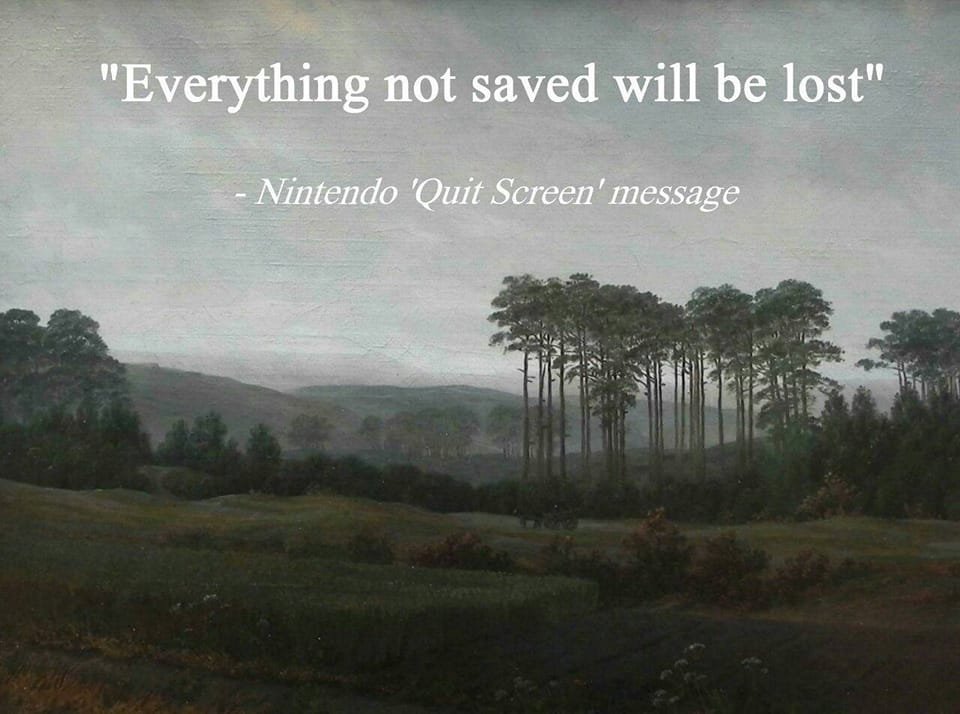
The image depicts a landscape scene shrouded in mist or fog. Rolling hills are visible in the background, gradually receding into a hazy distance. A cluster of tall, dark evergreen trees stands prominently in the midground, anchoring the composition. The foreground features a field of tall grass. The color palette is muted and primarily consists of greens, grays, and whites. The lighting is soft and diffused, enhancing the sense of mystery and transience. The overall mood is melancholic, peaceful, and slightly ominous. The text "Everything not saved will be lost" (attributed to a Nintendo "Quit Screen" message) is superimposed on the image in white, centered at the top.
Foucauldian Genealogical Discourse Analysis
The Nintendo message itself is fascinating through a Foucauldian lens. Foucault would argue it isn't merely a warning, but a discursive practice – a way of speaking that shapes how we understand and relate to digital creation, time, and loss.
- Power/Knowledge: The message doesn’t just describe a technical reality, it exercises power by defining what constitutes 'loss' within the Nintendo game environment. It dictates the terms: failure to save equals erasure. Nintendo, through this message, positions itself as the authority on defining what is valuable and worth preserving within the game.
- Genealogy of 'Saving': The act of "saving" has a genealogy. It's not a natural phenomenon, but a construct tied to the limitations of early computing technology. The message subtly reinforces the idea that everything is inherently transient without the intervention of technological preservation. It makes “saving” the default solution for the inevitable.
- Discipline: The message functions as a form of self-discipline. The player is conditioned to constantly interrupt their experience to preserve progress, creating a cycle of action and preservation. This isn't an external force, but self-imposed due to the threat of loss.
The image, paired with the message, amplifies this. The ephemeral mist in the scene evokes a sense of impermanence, mirroring the potential for digital data to be lost.
Critical Theory
Applying critical theory, specifically drawing on thinkers like Adorno and Horkheimer (the Frankfurt School), we can consider this image and message as reflecting the anxieties of late-capitalist society.
- Commodification of Experience: The image reflects how even our leisure activities (playing video games) are now heavily structured by market forces. The "save" function, while providing security, is also a constant reminder of the value of time spent and effort invested in the game—commodifying our experiences.
- The Illusion of Control: The "save" function gives the illusion of control over a fundamentally unstable digital world. We are led to believe we can preserve our creations, but this is contingent on the technology continuing to function and the company supporting the game.
- Alienation: The constant threat of loss can create a sense of alienation. The player isn't fully immersed in the experience because they are perpetually concerned with preservation, hindering full engagement.
Marxist Conflict Theory
Through a Marxist lens, the image can be interpreted as a reflection of the ownership of intellectual property and the control exerted by corporations like Nintendo over the creative labor of both game developers and players.
- Means of Production: Nintendo, as the owner of the game's platform, controls the means of digital production. Players create content (build worlds, level up characters), but this content is ultimately subject to Nintendo's rules and terms of service.
- Exploitation of Player Time: The 'save' function can be seen as a subtle form of exploitation. The player's time and effort are invested in the game, but the value of that investment is captured by Nintendo. The threat of loss incentivizes players to continue engaging with the game, benefiting the corporation.
- Commodification of Creativity: The game's content, including player creations, is ultimately commodified – it becomes a product that generates profit for Nintendo. The ‘save’ function reinforces this by highlighting the value of player investment.
Postmodernism
The image and message resonate with some key elements of postmodern thought:
- Simulation and Hyperreality: The Nintendo message creates a kind of hyperreality around the concept of loss. The digital loss isn’t the same as physical loss, but the message creates the feeling of genuine threat and importance.
- Loss of Grand Narratives: The message, in a way, undermines the idea of permanence. It implies that nothing is truly secure, challenging the traditional belief in lasting creations.
- Fragmentation and Ephemerality: The image's mist and the message’s warning reinforce the idea of impermanence. Digital data is inherently fragile and subject to loss. The fleeting digital experience is highlighted.
Queer Feminist Intersectional Analysis
This is the most difficult fit, but potential connections can be made, though more speculative:
- Vulnerability and Preservation: The message’s focus on loss can be connected to the anxieties around vulnerability and the need for preservation within marginalized communities. The act of "saving" can be seen as a form of self-preservation, protecting one's creations and identity from erasure.
- Digital Archives and Memory: The digital space, like the game environment, can be seen as a form of archive—a space where memories and experiences are stored. The threat of loss highlights the importance of preserving these archives and resisting the forces that seek to erase them.
- The “Save” as Labor: The consistent act of saving can be viewed as a form of unpaid labor often disproportionately carried by marginalized individuals. They may dedicate time and energy into maintaining online profiles, creating digital art, and curating their online presence, only to see it threatened by platform instability or censorship.
I hope this detailed breakdown is helpful. Remember, these are interpretations, and the image and message can be understood in many different ways. Let me know if you'd like me to elaborate on any of these points or explore other theoretical frameworks.
simple-description (llama3.2-vision)
The meme is an image of a serene landscape with a quote overlayed on top. The text reads: "Everything not saved will be lost" - a reference to a common error message in video games, but in this case, it's a humorous take on the idea that even in a peaceful landscape, everything can still be lost.
tesseract-ocr
iota Lae aes a AW}