First Seen
2023-05-10T21:03:36+00:00
simple-description (llama3.2-vision_11b)
The meme is a playful representation of the concept of Neo-Dadaism, a art movement that emerged in the 1950s, which challenged traditional notions of art and aesthetics. The image depicts a person's thoughts as a messy, abstract, and surreal landscape, with the text "I'm not a person, I'm a collection of thoughts" appearing in the corner. This meme is a humorous take on the idea that our thoughts are not always coherent or logical, and that our minds can be a jumbled and confusing place.
detailed-analysis (gemma3-27b-vision)
Okay, let's break down this image using the lenses you've requested. I'll organize it into sections, only including those approaches that feel relevant and fruitful given the image's content.
Visual Description
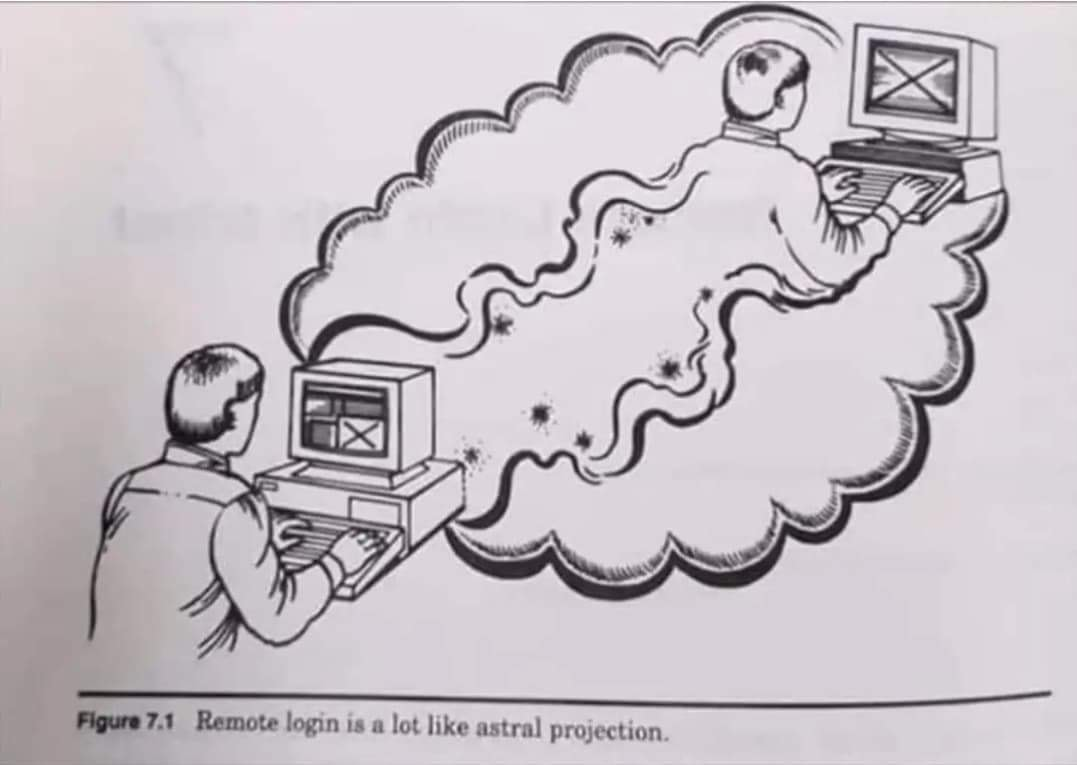
The image is a monochrome line drawing depicting two individuals seemingly connected through a cloud-like visual effect. Both individuals are seated at desktop computers with monitors displaying a simple windowed interface. One individual is positioned on the left, seen from behind, and the other on the right. The connection between them is a stylized, swirling, nebulous shape, resembling a cloud or mist filled with stars. This shape emanates from both computers and visually joins the two people. The caption reads: "Remote login is a lot like astral projection." This suggests the image intends to draw an analogy between the act of connecting to a remote computer and the out-of-body experience of astral projection. The style is somewhat dated, resembling illustrations from the early days of computing, possibly the 1980s.
Foucauldian Genealogical Discourse Analysis
This image is ripe for Foucauldian analysis. We can examine how the discourse of technology, particularly computing, has been constructed to create certain power dynamics. The metaphor of "remote login is a lot like astral projection" is key here.
- The Shift in Spatiality & Power: Traditionally, power and authority were tied to physical presence and control of territory. Remote login, and computing in general, disrupts this. It suggests that power can be exercised at a distance, through networks and code. The astral projection analogy reinforces this idea of disembodied control.
- Discipline & Control: Foucault argued that modern power operates through discipline - techniques of surveillance, normalization, and examination. This image, while seemingly fantastical, hints at the increasing capacity for networked control. The network is the panopticon, subtly tracking and influencing behavior through access to information. The "cloud" connection isn't just a visual effect; it’s the infrastructure of surveillance and data collection.
- Genealogical Tracing: A genealogical approach would ask: how did this idea of remote access, and its metaphorical connection to the "spiritual" or "mystical," emerge? The Cold War era is relevant here—the desire to control information and command operations from afar drove early network development. The rise of New Age spirituality and an interest in the non-physical world during the 1970s/80s would have provided a fertile ground for associating computing with out-of-body experiences.
Postmodernism
The image is deeply infused with postmodern sensibilities.
- Blurring of Boundaries: Postmodern thought challenges traditional distinctions between the "real" and the "virtual," the "physical" and the "spiritual." This image embodies that blurring. Remote login is literally connecting physical bodies across distance, but the analogy to astral projection suggests that this connection transcends mere physical space. The line between the material and the immaterial becomes increasingly unstable.
- Simulation and Hyperreality: Jean Baudrillard argued that we live in a "hyperreality" where simulations have become more real than the real itself. The image suggests that the experience of remote connection is becoming a kind of "reality" unto itself, separate from physical proximity. The "cloud" visual reinforces this idea of a detached, simulated space.
- Meta-Narratives & Fragmentation: Postmodernism is skeptical of grand narratives (e.g., progress, enlightenment). This image doesn’t offer a straightforward narrative. It presents an analogy, a playful juxtaposition of technology and mysticism, disrupting any singular, unified understanding of connection and power.
Critical Theory
Viewing through the lens of critical theory, we can see how technology is not neutral but is socially constructed and can be used to reinforce existing power structures.
- Technological Determinism vs. Social Shaping: The image could be interpreted as subtly promoting a kind of technological determinism, suggesting that technology inherently connects us in new, even mystical ways. However, a critical approach would argue that the social forces shaping the development and use of remote login are far more important.
- Alienation & Control: While it depicts connection, we can question what kind of connection is being fostered. Is remote login truly bringing people closer, or is it a means of extending control and surveillance? Could this form of connection contribute to social isolation and alienation, even as it appears to overcome distance?
- Ideology: The image presents a particular ideology of connection – one that equates technological access with spiritual or transcendent experience. Critical theorists would ask: who benefits from this framing? Does it obscure the material realities of digital inequality and the exploitation inherent in the tech industry?
Let me know if you'd like me to elaborate on any of these points, or if you want me to attempt a different theoretical lens!
simple-description (llama3.2-vision)
This meme features a cartoon illustration of two people sitting at computers, with one person's computer screen displaying a login page. The text "Remote login is a lot like astral projection" appears at the bottom of the image, implying that remote login is similar to the idea of astral projection, where the soul or consciousness is said to leave the body and travel to other realms. The meme is likely poking fun at the idea that remote login is somehow magical or mystical, rather than a simple technical process.
tesseract-ocr
aN ol part — ‘al CA . —_ j * f Ser" °c (wr, f—__ «5 i). 5 Sy (a = ] | VY — c/ igure 7.4 Remote login is a lot like astral projection.