First Seen
2023-05-10T21:03:36+00:00
simple-description (llama3.2-vision_11b)
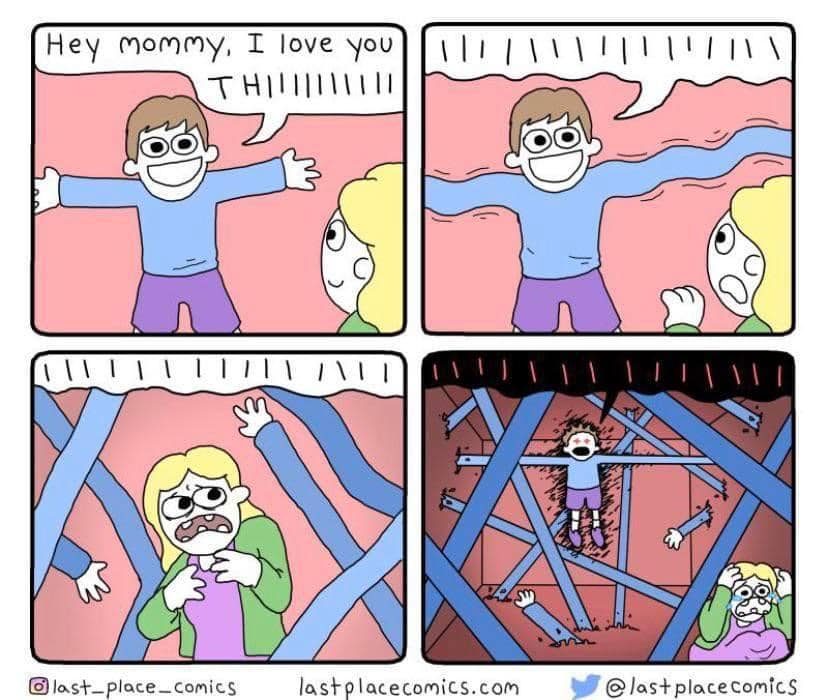
This meme is a Neo-Dadaist reinterpretation of a classic image, featuring a child's drawing of a family with a father, mother, and child. The meme presents a distorted and unsettling version of this familiar image, with the child's drawing of a family transformed into a grotesque and disturbing scene, featuring a child with a grotesque and menacing face, and the parents are now depicted as being held captive by the child.
detailed-analysis (gemma3-27b-vision)
Okay, let's break down this four-panel comic using the requested analytical frameworks. It's a deeply unsettling image, so the analyses will reflect that.
Visual Description
The comic panel is drawn in a simple, almost childish style, employing bold lines and flat colors. In the first panel, a child with wide eyes and arms outstretched is expressing affection to a blonde woman (presumably the mother). The background is a bright pink.
The subsequent panels depict an increasingly unsettling shift. Lines (presumably representing the mother's arms) begin to emerge from the mother, initially appearing as affectionate embraces, but quickly escalating into a constricting network. By the final panel, the child is trapped within a cage of these blue, purple, and pink "arms", appearing small and helpless against a darkened, almost blood-red background. The mother’s face in the final panel is distressed. The overall effect is claustrophobic and evokes a sense of entrapment and a loss of safety.
Foucauldian Genealogical Discourse Analysis
This comic is potent material for a Foucauldian analysis. The "arms" represent power/knowledge dynamics. The initial display of affection, the mother’s touch, can be seen as the first manifestation of power. However, this seemingly benign power swiftly morphs into a disciplinary force. The lines aren’t just arms; they are a system of control.
- Genealogy: We can trace the genealogy of this ‘mothering’ gesture. Initially, it is a gesture of love and care, but through repetition and normalization, it becomes a suffocating network of control. The comic shows how what starts as a seemingly positive practice can be co-opted and used to discipline, control, and limit.
- Panopticism: The network of lines creates a sort of 'panoptic' feeling, even though there isn't a central observer. The child is perpetually surrounded, monitored (even if unconsciously), and thus, self-disciplines, internalizing the boundaries and restrictions represented by the lines.
- Discourse & Subjectivity: The comic suggests how discourse around motherhood (love, protection, care) can be intertwined with power and control. The child's subjectivity is produced by this system. The child's agency is eroded by the lines, demonstrating how power isn't just repressive but also productive – it creates the very subject it controls.
Critical Theory
From a Critical Theory perspective (drawing on the Frankfurt School), the comic critiques the institution of the family and the ideologies surrounding motherhood.
- Repressive Tolerance: The initial loving embrace is a facade for a deeply problematic dynamic. The mother’s “love” functions as a means of control, illustrating how seemingly positive social forces can be oppressive.
- False Consciousness: The child, in the first panel, is presented as genuinely loving and affectionate, unaware of the insidious nature of the control developing around them. This represents a state of “false consciousness,” where the child is unable to recognize the systems that are shaping them.
- Critique of Ideology: The comic deconstructs the idealized image of motherhood. It suggests that maternal love, when coupled with an overbearing need to control, can be damaging and harmful. The comic critiques the inherent power imbalance within family structures.
Queer Feminist Intersectional Analysis
This comic, while not overtly dealing with sexuality or gender identity, offers a rich field for Queer Feminist Intersectional analysis.
- Constricted Subjectivity: The entanglement of the child within the lines represents the ways in which societal expectations and norms – specifically those surrounding family and motherhood – can constrict individual subjectivity and agency. The child’s ability to self-define is limited by the expectations imposed by the mother and, by extension, by the broader social structure.
- Gendered Power Dynamics: The dynamics in the comic are heavily gendered. The mother figure wields the power, and the child is subject to that power. The image plays into the problematic narrative of the mother as the primary caregiver and disciplinarian, and the child as the dependent, vulnerable recipient. The lines can be seen as the expectations and control imposed upon the child in order to conform to gendered norms.
- Intersectionality: While the comic doesn't explicitly address other dimensions of identity, the feeling of entrapment speaks to the way that multiple forms of oppression can converge to limit an individual’s agency. A child who also experiences other forms of marginalization (e.g., based on race, class, ability) might experience an even more intense version of the entrapment depicted in the comic.
Important Note: This is a highly unsettling image, and interpretations can vary. These analyses are based on a reading of the visual elements and the underlying themes, and the comic invites multiple readings.
simple-description (llama3.2-vision)
The meme is a comic strip featuring a child's conversation with their mother. The child says "Hey mom, I love you" and the mother responds with a graphic and disturbing image of her being murdered by a group of people wielding knives and chains. The text "I love you" is a darkly ironic commentary on the usual phrase.
tesseract-ocr
Stir] NY 6 —— Jd —— C2 Ny wr “J eS 4a J aA AS Ye WW) oy f 78) a WA x Dye @last_place_comics lastplacecomics.com ey