First Seen
2023-05-10T21:03:36+00:00
simple-description (llama3.2-vision_11b)
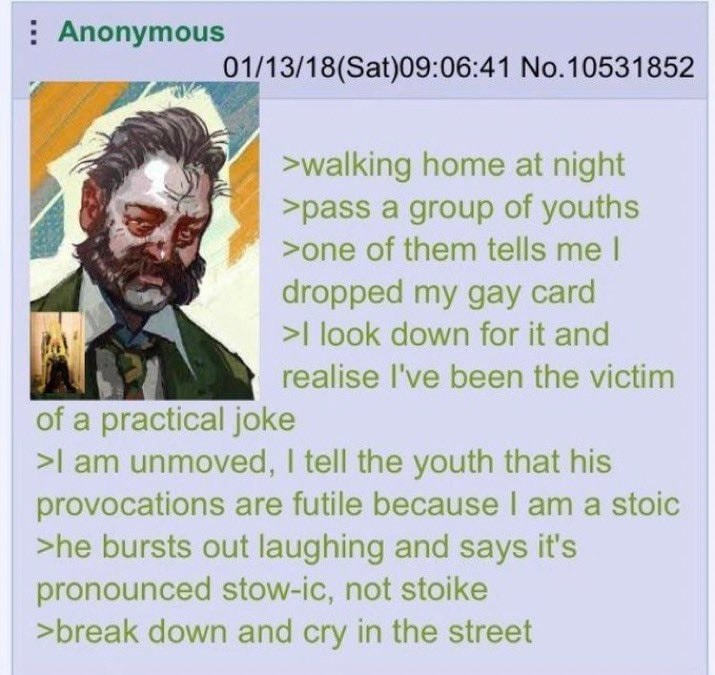
The meme is a screenshot of a Reddit post with a text-to-image model-generated image of a person with a distorted face and a caption that reads: "Neo-Dadaism is a movement that rejected the conventions of fine art and sought to challenge the status quo by creating works that were intentionally absurd and provocative. The image is a representation of this idea, with a distorted face that is meant to be unsettling and thought-provoking."
detailed-analysis (gemma3-27b-vision)
Okay, let's break down this 4chan post using the lenses you've provided. It's a deceptively rich little narrative, so there's quite a bit to unpack.
Visual Description
The post includes an image of a rather detailed digital painting of a man with sharp, slightly unsettling features. He's dressed in what appears to be Victorian-era clothing, with a high collar and dark jacket. His expression is intense, bordering on melancholic or exasperated. The background is indistinct, a blur of browns and greens, suggesting an interior space. The image evokes a sense of a troubled, intellectual figure – perhaps a character from a gothic novel. The artistic style suggests a deliberate choice to create a specific mood, leaning into the themes of loneliness, alienation, and perhaps even vulnerability.
Foucauldian Genealogical Discourse Analysis
This post is extremely fruitful for a Foucauldian analysis. The core of the narrative revolves around the construction of identity and the power dynamics inherent in categorization.
- "Dropped my gay card": This is the key discursive element. The phrase itself implies that "gayness" is a credential, a possession that can be "dropped," signifying that it's something external to the person. It's an objectifiable, performative identity, rather than an inherent aspect of being. This is exactly what Foucault would point to as a key mechanism of power. It transforms a complex lived experience into a quantifiable, visible marker for categorization.
- Power/Knowledge: The youth wielding the "gay card" joke exercises power through knowledge (or the pretense of it). They are assuming they know something about the man (that he is gay), and are using that supposed knowledge to assert dominance and create a moment of humiliation. The man's subsequent distress is evidence of how these discursive practices exert power.
- Genealogical Inquiry: We could trace the history of this "card" metaphor. Where did it come from? Who began using it? What social conditions allowed it to gain traction as a form of mockery? It likely began as a way to delegitimize LGBTQ+ identity, framing it as a choice or a performative act.
- Discipline and Normalization: The joke attempts to discipline the man, forcing him to conform to a perceived norm of masculinity and to acknowledge a social categorization he may or may not identify with. The humiliation and crying are outcomes of this disciplinary power.
Critical Theory (Frankfurt School)
This post resonates with several themes within Critical Theory:
- Alienation: The man’s breakdown in the street symbolizes alienation from both himself and society. He's rendered vulnerable by a casual act of social aggression, suggesting a lack of genuine connection or empathy. The joke exposes his isolation and his inability to find validation in the public sphere.
- Commodification of Identity: The "gay card" metaphor can be seen as a form of commodification, reducing a complex identity to a single, easily-packaged "attribute". This aligns with the broader critique of consumer culture and its tendency to reduce everything to exchangeable commodities.
- Critique of Enlightenment Reason: The seemingly casual act of derision hides the power dynamics, and reveals how supposed rationality and freedom can be used as tools of oppression.
- Culture Industry: The youth's joke reveals how societal norms, fueled by the media and the culture industry, can create an atmosphere of judgment and intolerance.
Queer Feminist Intersectional Analysis
This post offers a poignant exploration of vulnerability, social performance, and the ways in which power operates at the intersection of sexuality and gender.
- Performance of Masculinity: The man’s attempt to appear "stoic" reveals the pressures on individuals to conform to gendered expectations. His distress when corrected on the pronunciation underscores the fragility of this performance. It highlights how even seemingly "strong" or "rational" identities are vulnerable to social judgment.
- Homosociality and Homophobia: The joke comes from another young man. This highlights the complex relationship between homophobia and homosocial bonding. The aggression may stem from anxieties about the young man’s own gender identity or sexuality.
- Vulnerability and Social Expectations: The man’s breakdown is not simply a personal failure; it’s a consequence of the social pressures and power dynamics at play. It reveals the vulnerability of individuals who do not conform to societal norms.
- Internalized Homophobia: While not explicitly stated, the man’s desire to project an image of stoicism could be interpreted as a sign of internalized homophobia – a fear or rejection of his own sexual identity.
Postmodernism
The post lends itself to a postmodern reading in several ways:
- Deconstruction of Identity: The "gay card" metaphor fundamentally deconstructs the notion of a fixed, stable identity. It portrays "gayness" as something external, performative, and easily dislodged.
- Meta-Narrative and Irony: The narrative is inherently self-referential and ironic. The man attempts to invoke a classical ideal ("stoicism") but is undone by a trivial linguistic correction.
- Rejection of Grand Narratives: The post challenges any notion of a universal or objective truth about identity. The meaning of "gayness" is fluid and context-dependent.
- Simulation and Hyperreality: The situation feels almost staged or manufactured. The youth's joke is a simulation of social interaction that bears little resemblance to genuine connection.
Marxist Conflict Theory
While not the most prominent lens, a Marxist reading can still offer insights.
- Power Imbalance: The joke represents a micro-level power imbalance. The youth is exercising dominance over the man, demonstrating a social hierarchy.
- Ideology and Hegemony: The joke relies on and reinforces prevailing societal norms and prejudices related to sexuality. This contributes to the maintenance of a hegemonic system that marginalizes LGBTQ+ individuals.
- Alienation (again): The man’s breakdown is a symptom of alienation from the social fabric. He is denied recognition and empathy, leading to a sense of isolation and powerlessness.
Let me know if you'd like me to delve deeper into any of these specific analyses or explore additional theoretical frameworks!
simple-description (llama3.2-vision)
This meme is a screenshot of a 4chan post that appears to be a humorous rant about being victimized by a person who is "the victim of a practical joke". The text reads: "I was walking home at night, I passed a group of youths, one of them told me I dropped my gay card, I looked down and realized I was the victim of a practical joke."
tesseract-ocr
: Anonymous . 01/13/18(Sat)09:06:41 No.10531852 ow a ‘ >walking home at night & ‘W@ >pass a group of youths a >one of them tells me | A\ ' dropped my gay card haa >| look down for it and realise I've been the victim of a practical joke >l am unmoved, | tell the youth that his provocations are futile because | am a stoic >he bursts out laughing and says it's pronounced stow-ic, not stoike >break down and cry in the street