First Seen
2023-05-10T21:03:36+00:00
simple-description (llama3.2-vision_11b)
The meme is a screenshot of a YouTube video of a person swimming in a pool with a "water park" theme, but the pool is actually a giant water-filled hole in the ground. The text overlay reads "I'm not lazy, I'm just on energy-saving mode". This meme is an example of Neo-Dadaism, a movement that rejects traditional aesthetics and emphasizes absurdity and playfulness, often using everyday objects in unexpected ways to challenge societal norms.
detailed-analysis (gemma3-27b-vision)
Okay, let's break down this image through the requested theoretical lenses. It's a relatively simple image, but surprisingly rich for interpretation.
Visual Description
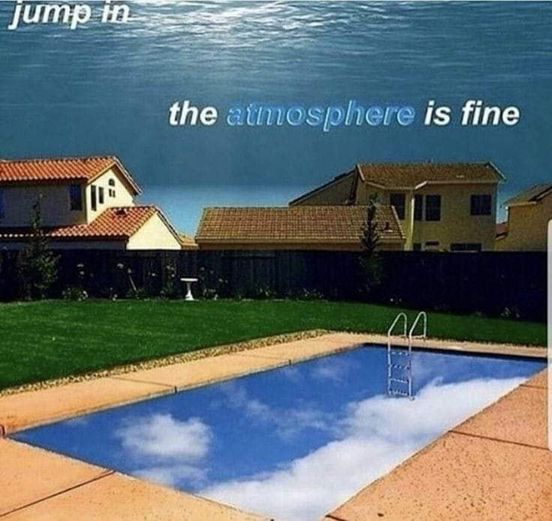
The image presents a scene of suburban American domesticity. It features a well-maintained, rectangular swimming pool in a manicured backyard. Behind the pool is a row of relatively new, two-story, tiled-roof houses. The sky is a muted, hazy blue, suggesting either overcast conditions or smog. There's a small white pedestal or object in the lawn behind the pool. The pool itself has a cloud-like pattern reflected on its surface, making it hard to distinguish between water and sky. Text overlays the image: "jump in" at the top and "the atmosphere is fine" centered. The lighting appears somewhat flat, contributing to a slightly unsettling, dreamlike quality.
Postmodernism
The image lends itself heavily to a postmodern reading. The juxtaposition of the seemingly idyllic suburban scene with the unsettling text ("the atmosphere is fine") is a key indicator. This dissonance creates a sense of irony and questioning.
- Simulacra and Simulation: The "perfect" suburban scene isn't real in the sense of being organically developed. It's a constructed environment built on consumerism and a desire for a specific lifestyle. It is a simulation of the "good life."
- Irony and Parody: The statement "the atmosphere is fine" is deeply ironic. In the context of climate change, environmental degradation, and perhaps even a general sense of societal unease, it’s a denial or minimization of a crisis. This is a classic postmodern tactic: presenting a seemingly normal statement that undermines itself through context.
- Fragmentation and Loss of Meaning: The blending of the sky and pool, the flat lighting, and the disjointed text contribute to a sense of fragmentation. Meaning is not stable or fixed, but rather fluid and open to interpretation. The “atmosphere” is not just the weather, but a broader sense of cultural and emotional climate, which is deliberately obscured or denied.
Critical Theory
The image resonates with key themes in Critical Theory, particularly those related to ideology and the "culture industry".
- Ideology and False Consciousness: The seemingly perfect suburban scene is an embodiment of a dominant ideology—a belief system that serves to maintain existing power structures. The manicured lawns, matching houses, and focus on consumer goods reinforce a belief in the American Dream—a narrative that often masks inequalities and social problems.
- The Culture Industry: The focus on aesthetics and comfort represents the output of the "culture industry," which, according to Adorno and Horkheimer, produces standardized goods (including lifestyles) that pacify and control the population.
- Repression and Denial: The phrase "the atmosphere is fine" can be read as a form of repression—a denial of uncomfortable truths. It suggests a willful blindness to environmental concerns, social injustices, or any other disruptive realities.
Marxist Conflict Theory
A Marxist interpretation of the image focuses on class, power, and material conditions.
- Symbol of Bourgeois Comfort: The scene embodies the material comforts enjoyed by a specific class—the bourgeoisie. The large houses, swimming pool, and manicured lawns represent access to resources and a privileged lifestyle.
- Concealment of Labor: The image obscures the labor—both human and environmental—that underpins this lifestyle. The perfect lawns require constant maintenance, the houses were built by workers (who likely don’t live in similar homes), and the resources used to create this environment come at an environmental cost.
- False Promise of Individualism: The idea of the “American Dream” as represented here promotes a myth of individual success and upward mobility, which deflects attention from systemic inequalities and class structures. The focus on individual houses suggests isolation and competition rather than collective action.
Queer Feminist Intersectional Analysis
While not immediately obvious, the image can be read through an intersectional lens, focusing on how power structures intersect to create and maintain social hierarchies.
- The "Ideal" Family/Home: The suburban home has historically been presented as the center of traditional gender roles and heterosexual family structures. This image, though not depicting people, evokes that history and can be seen as reinforcing those norms.
- Exclusion and Erasure: The image implicitly excludes those who do not fit into the dominant cultural script of suburban life (e.g., people of color, LGBTQ+ individuals, those living in poverty).
- Atmosphere of Control: The phrase "the atmosphere is fine" can be read as a subtle form of control – an assertion of power that silences dissenting voices and enforces conformity. It suggests that any discomfort or unease is invalid or unimportant.
In conclusion, this simple image is surprisingly complex and can be interpreted through multiple theoretical lenses. It's a powerful visual statement about consumerism, ideology, environmental denial, and the illusion of the "good life." The unsettling juxtaposition of the idyllic scene with the ironic text creates a sense of unease and invites critical reflection.
simple-description (llama3.2-vision)
This meme is a humorous image of a backyard pool with a cloudy, blue sky reflected in the water. The image is captioned "jump in. the atmosphere is fine." The joke is that the pool's water is so calm and clear that it perfectly reflects the sky above, creating a surreal and humorous image.
tesseract-ocr
tt eS ee Se the atinospliere is fine a 2 eae J , ae