First Seen
2023-05-10T21:03:36+00:00
simple-description (llama3.2-vision_11b)
The meme is a play on the concept of Neo-Dadaism, a 20th-century art movement that emphasized the absurdity and irreverence of modern life. The meme features a humorous image with the text "I can't believe I just spent 5 minutes making a 2 second video" and "I'm not lazy, I'm just on energy-saving mode".
detailed-analysis (gemma3-27b-vision)
Okay, let's break down this tweet through the lenses you've requested. It’s a succinct, somewhat plaintive statement, and its brevity allows for a variety of interpretations.
Visual Description
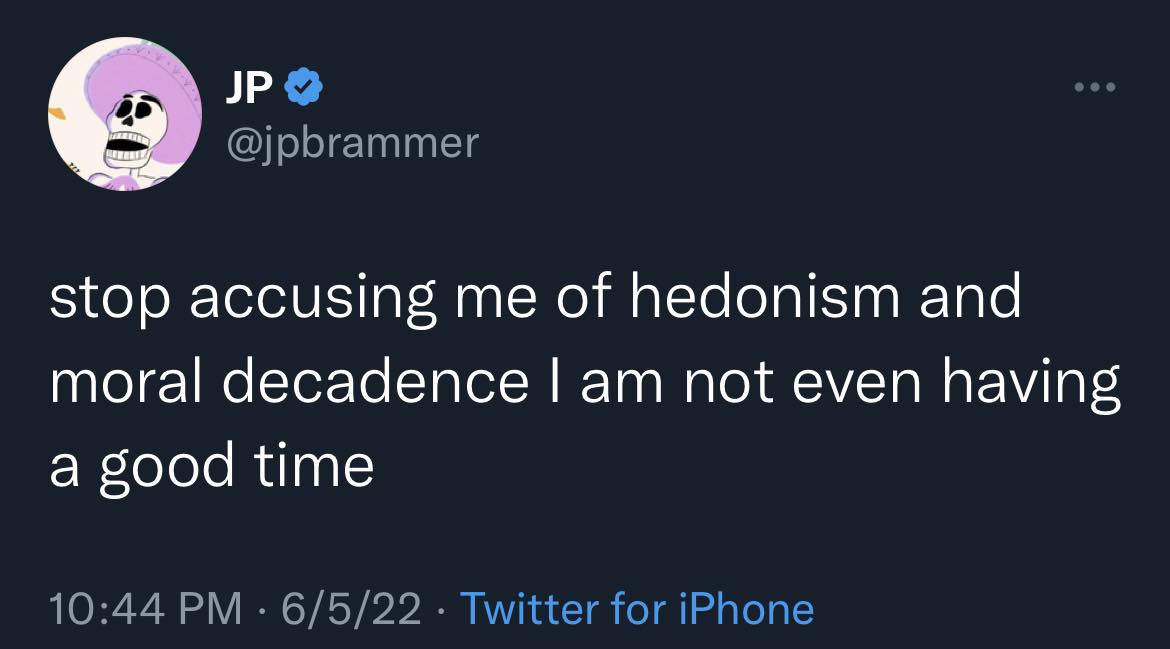
The tweet is a simple text post on the platform X (formerly Twitter). The profile image accompanying it is an illustration of a man's face from the neck up with an expression of shock, illustrated in a minimalist art style. It is primarily white with dark outlines. The post includes the user’s username (@jpbrammer), a verification checkmark, the text of the tweet, a timestamp, and an indication of the platform used to create it.
Foucauldian Genealogical Discourse Analysis
This tweet, while seemingly personal, is deeply embedded in a discourse concerning morality, pleasure, and public perception. Using a Foucauldian framework:
- Power/Knowledge: The accusation of "hedonism" and "moral decadence" isn't merely a personal jab. It’s a deployment of a historically constructed set of norms and values designed to regulate behavior. These accusations carry power – they aim to define the tweeter as outside the bounds of acceptable conduct.
- Genealogy: A genealogical analysis would trace the historical emergence of “hedonism” and “moral decadence” as concepts. What did those terms mean at different historical moments? How have they been used to control and discipline individuals? The accusation isn't about objective "truth" but about the ways in which these concepts have been deployed to enforce specific social norms.
- Disciplinary Power: The tweet suggests the tweeter feels disciplined by these accusations. They are responding to an external gaze and attempting to shape their public image (or defend it). The plaintive "I am not even having a good time" implies a defensive posture against the assumption that they should be enjoying the perceived "decadence."
Critical Theory
From a Critical Theory perspective, this tweet reveals broader societal dynamics:
- Ideology: The accusations of "hedonism" and "moral decadence" are likely rooted in a specific ideological framework – a set of beliefs about what constitutes proper behavior and societal values. This ideology may be conservative or traditional, asserting norms around self-control and virtue.
- Critique of Power: The tweeter’s response can be seen as a subtle pushback against these norms. By denying the enjoyment of the presumed decadence, they are rejecting the moral framing imposed upon them. They’re subtly questioning the legitimacy of the accusing gaze.
- Repression: The underlying implication is that the tweeter is being punished or scrutinized for a perceived transgression. The tweet highlights how societal expectations can create a repressive atmosphere.
Marxist Conflict Theory
Applying a Marxist lens:
- Superstructure & Ideology: The accusations of "hedonism" and "moral decadence" can be seen as part of the superstructure of society – the realm of ideas, culture, and institutions that serve to reinforce the economic base. These accusations likely reinforce class-based values, perhaps implicitly criticizing perceived indulgence as a sign of privilege.
- Class Conflict (Subtle): The tweet could be read as a response to a perceived judgment from a dominant class. There's a suggestion that the tweeter is being labeled as "decadent" by those who believe in stricter social control or traditional values.
- Alienation: The fact that the tweeter feels the need to defend themselves and claim they are not even enjoying themselves suggests a feeling of alienation from the expectations of society.
Postmodernism
A postmodern reading emphasizes:
- Deconstruction of Meaning: The tweet implicitly challenges the fixed meaning of terms like "hedonism" and "moral decadence." These concepts are not objective truths but social constructs whose meanings are fluid and contested.
- The Simulacrum: The accusation itself may be more important than any actual behavior. The tweeter is being judged based on an image of decadence, a simulacrum, rather than a lived reality.
- Subjectivity and Discourse: The tweet highlights the subjective nature of perception. What constitutes "hedonism" or "decadence" is ultimately a matter of interpretation.
Queer Feminist Intersectional Analysis
While not immediately obvious, a Queer Feminist Intersectional lens can offer some insights:
- Normative Judgments: Accusations of “hedonism” and “moral decadence” often carry implicit gender and sexuality norms. Enjoyment of pleasure and challenging conventional morality are often policed more rigorously for those who don't conform to heteronormative expectations.
- The Regulation of Bodies/Desire: The tweet can be seen as a response to the societal regulation of bodies and desires. The accusing gaze seeks to control how the tweeter lives and expresses themselves.
- Intersectionality: Depending on the tweeter's identity, the accusation could intersect with other forms of oppression and marginalization. Someone facing multiple forms of discrimination might be even more subject to normative judgment.
It is important to note that these are interpretations based on the tweet's content and apply frameworks; the tweeter's intent may be different.
simple-description (llama3.2-vision)
The meme is a screenshot of a tweet from a Twitter user named "JP" with the handle "@jpbrammer". The text reads: "stop accusing me of hedonism and moral decadence I am not even having a good time".
tesseract-ocr
ee @jpbrammer stop accusing me of hedonism and moral decadence | am not even having a good time 10:44 PM - 6/5/22 - Twitter for iPhone