First Seen
2023-05-10T21:03:36+00:00
simple-description (llama3.2-vision_11b)
The meme is a play on the idea of "I'm watching Netflix, I'm watching Netflix" being a mundane activity, but in this case, it's a robot's mundane activity being a play on the idea of a robot's mundane activity. The text "I'm watching Netflix, I'm watching Netflix" is replaced with "I'm being repossessed, I'm being repossessed" and the image shows a robot being repossessed, which is a play on the idea of a robot's mundane activity being a play on the idea of a robot's mundane activity.
detailed-analysis (gemma3-27b-vision)
Here's an analysis of the image, organized into the requested sections. Please note that the application of some theoretical frameworks will be stronger than others, given the nature of the imagery.
Visual Description
The image is a highly stylized, dramatic black and white graphic. The central figure appears to be a muscular human body, sculpted and reminiscent of a classical statue or anatomical illustration, but rendered with a rough, almost sketch-like quality. It’s presented in a dynamic pose, mid-throw, as if launching something forward. The figure’s arms and torso are prominent, and the focus is on action.
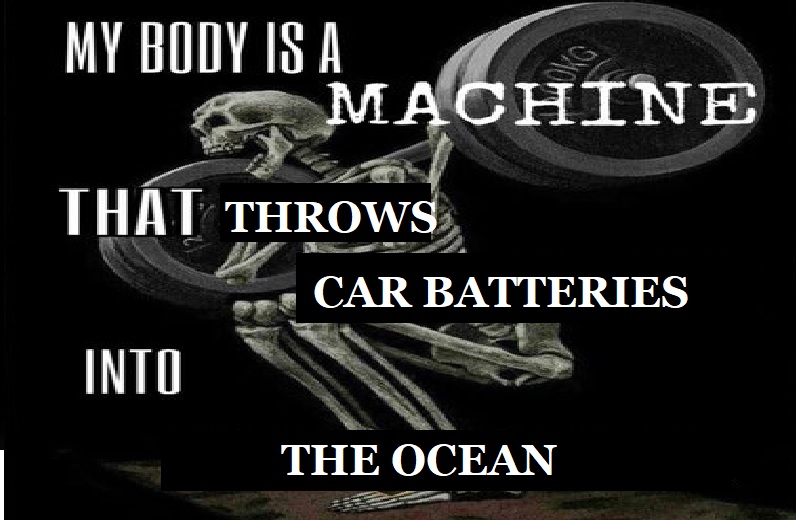
Above and to the right of the figure is an image of a car tire. Overlaid onto the image are the words “My Body Is A Machine That Throws Car Batteries Into The Ocean” in bold white capital letters. The text is arranged in a vertical layout, adding to the image’s dynamic feeling.
The overall aesthetic is striking and slightly unsettling. The juxtaposition of the idealized human form with the mundane and environmentally damaging act of throwing car batteries into the ocean creates a strong visual tension. The limited color palette and dramatic lighting contribute to a sense of urgency and perhaps even despair.
Foucauldian Genealogical Discourse Analysis
This image powerfully lends itself to Foucauldian analysis. The phrase "My Body Is A Machine" immediately suggests the shift from viewing the body as a natural, spiritual entity to one understood as a biomechanical instrument – a crucial development in modern thought, as described by Foucault in Discipline and Punish. The statement isn't just descriptive; it’s a performative statement, constructing the body as a machine.
We can trace a genealogy of this concept. Initially, the mechanical body was explored in anatomy and physiology – the body as a series of systems. But this shifted with industrialization and Taylorism – the body as a component of a larger productive system. The “machine” metaphor becomes not just about internal function but about external utility.
The act of throwing batteries into the ocean then becomes an exercise of power – power exerted through the body. It’s a disregard for environmental consequences, enacting a dominance over nature. Foucault would ask how this act is possible, and how the discourse around consumption, waste disposal, and environmental regulation either enables or attempts to control this behavior. The image challenges assumptions of human agency - is this a deliberate act of rebellion, or simply the logical conclusion of a system that reduces humans and the environment to resources?
Critical Theory
The image speaks to the core tenets of Critical Theory, particularly concerning the alienation of the human subject within modernity. The declaration “My Body Is A Machine” encapsulates the dehumanizing effects of industrialization and the objectification of the self. The body is no longer experienced as a lived, feeling entity but as a functional tool.
The act of throwing car batteries into the ocean is a pointed critique of unchecked consumerism and its ecological consequences. Car batteries represent dependence on fossil fuels, mass production, and the inherent waste produced by capitalist systems. The ocean, as a vast and seemingly limitless resource, symbolizes nature being exploited and polluted.
The image can be interpreted as a commentary on the powerlessness of the individual in the face of systemic environmental destruction. The “machine” is not acting autonomously, but is produced by and embedded within structures of power. It's a critique of the "instrumental rationality" that prioritizes efficiency and profit over ethical considerations and environmental sustainability.
Marxist Conflict Theory
From a Marxist perspective, the image highlights the exploitative relationship between humanity, nature, and the capitalist mode of production. The body is treated as a “machine” – a means of production – operating within a system driven by profit and accumulation.
The car battery represents a commodity produced through the exploitation of labor and natural resources. Throwing it into the ocean is a symbolic act of discarding waste – a consequence of the system’s inherent contradictions. This waste isn't simply removed from the system; it's externalized onto the environment, creating a crisis for future generations.
There's an inherent conflict between the forces of production (the "machine" body) and the relations of production (the capitalist system). The image implicitly questions who benefits from this system and who bears the cost of its environmental degradation. The act of throwing batteries isn’t a random act of vandalism; it’s a symptom of a deeper social conflict.
Postmodernism
The image aligns with postmodern sensibilities through its fragmentation, irony, and questioning of grand narratives. The statement “My Body Is A Machine” deconstructs the traditional humanist notion of the self as a unified, rational subject. It embraces a fluid, fragmented identity.
The juxtaposition of the classical body with the mundane object (a car battery) and the destructive act is inherently ironic. The image subverts expectations and challenges the viewer to question the relationship between nature, technology, and the human body.
Furthermore, the image rejects the idea of a singular, objective truth. It’s open to multiple interpretations and invites the viewer to construct their own meaning. There’s a sense of nihilism and despair underlying the image, reflecting a postmodern distrust of progress and reason.
Queer Feminist Intersectional Analysis
While not immediately obvious, a queer feminist lens can be applied through the deconstruction of the “machine” body. The traditional idealized muscular body is often associated with patriarchal norms of strength and dominance. The image's flattening of the body into a "machine" can be seen as an attempt to disrupt these norms and challenge essentialist notions of gender and physicality. The body, reduced to function, is somewhat “de-gendered”.
From a feminist perspective, the act of polluting the ocean can be linked to the historical exploitation of the natural world, often framed as a masculine pursuit. The ocean, as a feminine symbol, is being violated and harmed.
Intersectionality comes into play by considering how environmental degradation disproportionately affects marginalized communities. The image invites a broader consideration of how systems of power – patriarchy, capitalism, colonialism – intersect to create ecological injustices. Who is most impacted by the pollution of the ocean, and who benefits from the unsustainable practices that cause it? The image implicitly asks these questions.
I hope this provides a thorough and nuanced analysis of the image! Let me know if you'd like me to elaborate on any of these sections.
simple-description (llama3.2-vision)
This meme features a dark and eerie image of a skeleton with a body that's been transformed into a machine, with the text "My body is a machine that throws car batteries into the ocean" prominently displayed. The image is likely a humorous and satirical take on the idea of a body being a machine that's capable of performing strange and absurd tasks.
tesseract-ocr
Mt gett La THAT THRows), . Me ow BATTERIES LS Ne | Were