First Seen
2025-06-25T07:34:51.450563+00:00
simple-description (qwen3.5_2b-q8_0)
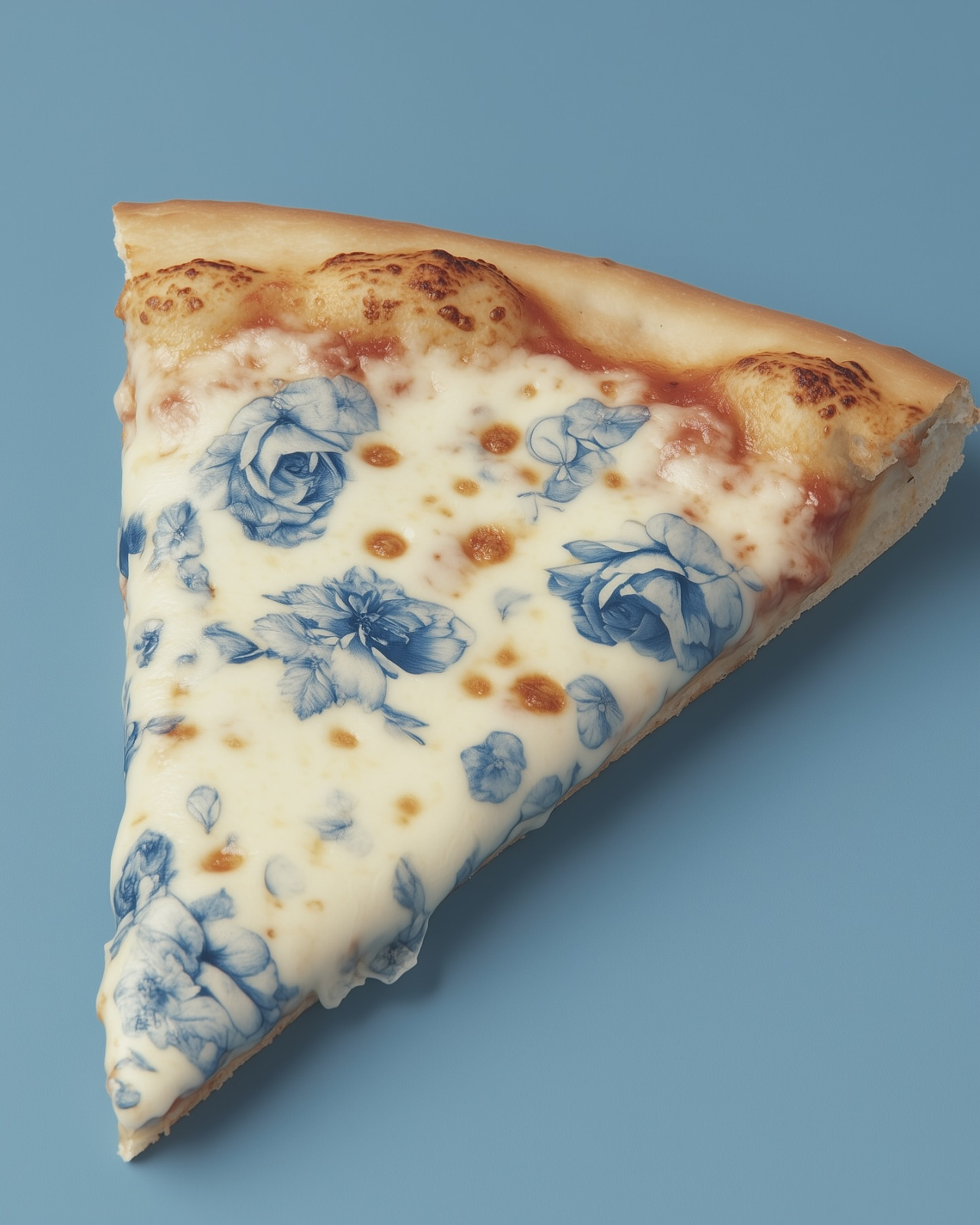
This image serves as a visual example of Neo-Dadaism, a style that embraces absurdity and the playful blending of high and low culture to subvert expectations. It humorously juxtaposes the golden-brown crust of a standard pizza slice against a delicate, hand-painted floral pattern that resembles a piece of porcelain rather than actual food. To someone who cannot see it, this creates a confusing but funny visual oddity where an edible object is treated as an abstract painting to highlight the surreal nature of modern meme culture.
detailed-analysis (gemma3_27b-it-q8_0)
Okay, let's dissect this image of a pizza slice adorned with a floral pattern through the lens of Neo-Dadaism, and other theoretical frameworks where applicable.
Visual Description
The image depicts a single slice of pizza, cut in a standard triangular shape, set against a solid, cool-toned blue background. The crust is golden brown and slightly puffed, exhibiting a slightly uneven texture. The cheese is melted and bubbly, but overlaid with a delicate, intricately patterned blue floral design – reminiscent of traditional porcelain or Delftware. This floral pattern abruptly stops before reaching the crust, creating a stark contrast between the manufactured simplicity of the pizza and the ornate, hand-painted aesthetic of the flowers. The lighting is soft and diffused, making the image appear clean and somewhat surreal. It is a photograph, not a painting, but strives for a flatness akin to painting.
Neo-Dadaism
This image operates strongly within Neo-Dadaist principles. Neo-Dada (emerging in the late 1950s and 60s) was a rejection of the perceived seriousness and preciousness of Abstract Expressionism, and a revival (though a very different version) of the original Dada movement's spirit of anti-art, absurdity, and the elevation of the mundane.
Here’s how it plays out:
- Ready-made/Found Object: The pizza slice itself is inherently a mundane, mass-produced object. Like Duchamp’s Fountain, it takes something ordinary and presents it as “art.” It isn't crafted as art in the traditional sense; it is a thing.
- Juxtaposition of the Incompatible: The fusion of the "low" culture pizza with the "high" culture aesthetic of delicate porcelain patterns is deeply Neo-Dadaist. Dada and Neo-Dada thrived on combining incongruous elements. This clash breaks down traditional hierarchies of artistic value. It's about forcing a confrontation, challenging the viewer’s expectations.
- Anti-Art Sentiment: The image undermines the very idea of "good taste" or aesthetic harmony. It’s a playful, ironic disruption of established norms. The artist isn’t trying to create something beautiful in a conventional sense; they’re questioning what constitutes beauty and value in the first place.
- Emphasis on Chance and the Absurd: The unexpectedness of the floral pattern on a pizza is inherently absurd. There's no logical reason for this combination, making it a gesture of deliberate irrationality.
- Pop Art influence - This image also demonstrates a clear influence of Pop Art, another movement emerging during the same period, which frequently integrated everyday objects into art.
Postmodernism
The image’s inherent playfulness and deconstruction of categories firmly places it within a postmodern framework.
- Deconstruction: The image deconstructs the categories of "high" and "low" art, “food” and “decoration.” It doesn’t propose a new unified aesthetic, but instead revels in the fragmentation of meaning.
- Simulation & Hyperreality: The floral pattern isn't actually on the pizza. It's a representation, a simulation of something else. This alludes to Baudrillard's concept of hyperreality—where simulations become more real than the real itself. We're not experiencing a pizza; we’re experiencing an image of a pizza, overlaid with a simulation of delicate floral artwork.
- Irony & Parody: The image is likely ironic. It's not sincerely attempting to make the pizza more beautiful or artistic. It's playfully mocking the conventions of both fine art and consumer culture.
Critical Theory
From a critical theory standpoint (particularly drawing from the Frankfurt School), the image could be seen as a commentary on the commodification of culture.
- Culture Industry: The pizza represents mass-produced, standardized culture – a product of the "culture industry" as described by Adorno and Horkheimer. The floral pattern, by appropriating a traditionally refined aesthetic, ironically "elevates" this mass-produced item, but ultimately doesn’t challenge its fundamental commodified nature. It's a superficial gesture, a “coating” of culture that doesn't alter the underlying system.
- Loss of Aura: The image reinforces the concept of the loss of the "aura" (as described by Walter Benjamin). The pizza, as a mass-produced item, lacks the unique, historical authenticity of a handcrafted artwork. The imposed floral pattern doesn't restore the aura; it merely highlights its absence.
Foucauldian Genealogical Discourse Analysis
Foucault's ideas are applicable as this image implicitly comments on power structures and how seemingly benign things can be tools of control and shaping our perceptions.
- Discursive Formation: The image disrupts the established "discourse" around food – it’s normally about nourishment, enjoyment, or practicality. Here, the pizza becomes a site for aesthetic play, a canvas for cultural appropriation.
- Power/Knowledge: The very act of taking a mundane object and re-contextualizing it as art is an exercise of power. The artist has the power to define what is considered art, and to challenge conventional ways of seeing. It shifts the discourse, suggesting that even something as basic as a pizza slice can be a vessel for complex meaning.
In summary: This image is a potent example of Neo-Dadaist practice. It embodies the movement's core principles of challenging artistic conventions, embracing absurdity, and deconstructing the boundaries between high and low culture. The image invites multiple readings through a number of critical frameworks, highlighting its complex engagement with modern and postmodern concerns.
simple-description (llama3.2-vision_11b)
In the context of Neo-Dadaism, this meme is a playful subversion of traditional art forms. The image is a pizza with a "fart in a jar" (a common Dadaist reference) made of pizza dough, with a "fart" in the center. The text "I can smell the pizza" appears on the image, poking fun at the idea of a pizza that's not even a pizza, but a "fart" in a jar.
detailed-analysis (gemma3-27b-vision)
Okay, let's analyze this rather unusual image of a floral-patterned pizza slice, using the frameworks requested.
Visual Description
The image presents a single slice of pizza, positioned at a slight angle on a flat, teal-blue background. The pizza slice is triangular, a standard shape, but is overlaid with a repeating pattern of blue and white floral designs, resembling porcelain china or a delicate toile fabric. The cheese appears melted and bubbly in spots, with golden-brown, slightly burnt edges, indicating it’s been baked. The floral pattern covers almost the entirety of the cheesy surface, creating a striking juxtaposition between the casual, commonplace nature of pizza and the decorative, traditionally 'refined' aesthetic of the floral design. The lighting is soft and even, accentuating the textures of both the pizza and the floral pattern.
Postmodernism
This image is very firmly within a Postmodern frame. The core principle of Postmodernism is the blurring of boundaries and the deconstruction of hierarchies. This pizza slice embodies that perfectly. We have the everyday, 'low' culture object of pizza, traditionally associated with casual consumption and often fast food, being adorned with a pattern historically linked to 'high' culture – fine china, aristocratic homes, delicate artistry.
- Pastiche & Irony: The image employs pastiche – a mixing of styles – and a layer of irony. It is not simply putting flowers on pizza, it is transforming the pizza into a surface for a traditionally ornamental pattern. This challenges the notion of "authentic" forms and the boundaries between art, design, and everyday objects.
- Deconstruction of Signifiers: The signifier “pizza” typically evokes specific associations (comfort food, casual dining, etc.). The addition of the floral pattern disrupts these established meanings, forcing the viewer to re-evaluate the object. Is it still pizza? Or is it something else entirely?
- Simulacra and Simulation: The floral pattern isn’t ‘real’ on the pizza, it’s a surface decoration, a simulation of a porcelain surface. This points toward the postmodern concept of simulacra - copies that have become detached from the original, existing as hyperrealities.
Foucauldian Genealogical Discourse Analysis
Michel Foucault's genealogical method explores the historical and cultural forces that have shaped our understanding of concepts and power dynamics. To analyze this image using this lens, we need to consider the discourses surrounding both pizza and the floral pattern.
- Pizza and the Discourse of ‘Italianness’: The history of pizza is deeply intertwined with the construction of 'Italian' identity. It became a symbol of immigration, working-class culture, and then, over time, a mainstream American staple. The simple, direct form of pizza aligns with a perceived authenticity, as opposed to more elaborate cuisine. This image disrupts that discourse by layering a "refined" pattern onto a traditionally 'rustic' food.
- Floral Patterns and the Discourse of Femininity/Domesticity: The floral pattern, especially in the toile style, is historically linked to the domestic sphere, femininity, and the aristocracy. It represents concepts of beauty, refinement, and controlled naturalness. This image appropriates that historical context.
- Power/Knowledge: The image can be seen as demonstrating how power operates through the control of categories and aesthetic judgment. 'Low' vs 'High' culture, 'rustic' vs 'refined' – these are not inherent qualities but socially constructed ones. The pizza slice challenges these categories and, thus, the power structures that uphold them.
Critical Theory
Applying a broad Critical Theory framework (influenced by thinkers like Adorno and Horkheimer), we can see this image functioning as a commentary on the increasing commodification of culture and the erosion of genuine experience.
- Culture Industry: The image can be interpreted as a manifestation of the ‘culture industry’ – the production of standardized cultural goods (including aesthetics) for mass consumption. The juxtaposition of pizza and flowers seems to suggest the flattening of cultural distinctions, where everything becomes interchangeable and surfaces become more important than substance.
- Loss of Aura: Walter Benjamin’s concept of ‘aura’—the sense of uniqueness and authenticity associated with a work of art—is arguably diminished here. The pizza slice, already a mass-produced item, is further stripped of its essential qualities by being transformed into a decorative object.
- Critique of Consumerism: This image can be read as a subtle critique of consumer culture, where aesthetics are often prioritized over functionality and genuine experience. The pizza slice becomes a symbol of superficiality and the pursuit of novelty.
Marxist Conflict Theory
From a Marxist perspective, the image can be viewed through the lens of class and the appropriation of cultural symbols.
- Cultural Capital: The floral pattern, historically associated with the upper classes, represents a form of cultural capital. By placing it on a pizza slice – a food traditionally associated with the working class – the image creates a visual tension. It can be interpreted as a commentary on the blurring of class lines or, conversely, the continued assertion of dominance by the upper classes.
- Commodification of Culture: The image is a prime example of how culture is commodified and used to create economic value. The floral pattern, once a symbol of aristocratic taste, is now a marketable aesthetic that can be applied to anything, including a pizza slice.
- False Consciousness: The image could be seen as contributing to a form of "false consciousness," where the superficial appearance of cultural integration masks underlying class divisions and power imbalances.
Queer Feminist Intersectional Analysis
While potentially less immediately apparent, a Queer Feminist Intersectional lens offers interesting readings:
- Subversion of Gendered Spaces: Traditionally, floral patterns are strongly associated with femininity and domesticity. Placing it on pizza - often a 'masculine' food and associated with public spaces - disrupts these gendered associations. This subversion can be seen as challenging heteronormative expectations.
- Reclaiming & Recontextualizing: Reclaiming traditionally 'feminine' aesthetics and applying them to something unexpected can be a form of empowerment. The image challenges the idea that floral patterns are inherently delicate or passive.
- Intersectional Critique of Taste: "Good taste" is historically shaped by class and gender. The image challenges the notion of a single, universal standard of taste, suggesting that aesthetic preferences are culturally constructed and subject to power dynamics.
- Disruption of Expected Consumption: The image disrupts the "expected" experience of consuming pizza. It asks us to question our assumptions about food, aesthetics, and cultural boundaries, potentially sparking a conversation about inclusivity and the challenging of established norms.
It's important to remember that these analyses are interpretations, and the image is open to multiple readings. The beauty of art (and even an image like this) lies in its ability to evoke complex and nuanced responses.
simple-description (llama3.2-vision)
This meme features a pizza with a slice missing, but instead of a normal filling, the missing slice has been replaced with a picture of a pizza itself. The text "I pizza myself" appears in the image, suggesting that the person has a sense of humor about their own pizza addiction.