First Seen
2023-05-10T21:03:36+00:00
simple-description (llama3.2-vision_11b)
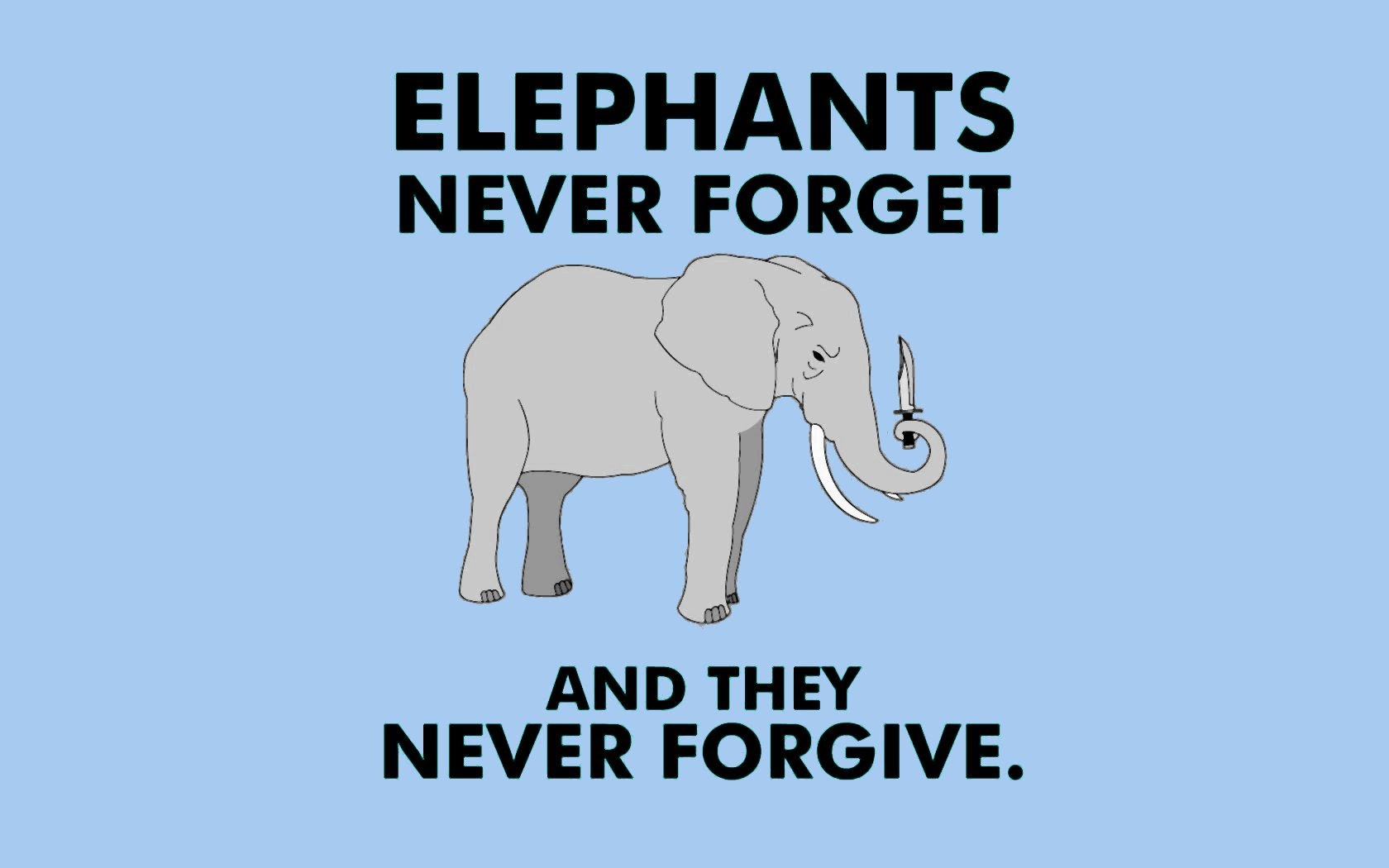
The meme is a play on the concept of Neo-Dadaism, a art movement that emphasizes the irrational and the absurd. The image depicts a cartoon elephant holding a knife and a fork, with the text "Elephants never forget. And they never forgive." This meme is a humorous take on the idea that elephants have exceptional memory, but also a twisted sense of revenge. The text is a clever play on words, using the elephant's reputation for good memory to imply a vengeful nature.
detailed-analysis (gemma3-27b-vision)
Okay, here's an analysis of the image, broken down by the requested theoretical frameworks. I'll indicate when a section isn't applicable, and provide a depth of analysis appropriate to the image's simplicity.
Visual Description
The image is a simple digital illustration on a pale blue background. The focal point is a grayscale depiction of a side-view of an elephant. The elephant is drawn in a cartoonish style, with simplified anatomy and outlines. It has large tusks and a slightly raised trunk.
Above the elephant, in bold, black capital letters, is the text "ELEPHANTS NEVER FORGET." Below the elephant, also in bold, black capital letters, reads "AND THEY NEVER FORGIVE." The overall aesthetic is somewhat stark and declarative, resembling a poster or warning.
Foucauldian Genealogical Discourse Analysis
This image lends itself well to a Foucauldian analysis because it implicitly establishes a discourse around memory, revenge, and power dynamics.
- Discourse & Knowledge/Power: The statement "Elephants never forget and never forgive" constructs a knowledge about elephants – a specific understanding of their cognitive and emotional capacities. This isn’t necessarily true scientifically, but the statement performs a certain knowledge and attributes to elephants. This "knowledge" isn't neutral; it associates them with a sense of long-held grievance and potential retribution. This associates knowledge with power - by defining an animal's characteristics we exercise control over how they are seen.
- Genealogy of the Statement: To trace the genealogy, we'd ask: Where did this idea come from? Likely, it’s a combination of observation of elephant behavior, folklore, and metaphorical extension to human behavior. Historically, this trope might have emerged from instances where elephants demonstrated a robust memory related to location of resources or recognizing threats/individuals, which then became amplified and imbued with a moral dimension (forgiveness/revenge).
- Power/Knowledge Relation: The statement operates as a form of power/knowledge because it shapes how we perceive elephants and potentially justifies certain interactions with them. If elephants are believed to hold grudges, it may subtly influence how people treat them, creating a self-fulfilling prophecy. It can also be used as a cautionary tale about holding onto grievances.
Critical Theory
This image invites a critique through the lens of Critical Theory, particularly focusing on the construction of "otherness" and the association of particular traits with marginalized groups.
- Othering & Essentialism: The statement essentializes elephants by attributing to them a single, defining characteristic – their unwavering memory and unforgiving nature. This creates a sharp boundary between “elephants” and “other” beings (like humans, who are supposedly more capable of forgiveness). This framing can reinforce a simplistic “us vs. them” dynamic.
- Implicit Moral Judgement: The addition of “and they never forgive” carries a moral weight. It positions forgiveness as a virtue, and by contrasting it with the elephant's perceived inability to forgive, it implicitly critiques the elephant's behavior. This reinforces a particular normative framework for acceptable emotional responses.
- Power Dynamics: The image subtly reinforces human dominance by defining and judging an animal's inherent traits. This act is an assertion of power, where humans position themselves as the arbiters of acceptable behavior, even for non-human species.
Marxist Conflict Theory
While the image isn't overtly political, a Marxist reading can explore the underlying theme of retribution and resource control.
- Conflict & Resource Control: The implied “never forgive” aspect can be read as a metaphor for long-standing conflicts over resources. Elephants, as large herbivores, are often in competition with humans and other animals for food and space. The statement could be interpreted as a warning about the consequences of exploiting or displacing them.
- Class Struggle (Metaphorically): The “unforgiving” elephant could symbolize a historically oppressed group seeking justice or retribution for past wrongs. The image, then, becomes a subtle commentary on the dynamics of power and the consequences of exploitation. However, this is a highly metaphorical reading.
Postmodernism
This image can be read through a Postmodern lens by deconstructing the “truth” behind the statement.
- Deconstruction of "Truth": The claim that "Elephants never forget" is a generalization and likely an exaggeration. Postmodernism would question the very notion of objective truth and highlight how this statement is a construction of language and cultural belief, rather than a verifiable fact.
- Simulacra & Hyperreality: The image presents a simplified, symbolic representation of elephants – a simulacrum. It creates a representation that may have little connection to actual elephant behavior, instead existing as a self-referential symbol of memory and retribution.
- Loss of Grand Narratives: The statement implicitly relies on a “grand narrative” about justice and revenge. Postmodernism would challenge the validity of such overarching narratives, suggesting that meaning is always contextual and fragmented.
Queer Feminist Intersectional Analysis
This is the least applicable framework here, but can still be approached.
- Power Imbalances: While centered on an animal, we can pull the idea of "never forgetting" to the context of historical and ongoing oppression. For example, how groups impacted by systematic discrimination "never forget" their experiences, and the importance of holding accountable those who inflict harm.
- Memory & Trauma: The concept of "never forgetting" is central to understanding trauma, particularly as experienced by marginalized communities. The image can be read as a metaphor for the enduring impact of trauma and the need for acknowledgment and healing.
- Non-Human Animal Rights: While not directly addressing gender or sexuality, the image indirectly raises questions about the ethical treatment of animals. From a Queer Feminist lens, this can connect to broader concerns about challenging systems of domination and advocating for the rights of all beings.
I hope this comprehensive analysis provides a nuanced understanding of the image through these diverse theoretical frameworks! Let me know if you’d like me to elaborate on any specific point.
simple-description (llama3.2-vision)
This meme is a play on the common phrase "elephants never forget" and features a cartoon elephant holding a knife and a fork, implying that they can indeed forget and forgive. The text above the elephant reads "Elephants never forget... and they never forgive" in a sarcastic tone, poking fun at the idea that elephants are known for their exceptional memory.
tesseract-ocr
ELEPHANTS NEVER FORGET ays AND THEY NEVER FORGIVE.