First Seen
2023-05-10T21:03:36+00:00
simple-description (llama3.2-vision_11b)
The meme is a play on the concept of Neo-Dadaism, an art movement that challenges traditional notions of art and aesthetics. The image shows a series of seemingly unrelated objects, including a chair, a lamp, and a book, arranged in a way that creates a sense of absurdity and chaos. The text overlay reads "I can explain it, but the explanation is too long and boring".
In the context of Neo-Dadaism, this meme pokes fun at the idea of trying to explain something that is inherently absurd or illogical. The image is a commentary on the futility of trying to understand or explain something that is fundamentally nonsensical.
detailed-analysis (gemma3-27b-vision)
Okay, let's break down this image and its inherent memetic humor through several critical lenses. It’s worth noting that this is a deliberately absurd image, so applying high-level theory will reveal the absurdity and how those theories might illuminate even silliness.
Visual Description
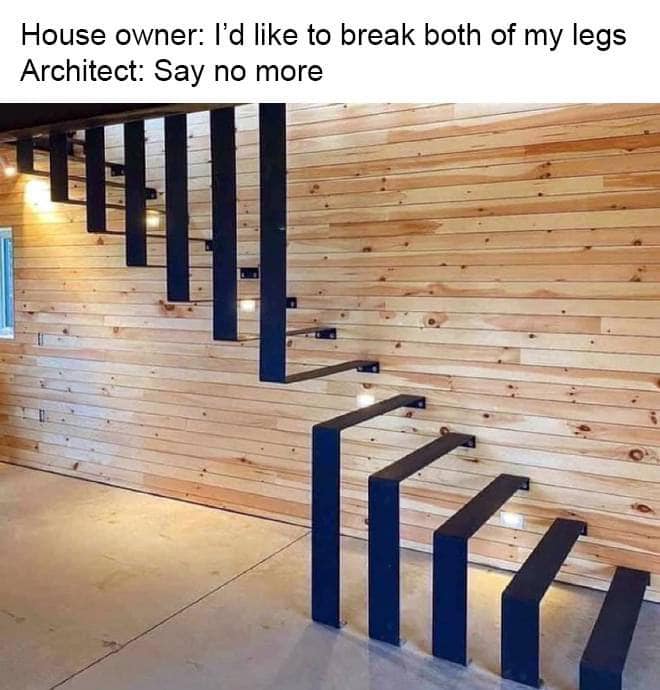
The image depicts a staircase constructed of simple, black metal supports and what appears to be exposed concrete or stone treads. The staircase is strikingly minimalist. It lacks any handrail or safety features beyond the treads themselves. The supports are thin, vertical rectangles, creating a visually "floating" effect for the steps. The background is a wall clad in light-colored, horizontally laid wooden planks, adding a rustic, unfinished aesthetic. The stairs are dramatically steep and appear rather treacherous. The caption reads: "Owner: I'd like to break both my legs. Architect: Say no more."
Foucauldian Genealogical Discourse Analysis
This image, interpreted through a Foucauldian lens, highlights how power operates through discourse and the shaping of "normality." The "owner" articulates a desire – a desire for a painful experience. The architect’s response ("Say no more") isn't about care for the owner, but completion of the statement. The architect takes the owner's absurd desire and actualizes it.
The staircase isn’t simply a functional object; it’s a materialized discourse of risk, danger, and the acceptance of bodily harm. Traditionally, architecture is meant to protect the body, to provide safe passage. This staircase actively threatens it. The architect isn’t merely designing space; they are constructing a specific regime of truth—one where vulnerability and potential injury are not avoided, but enthusiastically embraced (even if tongue-in-cheek). The image functions as a genealogical “excavation” of the relationship between design and bodily harm, showing how seemingly neutral architectural choices can become sites of power and potential injury.
Critical Theory (Specifically, Adorno & Horkheimer)
From the perspective of the Frankfurt School and thinkers like Adorno and Horkheimer, this image exemplifies the logic of domination inherent in instrumental reason. The architect doesn't engage with the owner's stated desire, or consider the implications of it. Instead, the architect focuses solely on "fulfilling" it— turning it into a quantifiable, engineered outcome. The result is an object devoid of ethical considerations, driven purely by technical execution.
The staircase embodies a form of "technical rationality" that prioritizes efficiency and design purity over human safety and well-being. It mirrors the larger cultural trend of turning all aspects of life into commodities or technical problems to be solved, disregarding intrinsic values. The aesthetic minimalism, while visually appealing, is actually masking a disregard for the user’s fundamental needs— the need for safety and comfortable movement.
Postmodernism
This image is a perfect example of Postmodern irony and the deconstruction of functional norms. It's a self-aware parody of architectural design. Traditional architecture valued form following function. This staircase boldly inverts that principle. It's aesthetically striking but utterly impractical.
The humor derives from the blatant disregard for usability. Postmodernism often celebrates pastiche, irony, and the fragmentation of grand narratives. The image is a fragment – a single, absurd staircase – that undermines the idea of architecture as a noble, service-oriented profession. It's saying, "We can design anything, even something deliberately dangerous, and call it art!"
Queer Feminist Intersectional Analysis (Applicable, though somewhat stretched)
While not a primary focus, a queer-feminist reading could touch on the construction of bodies within architectural space. The staircase disables those who do not fit an assumed ideal of physical ability. The steepness and lack of safety features create a space that is inherently unwelcoming or even hostile to individuals with mobility impairments, elderly individuals, or anyone who doesn't conform to a standard of physical fitness and agility.
Furthermore, the image can be interpreted as a subtle commentary on the historical exclusion of marginalized bodies from spaces of power and comfort. The staircase actively excludes, mirroring broader societal structures that create barriers for certain groups. The architect, in fulfilling the owner's request, is complicit in this exclusionary practice. The humor masks a more subtle critique of architectural design that often prioritizes aesthetics over accessibility and inclusivity.
Let me know if you would like any of these analyses elaborated upon, or if you'd like me to explore another critical lens!
simple-description (llama3.2-vision)
This meme is a humorous image of a staircase with the railings removed, implying a reckless and reckless attitude. The text at the top reads "House owner: I'd like to break both of my legs" and the response from the architect is "Say no more". The joke is that the house owner is requesting a design that would intentionally cause harm, and the architect is simply agreeing to the request.
tesseract-ocr
House owner: I'd like to break both of my legs Architect: Say no more a a ss eS . hr Sj — - 5 ee i ir. UC <i : =i = — i. z = a E ——— : = = = =< : = ss . f : ss