First Seen
2025-06-07T06:06:24+00:00
simple-description (qwen3.5_2b-q8_0)
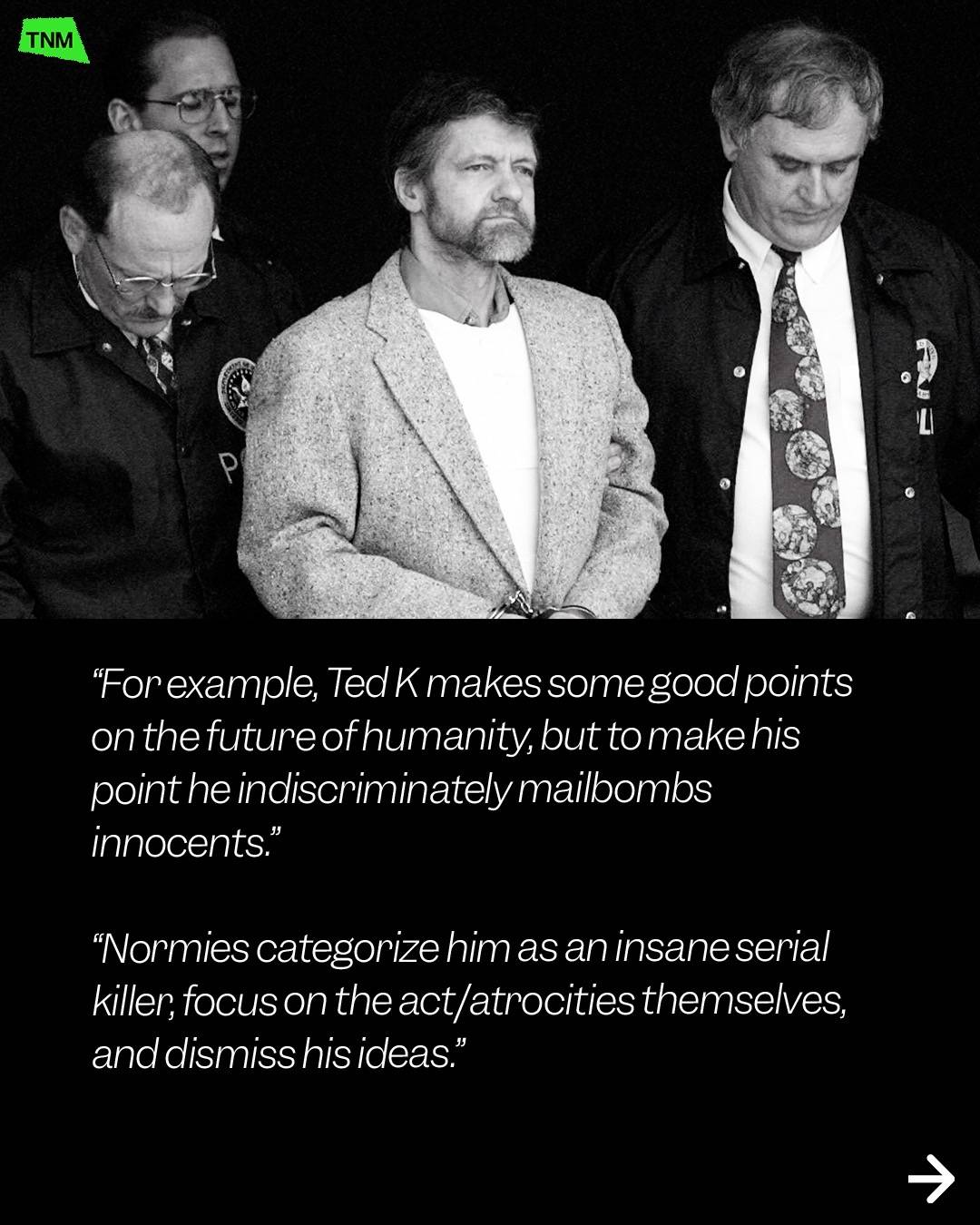
This meme plays on the internet trend known as "Neo-Kaczynskiism," which references the persona of T.J. Normies, a former collaborator for Kaczynski's real-world Unabomber. It humorously suggests that the person pretending to be the "Unabomber" is actually just a normal guy, creating a sharp contrast between this "Normie" persona and the actual Ted Kaczynski. The image's text highlights the absurdity: while the person impersonating the Unabomber makes "good points" about humanity, the real Kaczynski is shown in handcuffs, with "Normies" dismissing his ideas and focusing solely on the crimes.
detailed-analysis (gemma3_27b-it-q8_0)
Okay, let's break down this meme through the lens of Neo-Kaczynskiism. This is a complex ideological space, so the analysis will be detailed. I'll focus on the areas that most directly apply – namely Critical Theory and a degree of Postmodernism. There's not much to be gained from Queer Feminist Intersectional Analysis or Marxist Conflict Theory here.
Before we begin: Neo-Kaczynskiism is a contemporary political and philosophical tendency that draws heavily from the writings of Ted Kaczynski (the "Unabomber") but generally disavows the violence of his actions, focusing instead on his critique of modern technology and its societal effects. It is often associated with dark enlightenment, accelerationist thought, and a deep skepticism toward the modern world.
Visual Description
The image depicts Ted Kaczynski in a mugshot, flanked by two men in what appears to be law enforcement or federal agent attire. The composition is stark, black and white, lending it a severe, almost iconic quality. The central focus is Kaczynski's intense, unwavering gaze. The overall effect emphasizes Kaczynski’s isolation, but also his perceived resistance to the system represented by the figures around him.
Critical Theory
This meme hits hard at the heart of a core concern within Critical Theory, specifically as it intersects with Neo-Kaczynskiism: the relationship between critique and action. The initial statement – "For example, Ted Kaczynski makes some good points on the future of humanity, but to make his point he indiscriminately mailbombs innocents." – highlights a deeply uncomfortable tension.
- Critique of Instrumental Reason: Kaczynski's central argument, as understood through this lens, isn’t about hating people; it’s a critique of the instrumental reason that permeates modern technological society. He argued that technology is not neutral, but shapes human behavior and ultimately destroys human freedom. Neo-Kaczynskiists frequently echo this concern, believing that the "system" dehumanizes individuals.
- The Problem of Legitimacy: The meme implicitly challenges the notion of legitimate critique. Can a profound analysis of societal ills ever justify violence? Neo-Kaczynskiism grapples with this. They may dismiss the violence as a tragic flaw, an understandable (though regrettable) consequence of desperation, or even a necessary (though ineffective) attempt to disrupt the system. The meme, however, presents this as a contradiction that disqualifies Kaczynski's insights.
- Power/Knowledge: The second statement—"Normies categorize him as an insane serial killer; focus on the atrocities and dismiss his ideas."—is deeply critical of the dominant discourse surrounding Kaczynski. It's a classic example of Foucault’s idea that power operates through knowledge. "Normies" (a dismissive term for mainstream society) deploy the category of "insane serial killer" to discredit Kaczynski's ideas, effectively silencing dissent. This categorization, the meme argues, is not based on a neutral assessment of his work, but is a power move designed to maintain the status quo.
- Ideology Critique: The meme implicitly points out that the “normie” framing of Kaczynski serves an ideological purpose—it protects the technological system from critical scrutiny. The meme's adherents would argue that dismissing Kaczynski as simply "crazy" allows people to avoid confronting the uncomfortable truths he identified.
Postmodernism
A thread of Postmodernism is evident in the meme's deconstruction of the "truth" about Kaczynski.
- Rejection of Grand Narratives: Neo-Kaczynskiism, in a way, rejects the grand narrative of progress that drives technological development. Kaczynski's critique is fundamentally anti-modern, and this perspective aligns with Postmodern skepticism toward universal truths.
- Social Construction of Reality: The meme suggests that Kaczynski's image and reputation are constructed by societal forces ("Normies"). Reality is not objective; it's shaped by the dominant narratives and power structures. The "insane serial killer" label is not an inherent truth about Kaczynski; it's a label applied to him by a society that feels threatened by his ideas.
- Discourse as Power: The meme shows how language is used to control the narrative. The categorization of Kaczynski as insane isn’t a neutral description, it's a tool used to marginalize his critique and uphold the existing power structures.
Foucauldian Genealogical Discourse Analysis
(While not the primary focus, touches on this through Critical Theory)
Foucault's genealogical method traces the historical evolution of concepts and power relations. This meme engages with this by hinting at the history of how the figure of the "terrorist" or "radical" is constructed. The label of "insane serial killer" is not timeless, but a product of specific historical and social forces. It’s a way of rendering Kaczynski legible within the dominant framework of criminality and pathology, rather than considering him as a philosophical critic.
In conclusion: This meme is more than just a provocative statement about a controversial figure. It's a condensed expression of Neo-Kaczynskiist anxieties about the suppression of critical thought, the power of dominant narratives, and the insidious effects of technological society. It’s a defiant attempt to reclaim Kaczynski’s ideas from the stigma attached to his actions and to reignite a debate about the future of humanity. It subtly signals a position outside mainstream thought, and a rejection of the ways in which the mainstream attempts to categorize and control dissenting voices.
simple-description (llama3.2-vision_11b)
The meme is a humorous take on the concept of Neo-Kaczynskiism, a philosophical movement that explores the intersection of technology and human nature. The meme uses a quote from a fictional character, "I'd like to say I'm not a fan of the way the world is," to poke fun at the idea that people are often more interested in their own lives than in making the world a better place. The meme is a lighthearted commentary on the human tendency to prioritize personal interests over the greater good.
detailed-analysis (gemma3-27b-vision)
Here's an analysis of the image and text, broken down by the requested theoretical lenses. Note that some lenses will be more relevant than others.
Visual Description
The image is a grainy black and white photograph. It appears to be a courtroom or official setting, with three men in suits standing close to each other. The central figure is clearly Ted Kaczynski (also known as the Unabomber), identified by his signature look—hooded sweatshirt under a suit jacket. His expression is somber, looking downward. The two men flanking him seem to be discussing something, glancing at each other. The overall composition suggests a moment of tension and formality. The image's quality (grainy, in black and white) lends it an air of historical documentation. The TNM watermark is in the upper left corner.
Foucauldian Genealogical Discourse Analysis
This image and accompanying text lend themselves well to a Foucauldian analysis.
- Discourse & Power: The text establishes a discourse around Ted Kaczynski, not just as a criminal, but as someone who has "points" about the future of humanity. This frames him as an intellectual, not merely a violent actor. The “normies” dismissing his ideas are performing a power dynamic—silencing a voice they deem dangerous by framing it as insane, thereby controlling the narrative. The act of defining Kaczynski as "insane" isn't a neutral observation, but a method of disqualification—removing his ideas from legitimate debate.
- Genealogy of "Insanity": We could trace the genealogy of the concept of “insanity” as it relates to criminality. How did the idea of “insanity” as a legal and social defense emerge? What power structures does this concept serve? The text suggests that labeling Kaczynski “insane” is a way of avoiding engaging with the potentially unsettling ideas he espoused, thus maintaining the status quo.
- Panopticism/Surveillance: The courtroom setting itself evokes panoptic elements. The surveillance of Kaczynski's ideas and actions is apparent in this context. The courtroom is a site of surveillance and normalization, of defining what is acceptable thought and behavior.
Critical Theory
This image and text raise several critical theory points.
- The Problem of Enlightenment Reason: Kaczynski’s manifesto critiques the dangers of technological advancement and the alienation it creates. While his methods were horrific, the text hints at a legitimate concern with the consequences of modern, technologically driven society—a concern rooted in the critique of Enlightenment rationality. The text suggests a critique of the idea that unchecked reason and progress are inherently good.
- The Role of Ideology: The statement “Normies…dismiss his ideas” suggests that mainstream thought operates under certain ideological constraints. It implies that “normies” are unable or unwilling to engage with ideas that challenge the dominant worldview, thus reinforcing the existing power structure. It's about how dominant ideologies work to suppress or discredit dissenting voices.
- The Dialectic of Violence: The text implies a dangerous dialectic. The implication is that dismissing uncomfortable ideas can fuel radicalization, even if one disagrees with the methods. It's not justifying violence, but rather pointing out that silencing dissent can have unintended consequences.
Marxist Conflict Theory
- Alienation: Kaczynski’s manifesto (and the text’s reference to it) is heavily concerned with alienation—the separation of individuals from their labor, from nature, and from each other. This is a central tenet of Marxist thought. The text, even with its troubling framing, acknowledges the core of Kaczynski’s critique of industrial society and its impact on human experience.
- Class Conflict (Indirectly): While not explicitly stated, Kaczynski's focus on the dehumanizing effects of technology can be seen as a critique of the capitalist mode of production and its reliance on alienation and exploitation. The "normies" dismissing his ideas could be seen as representatives of the status quo defending a system that benefits them.
- Power Structures: The dismissal of Kaczynski’s ideas is itself a demonstration of power. Those who control the narrative (i.e., "normies") can silence dissenting voices and maintain the existing order.
Postmodernism
- Deconstruction of Truth: The text hints at a postmodern questioning of “truth” and “reason.” The fact that someone like Kaczynski can have "good points" suggests that there isn't a single, objective truth, but rather multiple perspectives and interpretations.
- The Rejection of Grand Narratives: Kaczynski's manifesto rejects the “grand narrative” of progress, arguing that technology and industrialization are not inherently beneficial. This aligns with a postmodern skepticism towards universal claims and metanarratives.
- Subjectivity and Interpretation: The text suggests that interpretation is subjective. The fact that some people see Kaczynski as simply insane, while others acknowledge his ideas, highlights the role of individual perspectives in shaping understanding.
Important Caveat: It's crucial to emphasize that analyzing these concepts in relation to Kaczynski does not constitute endorsement of his actions or beliefs. The goal is to use theoretical frameworks to understand the complexities of the discourse surrounding him and his ideas, not to excuse violence or justify extremism.
simple-description (llama3.2-vision)
The meme is a satirical commentary on the "good" and "bad" that make for the of . It features an image of Ted K and for . The text below the image quotes for and . The meme pokes at that to and to .