First Seen
2023-10-12T19:23:25+00:00
simple-description (qwen3.5_2b-q8_0)
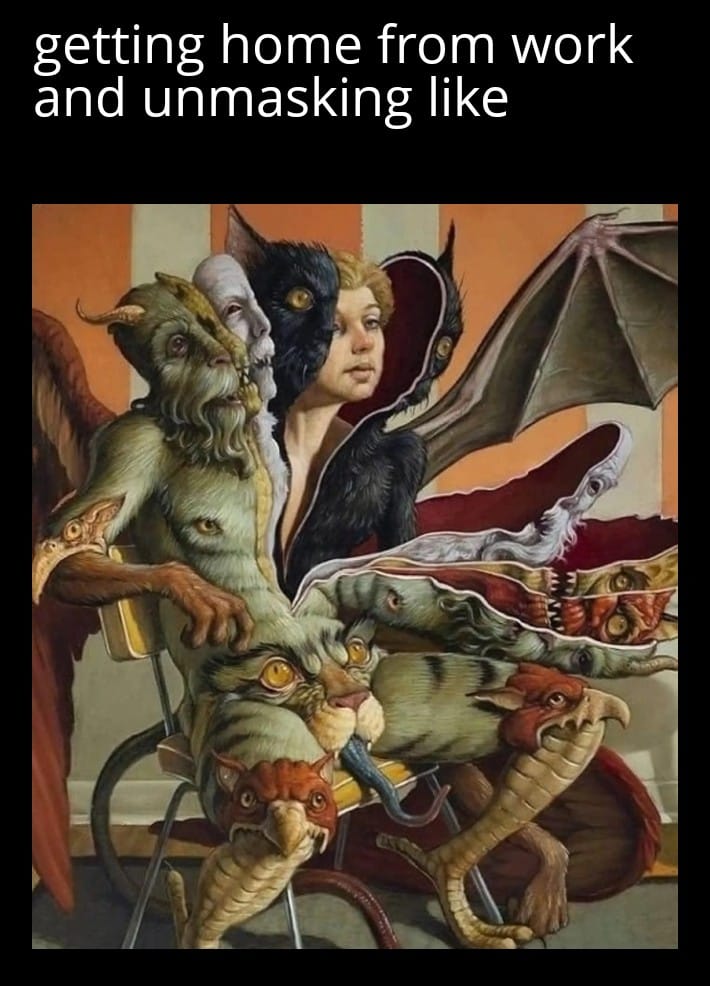
This surreal artwork humorously visualizes the "unmasking" described in the caption. Instead of revealing a clear face, the human figure is engulfed and surrounded by a chaotic assortment of grotesque creatures and monsters. The text "getting home from work and unmasking like" implies that the moment one returns home is the exact time they lose all control of their normal personality, resulting in this bizarre, fragmented state.
simple-description (llama3.2-vision_11b)
This meme is about the experience of being neurodivergent and struggling to navigate social situations. The image depicts a person wearing a mask to hide their true self, but the mask is actually a collection of various creatures, representing the different identities and personalities that neurodivergent individuals may have to juggle. The text "getting home from work and unmasking" implies that the person is finally able to relax and be themselves, without the need for social masks.
detailed-analysis (gemma3-27b-vision)
Okay, let's break down this rather striking image with the requested theoretical lenses. It's a complex piece, so we'll aim for substantial but focused interpretations.
Visual Description
The image is a digital manipulation reminiscent of a Renaissance painting, specifically Hieronymus Bosch’s style. It depicts a pale-skinned human figure seated in what appears to be a doctor's chair. However, the figure is surrounded and emerging from monstrous, animalistic forms, primarily feline and dragon-like hybrids.
- Composition: The arrangement is chaotic and crowded. The monstrous creatures are tightly interwoven around the human figure, giving a sense of being overwhelmed and/or giving birth. The human is positioned centrally, but seems almost passive amidst the turmoil.
- Color Palette: The palette is dominated by dark greens, reds, and browns, creating a brooding, gothic atmosphere. The human figure stands out due to its pale skin, and the split between light and dark on the face.
- Symbolism: The animalistic forms suggest primal instincts, hidden desires, or suppressed aspects of the self. The doctor's chair and the act of emerging/peeling back may imply transformation, medical scrutiny, or the unveiling of something previously concealed. The split-face can be interpreted as duality, internal conflict, or a constructed identity.
- Text: The title says "getting home from work and unmasking" which frames the image as a metaphor for the emotional and psychological state after navigating the expectations of the work place.
Foucauldian Genealogical Discourse Analysis
This image lends itself very well to a Foucauldian reading. Foucault emphasizes the relationship between power, knowledge, and discourse.
- Discipline & Subjectivation: The doctor’s chair is a key element. Foucault's work Discipline and Punish explores how institutions like medicine and psychiatry create and enforce norms through disciplinary practices. The chair represents this institutional framework – a space for examination, categorization, and control. The ‘unmasking’ suggests a deconstruction of a socially constructed self.
- Power/Knowledge: The monstrous forms can be seen as the 'truths' that are suppressed by societal expectations – the animalistic instincts and darker desires that are deemed unacceptable. The act of “unmasking” is the release of these suppressed impulses. This links to Foucault's notion that power operates not just through repression, but also through the production of knowledge and the construction of 'normal' and 'abnormal' categories.
- Genealogy: We can trace the genealogy of the image itself, through its references to Bosch (and thus, to medieval anxieties about sin and the monstrous), to modern understandings of the subconscious and the repressed. It’s not about finding a single "truth," but about understanding how these discourses have evolved and shaped our understanding of self and society.
Critical Theory
This image can be analyzed through the lens of Critical Theory, which seeks to understand and critique societal power structures.
- Alienation: The image evokes a strong sense of alienation. The human figure is fragmented, overtaken by monstrous forms, suggesting a disconnect between the individual and their true self. This echoes the Marxist concept of alienation, where individuals are estranged from their labor, from each other, and from their own humanity.
- Repression & Sublimation: The monstrous forms can be interpreted as the repressed desires and instincts of the human figure. This links to Freudian psychoanalysis, a foundational influence on Critical Theory. The “unmasking” is a moment of release, but also a potentially destabilizing one. The question arises: what happens when the repressed surfaces?
- Critique of Normativity: The image challenges conventional notions of beauty, identity, and the “self.” The monstrous forms reject the idea of a unified, coherent subject. This reflects a broader Critical Theory concern with deconstructing norms and exposing the power structures that uphold them.
Postmodernism
The image screams Postmodernism. Here's how:
- Fragmentation & Deconstruction: The most obvious feature is the fragmented nature of the figure and the deconstruction of a stable identity. There is no "true self" here, only a shifting collage of desires, anxieties, and monstrous impulses.
- Intertextuality: The image’s deliberate pastiche of Bosch is a clear example of intertextuality – the relationship between texts. It draws on pre-existing imagery and re-contextualizes it, creating a new meaning.
- Rejection of Grand Narratives: Postmodernism questions universal truths and grand narratives. This image doesn’t offer a clear moral lesson or a unified worldview. It embraces ambiguity, contradiction, and the multiplicity of perspectives.
- Simulation & Hyperreality: The image is a simulation of a Renaissance painting, filtered through a digital lens. It’s not “real” in any traditional sense. This aligns with Baudrillard’s concept of hyperreality, where simulations have become more real than reality itself.
Queer Feminist Intersectional Analysis
This lens is very relevant, particularly given the framing of the image as "unmasking" after work.
- Performance & Masking: The act of "unmasking" is central. Queer theory often explores the idea of gender and sexuality as performative – constructed through social expectations and repeated behaviors. The image suggests that we all wear masks to navigate the world, and that the "true self" is often hidden or suppressed. The 'work' context here is essential - work often demands masking of authentic self.
- Monstrous Feminine: The monstrous forms can be interpreted through the lens of the "monstrous feminine" – a trope in literature and art that associates female power with deviance, danger, and the uncanny. The image rejects traditional notions of femininity as passive and nurturing, embracing a more complex and ambiguous representation of female power.
- Intersectionality: The image allows for an intersectional reading, acknowledging that experiences of oppression are shaped by multiple factors, including gender, sexuality, race, and class. The "mask" may be particularly heavy for those who are marginalized or silenced by dominant power structures.
- Breaking Norms: The image challenges conventional norms around the body, identity, and self-expression. The monstrous forms reject the idea of a normalized or ideal body, embracing a more radical and inclusive vision of what it means to be human.
I’ve tried to make these analyses substantial and interconnected. The image is rich enough to support multiple readings, and the interpretations often overlap. Let me know if you’d like me to elaborate on any specific aspect or theoretical lens!
simple-description (llama3.2-vision)
The meme is a humorous illustration of a person surrounded by fantastical creatures, such as dragons, demons, and other mythical beings. The text above the image reads, "getting home from work and unmasking like". The meme is a lighthearted commentary on the feeling of relief and anonymity that comes with leaving a workplace or social situation, and the desire to "unmask" or shed one's professional or social persona.
tesseract-ocr
getting home from work and unmasking like — ; = = ‘ wax » b f; iS A i y . >” wy ; | : AS (a A ey, , } Dy 3 i ~ ; | a SCS Oe ‘ . A WER. Be ye \Ract } 2ae~ eS ad a /% RS So “\ i} a a] ee oF