First Seen
2023-10-25T03:55:02+00:00
simple-description (qwen3.5_2b-q8_0)
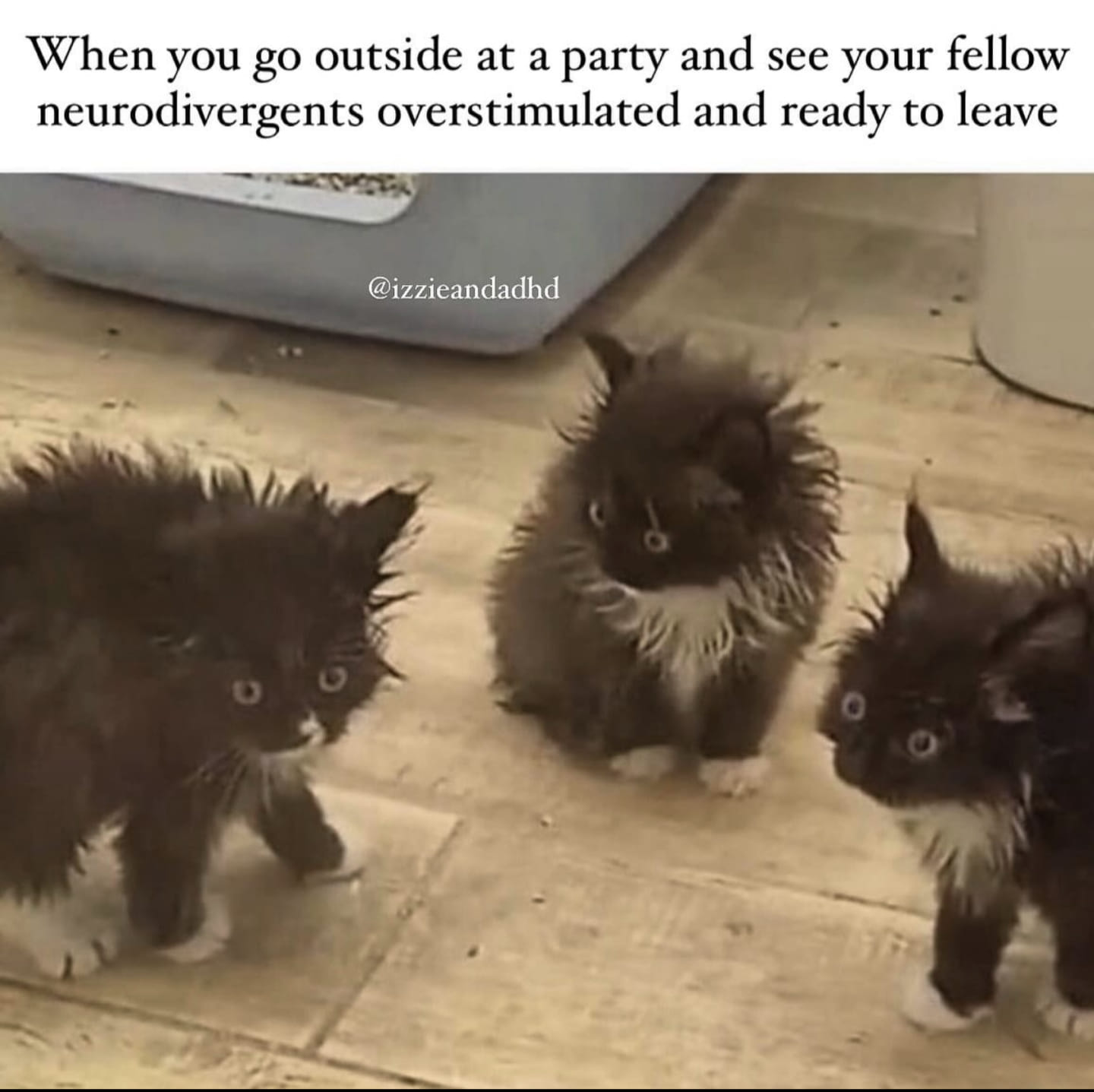
The image uses three fluffy kittens to represent people with neurodivergent conditions, such as autism or ADHD, who often struggle with sensory overload. When these individuals go outside at a party, the sudden noises and crowds can feel overwhelming. As the caption notes, people with these traits often feel "overstimulated and ready to leave" to escape the sensory barrage.
simple-description (llama3.2-vision_11b)
This meme is about a situation where someone who is neurodivergent (has a neurological difference) is trying to navigate a social situation, but is struggling to cope with the sensory overload and expectations of others. The image is of three cats with frazzled hair, implying that the neurodivergent person is feeling overwhelmed and "frayed" like the cats' hair. The text "When you're neurodivergent and everyone expects you to be 'on' at a party" is a relatable commentary on the challenges of being neurodivergent in social situations.
detailed-analysis (gemma3-27b-vision)
Okay, let's break down this meme using the requested theoretical frameworks. It's a surprisingly rich little image for the depth of analysis we can apply!
Visual Description
The image features three small, dark-furred kittens, each with extremely puffed-up fur, resembling a collective explosion of fluff. Their eyes are visible, appearing wide and round. They stand in a line on a patterned linoleum floor. A laptop is partially visible in the upper portion of the frame. The image is slightly grainy. The text overlay reads, “When you go outside at a party and see your fellow neurodivergents overstimulated and ready to leave.” The meme creator's username, @izziedandhd, is visible at the top. The overall effect is humorous and relatable, suggesting a shared experience of sensory overload and a desire to escape a stimulating environment. The kittens' appearance is a visual metaphor for the internal state of being overwhelmed.
Foucauldian Genealogical Discourse Analysis
This meme engages with the discourse surrounding neurodiversity and mental health. Foucault's genealogical approach asks us to trace the history of how concepts like “overstimulation” and “neurodivergence” came to be understood and labeled. The very use of the term “neurodivergent” is a rejection of a “normal” neurological standard—a standard historically constructed by medical and psychiatric authorities.
The meme doesn’t create the discourse, but circulates it. It presupposes a shared understanding of neurodivergence as a legitimate experience, resisting the medicalization that historically pathologized difference. The puffed-up kittens represent a visually coded signifier for the internal experience of overstimulation—a "truth" produced through diagnosis, self-identification, and online community discourse.
The meme also implicates power dynamics. The desire to leave a party is not simply a preference, but potentially a response to environments designed without consideration for diverse sensory needs. This could be seen as a subtle challenge to the assumption that social spaces are universally accessible or comfortable. The meme performs a kind of “counter-discourse,” using humor to validate an experience that has historically been dismissed or stigmatized.
Critical Theory
From a critical theory perspective, the meme can be understood as an example of how culture reflects and reinforces social norms. The meme implicitly critiques the expectation that individuals should enjoy social gatherings. It acknowledges that these environments can be actively harmful to some people.
The meme hints at the idea that ‘normal’ social behavior is not natural but constructed. The expectation of extended social interaction is normalized, but this is challenged by the relatable image of the kittens expressing a desire to remove themselves from a stimulating environment.
The meme functions as a form of emancipatory consciousness. By circulating a shared experience of discomfort, it encourages validation and recognition among those who experience overstimulation. It provides a cultural moment of recognition.
Postmodernism
The meme embodies several key postmodern principles. It's inherently intertextual – it draws upon pre-existing cultural understandings of cats, online meme culture, and the discourse surrounding neurodiversity. The kittens aren't literally neurodivergent people, but a sign referencing that lived experience.
The image destabilizes a fixed definition of social “enjoyment.” What constitutes a “good” time at a party is presented as subjective and dependent on individual neurological profiles. It rejects a grand narrative of universal social pleasure.
The meme is also deeply ironic. The absurdity of the image (puffed-up kittens) enhances the message, creating a humorous yet poignant commentary on a serious issue. It acknowledges the complex and sometimes contradictory nature of lived experience.
Queer Feminist Intersectional Analysis
This is where the analysis becomes particularly layered. Neurodivergence intersects with gender, sexuality, and other marginalized identities. While the meme doesn’t explicitly address these intersections, it creates a space for recognizing different embodied experiences.
Often, societal expectations of social engagement (e.g., "being a good hostess," "mingling," "making conversation") are gendered. For neurodivergent individuals who struggle with these expectations, the pressure to conform can be heightened. The meme validates the right to prioritize one’s own sensory well-being over these expectations.
The meme also offers a potential space for solidarity. It creates a sense of community among neurodivergent individuals, validating their experiences and challenging the dominant narratives of "normal" social behavior. It recognizes that the experience of overstimulation can be exacerbated by factors like ableism, gender bias, and other forms of oppression.
The inherent vulnerability represented by the image of the "puffed-up" kittens can resonate with queer and feminist sensibilities, which often celebrate authenticity and challenge societal expectations of conformity. It’s a validation that sometimes, retreat is a radical act of self-care and resistance.
Let me know if you’d like me to elaborate on any of these points, or explore another theoretical framework!
simple-description (llama3.2-vision)
This meme features a humorous image of three cats with wild, unkempt fur, implying they've been left unattended for a while. The caption above the image reads, "When you go outside at a party and see your fellow neurodivergents are still stimming and you're expected to join in."
tesseract-ocr
When you go outside at a party and see your fellow neurodivergents overstimulated and ready to leave @izzieandadhd i hk, yr / a