First Seen
2023-11-10T21:40:57+00:00
simple-description (qwen3.5_2b-q8_0)
This image uses a visual narrative to describe coming home tired, but the humor comes from the text at the bottom which is difficult to read. For a neurodivergent person, especially someone with dyslexia, the individual words in the bottom sentence "(RAN ONE SINGLE ERRAND)" are hard to parse because the text is centered and small on top of the image. Additionally, the specific word "ERRAND" creates a subtle language barrier that a reader might struggle to decode individually compared to a whole sentence.
simple-description (llama3.2-vision_11b)
The meme is a play on the classic "I'm not lazy, I'm just on energy-saving mode" joke, but with a neurodivergent twist. The image depicts a person who is actually a wizard, but instead of casting spells, they're just trying to get to their destination after a long day of being overstimulated. The text overlay says "Running late because I'm not lazy, I'm just on neurostimulation-saving mode".
detailed-analysis (gemma3-27b-vision)
Okay, let's break down this image with those theoretical lenses. It’s a fascinating piece that lends itself to multiple interpretations.
Visual Description
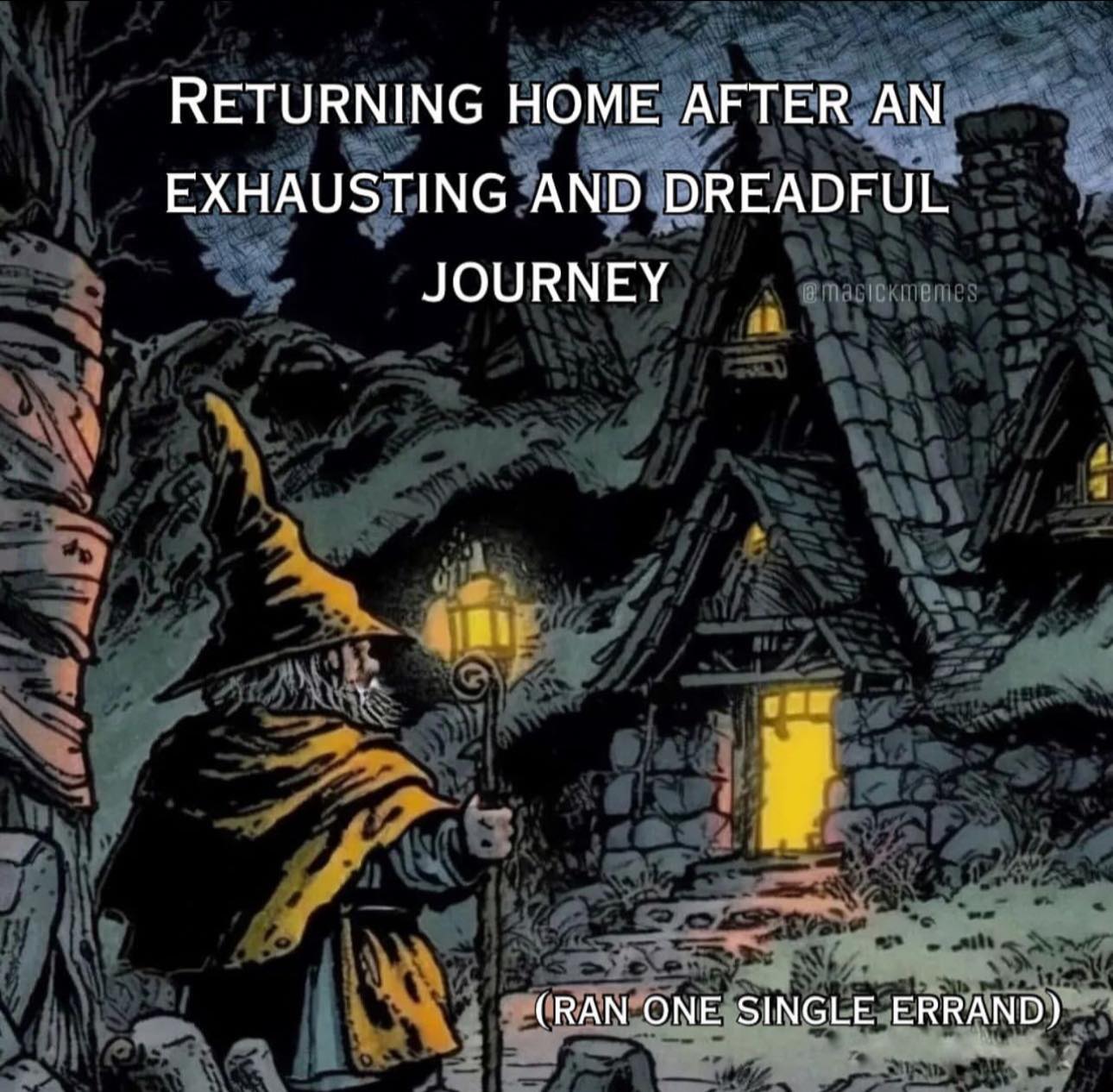
The image is a darkly rendered illustration in a woodcut-like style, evoking classic horror or gothic art. A lone, cloaked figure is trudging toward a warmly lit cottage. The figure is heavily shadowed, almost a silhouette, but enough detail is present to suggest a weary, slumped posture. The cottage is rustic and appears somewhat isolated, set within a dark and overgrown environment—a thick forest of thin trees—with stone structures and what appear to be gravestones (or similar markers) visible. The illumination emanating from the cottage's windows is a bright, rectangular yellow, providing a strong contrast with the surrounding darkness. The text "RETURNING HOME AFTER AN EXHAUSTING AND DREADFUL JOURNEY (RAN ONE SINGLE ERRAND)" is superimposed on the image, creating a sense of ironic understatement. The style feels deliberately retro, leaning heavily into aesthetic tropes of spookiness and mystery.
Foucauldian Genealogical Discourse Analysis
This image can be examined through Foucault’s lens by analyzing the discourse around “home,” “journey,” and even “exhaustion.” Historically, the discourse of the journey is tied to concepts of self-discovery, heroism, and adventure. Yet, this image subverts that discourse. The “exhausting and dreadful journey” is revealed to be a single, mundane errand.
Foucault’s idea of power/knowledge is relevant here. The image challenges the normalization of equating effort with significance. We are conditioned to associate strenuous journeys with grand purposes. By revealing the disconnect, the image exposes the power dynamics that dictate what we deem meaningful and exhausting. The expectation to expend significant energy, even for a trivial task, is implicitly critiqued. The image asks us: Who benefits from the construction of this expectation? What mechanisms are in place to reinforce it? It highlights the constructed nature of "exhaustion" itself; it's not inherent to the errand, but produced by the social demands of performing even small tasks.
Critical Theory
From a Critical Theory perspective, the image can be seen as a commentary on the alienation of modern life. The exhaustion and dread don’t stem from the actual journey but from the larger social structures that make even simple tasks feel overwhelming. This resonates with the Frankfurt School’s critique of instrumental reason – the idea that everything is valued only for its utility. The image suggests that even basic activities have been absorbed into this system, becoming sources of anxiety and exhaustion.
The juxtaposition of the dramatic, gothic imagery with the banal reality of "ran one single errand" highlights the absurdity of modern existence. It suggests that our lives are filled with unnecessary struggles and that we are often made to feel overwhelmed by trivial things. The figure's cloaked anonymity and trudging posture further emphasize a sense of disempowerment and alienation. It is also possible to see commentary on the societal expectation to constantly do and achieve, even to the point of personal exhaustion.
Marxist Conflict Theory
From a Marxist perspective, the image can be interpreted as a microcosm of the alienation of labor. The figure’s exhaustion represents the worker’s exhaustion under capitalist conditions. The “single errand” can be seen as a metaphor for the repetitive, meaningless tasks imposed on the working class.
The stark contrast between the dramatic setting and the trivial task underscores the surplus value extracted from the figure's labor. Even for a seemingly insignificant task, the figure expends energy (their labor) while the "owner" of the errand (whoever the errand was for) benefits. The dark and oppressive atmosphere can be seen as a representation of the exploitative conditions of capitalist labor. It asks: is this disproportionate expenditure of energy and emotional state reflective of the alienation between the labor and the reward?
Postmodernism
The image heavily engages with postmodern themes through its use of irony, pastiche, and the disruption of meaning. The deliberate clash between the gothic aesthetic and the mundane reality of the errand creates a sense of playful absurdity. It deconstructs the traditional association between journeys and grand adventures, revealing the emptiness at the heart of that narrative.
The image also plays with the idea of simulacra and simulation. The gothic imagery is a simulacrum – a copy without an original – that evokes a sense of horror and dread. However, this horror is ultimately disconnected from any real danger. The image is a simulation of a dramatic journey, but the reality is far more banal. It’s a commentary on how modern life is increasingly dominated by superficial appearances and empty signifiers.
Queer Feminist Intersectional Analysis
While not immediately obvious, a Queer Feminist Intersectional reading can be applied. The exhaustion of the figure can be linked to the often-invisible labor (emotional, physical, mental) disproportionately placed on marginalized bodies.
For example, consider the invisible labor often placed on women: the expectation to manage household chores, emotional support, and social engagements on top of paid work. For queer individuals, this can be compounded by the need to constantly navigate heteronormative spaces and perform emotional labor to ensure safety and acceptance.
The image can also be read as a critique of the expectation that individuals must constantly perform or maintain a certain image or level of energy, even when depleted. This expectation can be particularly oppressive for marginalized groups who are often forced to navigate multiple systems of power and oppression. The figure’s cloaked anonymity and weary posture could be interpreted as a rejection of this pressure to perform. It is a commentary on the burden of constant self-management and the emotional toll it takes on marginalized bodies.
Hopefully, this detailed analysis provides a comprehensive understanding of the image through these different theoretical lenses. Let me know if you’d like me to delve deeper into any of these areas!
simple-description (llama3.2-vision)
This meme is a humorous illustration of a character returning home after a long, exhausting journey. The image depicts a wizard-like figure standing in front of a small cottage, exhausted and worn out. The text overlay reads: "Returning home after an exhausting and dreadful journey. (Just ran one single errand)".
tesseract-ocr
Pam LILI emo - S ] i ed ad a. Fe a > CAUSA ceo) Noh Co Pag fi »\ .- = a JOURNEY PY Vy . Ng, ae A NG ae 2 NR Sect ie ime | & 5 & c > \s Va \ Ae —. « THRs Wag F | x i WA ee - f Ley ¥' gi HA SS D> ANY z, ey Pat YY) x SAX Es a. GON AC) <> emer SS 6S ie || 2 <a ~ ~~ Q) 4a Sh iie . SS Be Le FC: ae Md» WaT, /y) IS Nar gk IO : in Pee cam: ee \ i wa | @(RANZONE}SINGLE.ERRAND)© Xu On" WW A Sa ge _ et