First Seen
2024-05-28T23:27:03.103123+00:00
simple-description (qwen3.5_2b-q8_0)
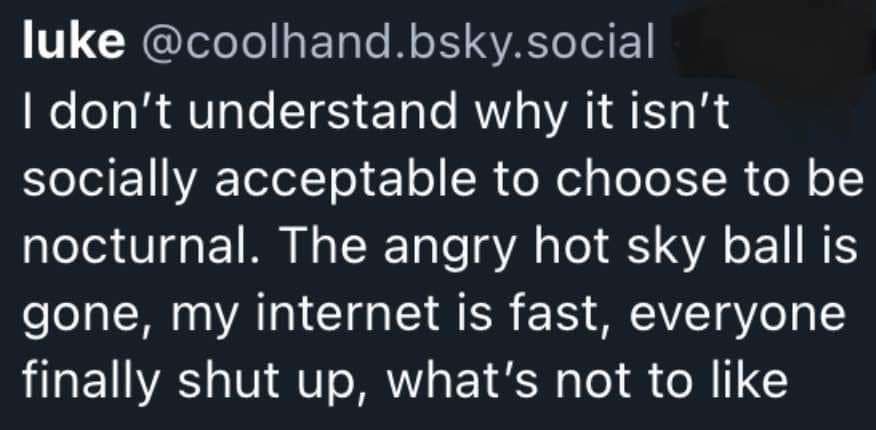
This meme suggests that nocturnal social media usage is acceptable because the user believes they have better attention spans during the day, allowing for better reading comprehension. Luke @coolhand.bsky.social notes that "everyone finally shut up," implying that nocturnal users are more productive and capable than the average person during the day.
simple-description (llama3.2-vision_11b)
The meme is a screenshot of a tweet from a Twitter user named @lucas, where he shares his frustration with the social media platform's "nocturnal" mode, which allows users to post content that would normally be considered inappropriate during the day. He complains about the lack of understanding of why this feature is allowed, and how it's not suitable for all audiences.
detailed-analysis (gemma3-27b-vision)
Here's an analysis of the provided text, broken down by the requested theoretical frameworks. Note that some frameworks may be more applicable than others, and the analysis will reflect that.
Visual Description
The image shows a screenshot of a post from a social media platform ("bsky.social"). The username is "coolhand," and the post is by a user named "luke." The background is solid black, with white text. The text itself is a fragmented stream-of-consciousness statement. The style is minimalist, aiming to highlight the message itself rather than any visual embellishment.
Foucauldian Genealogical Discourse Analysis
This text provides fertile ground for a Foucauldian analysis. The user expresses discontent with the social expectation to be “diurnal” – to align with the day/night cycle conventionally valued in society.
- Discourse & Power: The notion of being "nocturnal" isn’t simply a preference, but a deviation from a normalized discourse around productivity, visibility, and social engagement. Foucault would argue that this "normality" is produced through discourse – through the repeated assertion of certain ways of being as natural and proper, and the pathologization of others. The demand that people "shut up" further reinforces a dominant discourse that silences dissenting views.
- Genealogy: Tracing the "genealogy" of the diurnal/nocturnal binary would reveal how it has historically been linked to concepts of labor, control, and surveillance. Historically, diurnal activity has been essential for agricultural societies and later, industrial production. The expectation to be "productive" during daylight hours is tied to systems of power and control.
- Discipline: The desire to escape this norm can be read as a rejection of disciplinary power – the subtle ways in which individuals are monitored and corrected to conform to social expectations.
Postmodernism
The fragmented, disjointed nature of the text is highly characteristic of postmodern writing.
- Rejection of Grand Narratives: There is no overarching argument being presented, just a series of observations and frustrations. This resists the idea of coherent, universal truths or explanations.
- Deconstruction of Binary Oppositions: The text implicitly challenges the binary opposition between day/night, activity/rest, productivity/leisure. It questions why one is considered "normal" and the other "deviant."
- Emphasis on Subjectivity: The post is deeply personal and subjective, prioritizing the individual’s experience over any objective standard. The phrase "What's not to like?" is a rhetorical question suggesting the individual's dissatisfaction is self-evident and valid.
- Hyperreality: The comment on “fast internet” seems almost entirely disconnected, adding to the sense of a fragmented experience. It introduces an element of digital experience into the otherwise existential concern, contributing to a blurring of reality and simulation.
Critical Theory
The post can be interpreted through the lens of Critical Theory, focusing on the relationship between the individual and societal structures.
- Alienation: The user’s dissatisfaction with societal expectations can be read as a form of alienation. They feel disconnected from a system that doesn't accommodate their preference for a nocturnal lifestyle.
- Domination and Resistance: The assertion of wanting to be nocturnal is a subtle act of resistance against a dominant ideology that values productivity and conformity.
- Ideology: The expectation to align with the "angry hot sky ball" (the sun) reveals an underlying ideology that naturalizes certain ways of being and silences others.
Queer Feminist Intersectional Analysis
While not overtly about gender or sexuality, this post can be read through a queer feminist lens, especially concerning the rejection of norms.
- Rejection of Normativity: The desire to be “nocturnal” can be interpreted as a rejection of societal expectations around productivity and activity, and aligns with queer and feminist rejection of compulsory heteronormativity and the pressures to conform to conventional lifestyles.
- Subversion of Time: Historically, time itself has been structured around patriarchal and capitalist needs. Rejecting the conventional day/night cycle can be seen as a disruption of this power structure.
- Intersectional Consideration: This seemingly individual preference might be more complex when considering how it intersects with other forms of marginalization. For instance, someone who works a night shift, has a disability that affects their sleep patterns, or lives in a climate with long nights might find this preference more crucial.
Note: The interpretations above are not exhaustive, and other frameworks could also be applied. The text's ambiguity allows for multiple readings.
tesseract-ocr
luke @coolhand.bsky.social | don't understand why it isn’t socially acceptable to choose to be nocturnal. The angry hot sky ball is gone, my internet is fast, everyone finally shut up, what's not to like
simple-description (llama3.2-vision)
This meme is a screenshot of a Twitter post from a user named "Luke" (likely a parody of Luke the 6-2-4-2 user). The text reads: "I don't understand why it's socially acceptable to be upset when it's not dark outside. The anger has gone, my internet is fast, everyone finally shut up, what's not to like?" The meme is likely a humorous commentary on the changing times and the shift in social norms.