First Seen
2024-05-26T04:27:48.471608+00:00
simple-description (qwen3.5_2b-q8_0)
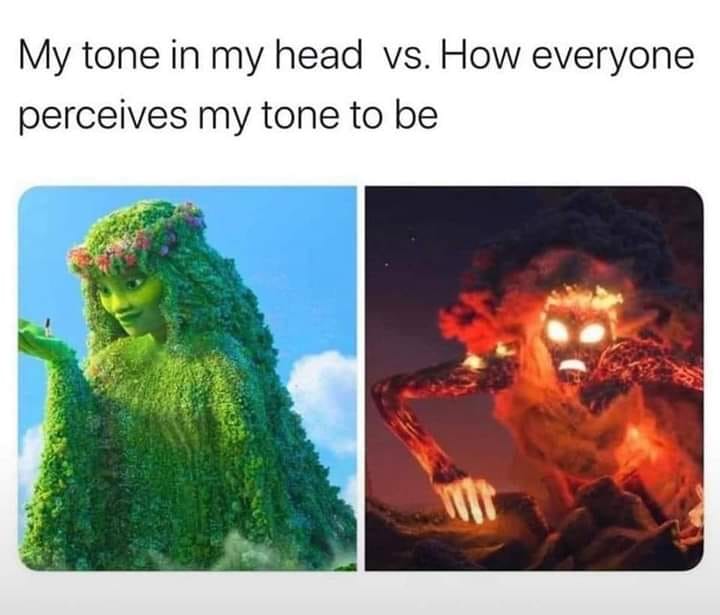
One side of their experience feels like the serene, green tree girl on the left, where their voice sounds gentle and soothing. The other side feels like the fiery, screaming demon on the right, where their internal thoughts feel like a chaotic explosion. This visual contrast illustrates the confusion of how a person's "inner voice" might feel like a destructive monster to others, while their "outer self" is often a calm spirit.
simple-description (llama3.2-vision_11b)
The meme is a humorous take on the concept of neurodivergence, specifically the experience of having a unique perception of the world. The image shows a split-screen comparison between two characters from the movie "Moana": one character is depicted with a calm and serene expression, while the other character is shown with a chaotic and intense look on their face. The text above the image reads: "My brain vs. everyone else's brain". This meme is relatable to individuals with neurodivergent conditions, such as autism or ADHD, who often experience the world in a different way than those without these conditions.
detailed-analysis (gemma3-27b-vision)
Okay, let's break down this meme using the requested theoretical lenses. It's a surprisingly rich image for this kind of analysis.
Visual Description
The meme is a side-by-side comparison. On the left is a still from Disney's Moana, depicting Te Fiti, a goddess of life and creation. She is a lush, vibrant being made entirely of plants, depicted in shades of green with a calm, peaceful demeanor. The background is a bright blue sky with clouds. On the right is an image of an enraged, fiery version of Te Fiti, transformed into the lava demon Te Kā from the same film. She is glowing red, surrounded by fire and lava, and looks menacing. The caption reads "My tone in my head vs. How everyone perceives my tone to be." This sets up a dichotomy between internal emotional/intentional state and external perception.
Foucauldian Genealogical Discourse Analysis
This meme powerfully illustrates the concept of discourse in a Foucauldian sense. Michel Foucault argued that knowledge and power are intertwined, and "truth" isn’t an objective reality, but is constructed through discourse—the systems of thought, language, and practice that shape our understanding of the world.
Here, the discourse surrounding emotional expression is the key. The left side (Te Fiti) represents the intended emotional state – peaceful, nurturing, and benevolent. The right side (Te Kā) is the constructed perception – angry, hostile, and intimidating. The meme suggests that the "truth" of the individual's emotional state is secondary to how it is interpreted by others. The power dynamic lies in the interpreter. The meme indicates a disconnect and suggests that dominant discourses about "appropriate" or "acceptable" emotional expression might misread or mislabel the internal state. Perhaps someone presenting as calm is labeled as aloof or dismissive, and therefore perceived as angry. There's an implicit power struggle in how we label and judge others based on perceived tone, ultimately shaping the way they are treated.
Critical Theory
This meme aligns strongly with the themes explored in Critical Theory, specifically the Frankfurt School. A core tenet of Critical Theory is the examination of how social structures and power dynamics maintain the status quo and create systems of domination.
In this context, the meme suggests a social expectation around emotional expression. The assumption is that there's a "right" way to express emotion, and any deviation from that norm is misinterpreted as something negative (like anger). This can be seen as a form of social control—forcing individuals to conform to pre-defined emotional scripts. The meme implies that if you don't fit the mold, you'll be labeled and treated accordingly, regardless of your internal state. This can reinforce existing power imbalances. Consider if this is particularly prevalent for marginalized groups whose emotional expression is often policed or deemed "aggressive" when it is simply authentic.
Marxist Conflict Theory
While not as directly obvious as in the other readings, we can explore this meme through the lens of Marxist Conflict Theory by looking at how social dynamics contribute to alienation. Marx argued that capitalism alienates individuals from their labor, each other, and themselves.
In this context, the meme can be seen as illustrating a form of emotional alienation. The individual's "true" emotional state (Te Fiti) is not recognized or understood by others, leading to a disconnect and a sense of being mislabeled or misrepresented. This misrepresentation can lead to conflict, as the individual struggles to be seen and heard authentically. Perhaps, the individual's attempt at gentleness (Te Fiti) is perceived as weakness, leading to exploitation or oppression.
Postmodernism
Postmodernism emphasizes the subjective nature of reality, the deconstruction of grand narratives, and the fluidity of identity. This meme perfectly embodies a postmodern sensibility.
The central concept is that the individual's internal reality (Te Fiti) is radically different from the external perception (Te Kā). There's no objective "truth" about the individual's tone; it's entirely dependent on the observer's interpretation. The meme deconstructs the idea of a stable, unified self by highlighting the disconnect between intention and perception. It suggests that identity is not fixed but is fluid and constructed through interactions with others. It suggests that meaning is not inherent in the tone itself, but is assigned by the interpreter, and that this meaning is potentially arbitrary.
Queer Feminist Intersectional Analysis
This meme resonates strongly with Queer Feminist and Intersectional thought. It speaks to the ways in which marginalized identities (particularly those based on gender, sexuality, and emotional expression) are often misread and mischaracterized by dominant cultural norms.
For individuals who don't conform to traditional gender roles or who express emotions in ways that deviate from societal expectations, this disconnect can be particularly acute. For instance, a woman expressing anger might be labeled as "hysterical" or "emotional," while a man expressing vulnerability might be seen as "weak." The meme highlights the ways in which power structures (patriarchy, heteronormativity, etc.) shape our perceptions and contribute to the silencing or misrepresentation of marginalized voices. The meme can also be linked to the concept of emotional labor—the often-unacknowledged work that marginalized individuals must do to manage the emotional responses of others. If someone is constantly misread, they must exert additional energy to correct those misinterpretations.
Let me know if you’d like me to elaborate on any of these analyses!
tesseract-ocr
My tone in my head vs. How everyone perceives my tone to be Rae Se ‘ee) ee a Bat S - yey a i ae
simple-description (llama3.2-vision)
This meme is a humorous comparison between one's internal emotional state (represented by a green, fluffy, and happy creature) and how others perceive that state (represented by a fiery, monstrous creature). The text above the images reads: "My tone in my head vs. How everyone perceives my tone to be."