First Seen
2023-05-10T21:03:36+00:00
simple-description (llama3.2-vision_11b)
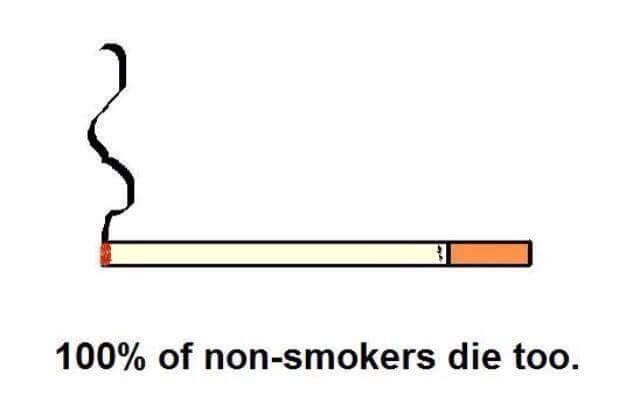
The meme is a simple image of a cigarette with a red "X" marked through it, implying that smoking is a bad habit. The text "100% of people who use tobacco will die of tobacco" is written in a playful, ironic tone, exaggerating the risks of smoking. From a nihilistic perspective, the meme pokes fun at the inevitability of death, highlighting the absurdity of trying to avoid it.
detailed-analysis (gemma3-27b-vision)
Okay, let's break down this image and its accompanying text using the frameworks you've requested. I'll only include sections where the theory genuinely applies, and will indicate when a framework isn't really a good fit.
Visual Description
The image depicts a simple, almost cartoonish representation of a lit cigarette. It's drawn with thick, clean lines. The cigarette is horizontal, and has a red/orange glowing tip and a gradient transitioning to a light tan/yellow. Above the cigarette is a black, wispy curl of smoke. Below the image in a straightforward font, is the phrase "100% of non-smokers die too." The background is plain white, which emphasizes the cigarette. It's minimalist, conveying the message directly without elaborate detail.
Foucauldian Genealogical Discourse Analysis
This image and its text are incredibly amenable to a Foucaultian reading. The central point is the disruption of a "truth" created through discourse. For decades, public health campaigns have constructed smoking as a dangerous activity, associating it with disease, death, and social deviance. These campaigns have produced the knowledge that smoking is harmful, making it a visible target for regulation and moral judgment.
The phrase "100% of non-smokers die too" doesn't deny the harms of smoking. Instead, it challenges the power/knowledge nexus around it. It highlights the absurdity of singling out smoking as a unique pathway to death, given the universality of mortality.
- Genealogy: Foucault’s genealogical method would trace the historical development of discourses around health, risk, and mortality. It would examine how smoking became a uniquely stigmatized practice, and what social and political forces were at play in that construction. This image disrupts this established genealogy by reminding us that death is not specific to smoking.
- Discourse: The image breaks with the dominant discourse surrounding smoking. By stating a simple, undeniable truth, it reveals the selective nature of "truth" production. The focus on smoking as the danger allows other, equally dangerous aspects of life (diet, pollution, genetics, accidents) to remain obscured or less regulated.
- Power/Knowledge: The image demonstrates how power operates through the control of knowledge. The health authorities define what is dangerous and what isn't, thereby influencing individual choices and justifying social control. This image is a subtle challenge to that power.
Critical Theory
This image can be examined through a critical lens, particularly as related to ideology and social control.
- Ideology: The dominant discourse around smoking can be seen as ideological. It presents smoking as a moral failing and a deviation from health norms. The image challenges this ideology by demonstrating the inevitability of death, regardless of lifestyle choices.
- Social Control: Public health campaigns, while well-intentioned, also function as mechanisms of social control. They regulate behavior through the creation of fear and the promotion of certain norms. This image subverts that control by pointing out the absurdity of targeting one specific behavior when all life is finite.
- Unmasking the Taken-for-Granted: Critical theory seeks to expose the underlying assumptions that shape our understanding of the world. The image does this by challenging the common belief that avoiding smoking will guarantee a longer or better life, reminding us that mortality is universal.
Marxist Conflict Theory
While not a primary reading, some elements align. The image, on a very abstract level, could be seen as subtly challenging the consumerist system. The cigarette itself is a commodity, and the campaigns against it could be interpreted as a way to redirect anxieties about death toward individual behavior, rather than structural issues (e.g., pollution, dangerous working conditions). It isn’t a strong application, because the image doesn’t explicitly target economic systems.
Postmodernism
This image can be understood as a postmodern disruption of grand narratives.
- Deconstruction: The image deconstructs the seemingly self-evident "truth" that smoking is dangerous. It doesn't deny the danger, but it subverts the certainty with which it is usually presented.
- Relativism: The image suggests that there is no absolute answer to living a long life. While avoiding smoking may increase chances, death is inevitable. The image embraces the ambiguity and uncertainty of life.
- Meta-narrative Collapse: The image challenges the "meta-narrative" of health as a goal attainable through specific behaviors. It suggests that a focus on individual actions distracts from the larger, unavoidable reality of mortality.
Queer Feminist Intersectional Analysis
This framework doesn’t really align with this image. While health disparities are very real and disproportionately affect marginalized communities (a key tenet of intersectionality), the image doesn't explicitly address issues of gender, sexuality, race, or class. It’s a universal statement about death, and doesn’t engage with the complex power dynamics at the heart of queer feminist theory.
I hope this breakdown is helpful! Let me know if you'd like me to elaborate on any of these points.
simple-description (llama3.2-vision)
The meme is a simple, humorous graphic featuring a cigarette with a flame at the end, indicating it's lit. The text "100% of non-smokers die too" is written below the cigarette, implying that even non-smokers will eventually die, which is a darkly comedic and absurd statement.
tesseract-ocr
100% of non-smokers die too.