First Seen
2023-05-10T21:03:36+00:00
simple-description (llama3.2-vision_11b)
The meme is a screenshot of a computer error message that appears when a user attempts to access a file or folder that does not exist. The message reads "Directory not found" and has a "You have been warned" warning at the bottom. The humor in the meme comes from the irony of the message being displayed on a computer screen, implying that the user has been "warned" about the non-existence of the file, but the warning is being displayed in a context where it's not supposed to be.
detailed-analysis (gemma3-27b-vision)
Okay, here's an analysis of the image provided, broken down into sections as requested. I'll only include sections where the theoretical lens meaningfully applies to the image.
Visual Description
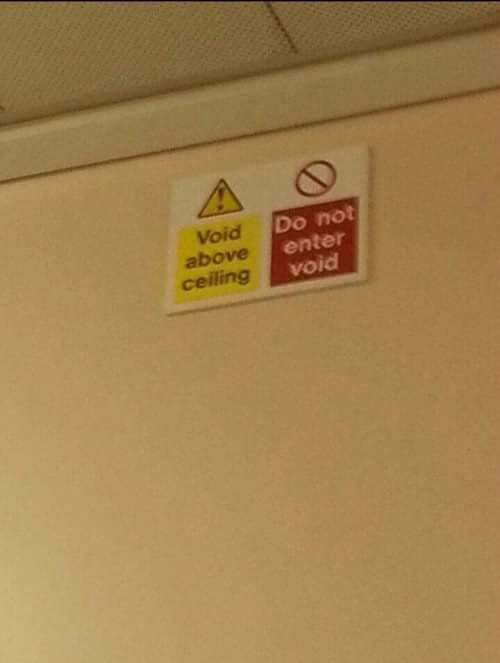
The image depicts two warning signs affixed to a pale yellow or off-white surface, likely a wall or panel within a commercial or industrial setting. The first sign is yellow with a black triangle containing an exclamation point, and the text reads "Void above ceiling" in black capital letters. The second sign, adjacent to the first, is a red circle with a diagonal line through it (a prohibition symbol), and it reads "Do not enter void" in white capital letters. The signs appear slightly worn and are likely intended to alert personnel to the existence of an empty or dangerous space above the ceiling and to discourage access to it. The overall setting seems utilitarian and institutional.
Foucauldian Genealogical Discourse Analysis
This image is ripe for a Foucauldian interpretation. The signs aren't simply conveying information; they are participating in a discourse around safety, control, and the management of bodies within a space.
- Power/Knowledge: The signs demonstrate how power operates through knowledge. The knowledge of the "void" and its potential hazards is used to exert power by controlling movement and access. The signs don't simply say what is, but what should be – a constructed order intended to ensure efficiency and prevent harm, but also inherently limiting.
- Discipline & Normalization: The signs discipline bodies by setting boundaries. They subtly normalize the idea of risk assessment and the necessity of constant vigilance and regulation within this environment. The assumption that a “void” needs to be warned against implies a system designed to keep people within established boundaries.
- Genealogy: A genealogical exploration of this signage would trace its origins – how did the idea of labeling such spaces come about? What historical industrial accidents or safety regulations led to this practice? It would reveal how the concept of "safety" itself has been constructed and changes over time.
- Panopticism: While not overtly visible, the signage evokes a sense of being surveilled. The implied awareness of a space above reinforces the idea that one’s actions are potentially monitored, even if not directly observed.
Critical Theory
This image lends itself to a Critical Theory analysis because the warnings about a “void” represent a larger system of control and rationalization within a bureaucratic or industrial context.
- Instrumental Rationality: The signs exemplify Max Weber's concept of instrumental rationality. The space above the ceiling is simply deemed a “void”, and therefore, a problem needing to be managed. The signage isn’t concerned with why the space exists or its potential uses, only with preventing access.
- Alienation: The reduction of space to “void” could be seen as a form of alienation. It’s a dehumanizing term, stripping the space of any inherent value or potential and reducing it to a potential hazard.
- Domination: The signage is a subtle form of domination. The institution (whatever it may be) dictates how individuals interact with the space. It’s not about providing options; it’s about enforcing obedience to a predetermined order.
Postmodernism
The signage can be viewed through a Postmodern lens by noting the arbitrary and constructed nature of the “void” itself.
- Deconstruction of Meaning: The term “void” is deceptively simple. What exactly constitutes a “void”? It's a lack of something, a negative space. The signage doesn't define it, leaving it open to interpretation, but simultaneously imposing a prohibition. It is an abstract concept that is used to justify restricting access.
- Simulacra and Simulation: The signs could be seen as simulacra - representations of a problem that may not be inherently dangerous in itself. The signage creates the perception of risk, rather than simply reflecting it.
- Challenge to Grand Narratives: The signage participates in a larger “grand narrative” of safety and control. A postmodern perspective questions the inherent validity of this narrative, suggesting that it's just one of many possible ways of organizing space and behavior.
I hope this breakdown is helpful! Let me know if you would like me to elaborate on any of these points, or if you would like me to explore a different theoretical angle.
simple-description (llama3.2-vision)
The meme is a humorous image of a sign typically found in public restrooms, specifically in the area above the toilet. The sign reads "Void above ceiling" and "Do not enter void". The humor comes from the absurdity of a sign that's already above the ceiling, so it's impossible to enter it.
tesseract-ocr
—_—— — vord rot duns \e as ae a