First Seen
2023-05-10T21:03:36+00:00
simple-description (llama3.2-vision_11b)
The meme is a humorous take on nihilism, a philosophical concept that argues life has no inherent meaning or value. The image is likely a photo of a sign that reads "Nothing to see here" or a similar phrase, implying that the absence of meaning or purpose is the only reality. The text "Nothing to see here" is a clever play on the phrase, suggesting that the lack of meaning is the only thing that truly exists.
detailed-analysis (gemma3-27b-vision)
Here's an analysis of the image, broken down into the requested theoretical sections. Note that not every theory neatly applies, and some overlap is inevitable.
Visual Description
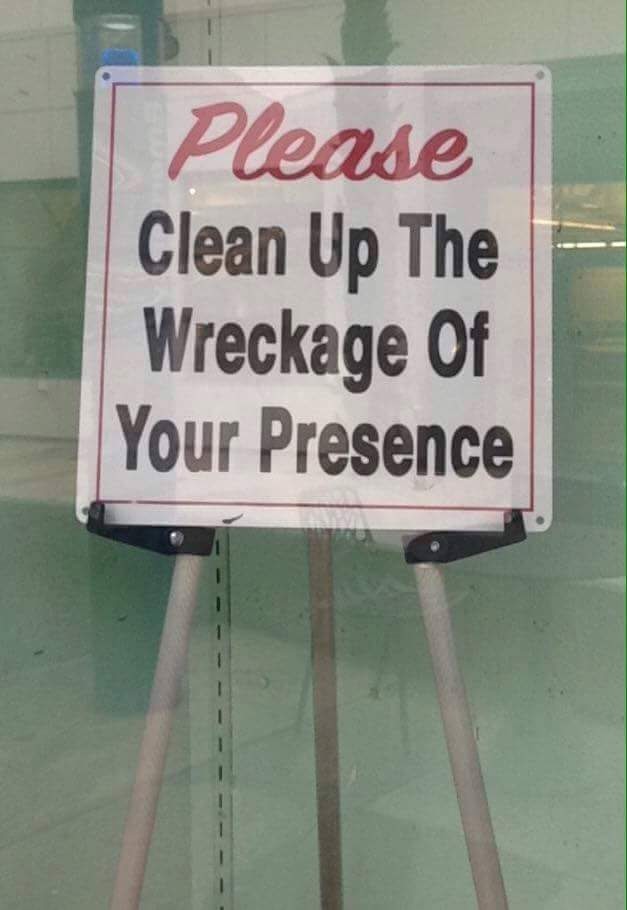
The image shows a small, white sign on a basic wooden easel, presumably placed in a public space (indicated by the green flooring). The sign's text, in bold, red lettering, states: "Please Clean Up The Wreckage Of Your Presence." The lettering is somewhat stylized, attempting a balance between politeness ("Please") and a rather harsh reprimand ("Wreckage"). The overall aesthetic is simple and direct, leaning toward a slightly ironic or passive-aggressive tone due to the intensity of the wording. The lighting is somewhat flat, suggesting an indoor environment, perhaps a gymnasium or public hall.
Foucauldian Genealogical Discourse Analysis
This sign is a fascinating example of disciplinary power at work. Foucault argued that power doesn't just come "from the top down" through explicit commands, but is diffused throughout society via discourses – ways of talking and thinking that shape our behavior.
This sign doesn't simply ask people to clean up; it frames their mere presence as inherently destructive, leaving "wreckage." This constructs a norm: the "proper" user of this space is one who does not leave wreckage. Deviations from this norm are implicitly condemned.
A genealogical reading asks where this discourse originated. It suggests a history of concerns about public space, perhaps related to messiness, maintenance costs, or a general desire for social order. The phrase “Wreckage of Your Presence” elevates the infraction from something merely untidy to something deeply impactful. The sign produces the problem of "wreckage" by defining it as an inherent consequence of presence, even before anyone has left anything behind.
The sign is not about physical cleanliness but about regulating bodies – making people self-police their behavior to conform to an unspoken standard.
Critical Theory
From a Critical Theory perspective (drawing on thinkers like Adorno and Horkheimer), the sign reveals broader societal dynamics of control and normalization. The harsh phrasing suggests a deeper anxiety about disruption and a desire for seamless order. This can be interpreted as a symptom of a society obsessed with efficiency and control, where even the most innocuous acts can be framed as “wreckage.”
The sign is a micro-expression of a culture of blame. Instead of addressing the causes of the mess (perhaps inadequate waste receptacles, overcrowding, or a lack of communal responsibility), it directs the blame entirely onto the individual "present" in the space.
The implicit message is that individuality is problematic; that simply existing, "being present," is potentially destructive. This reinforces the ideal of the compliant, invisible subject who leaves no trace.
Marxist Conflict Theory
From a Marxist lens, the sign can be seen as a manifestation of class-based control, even in a seemingly neutral public space. The demand for cleanliness and order often falls disproportionately on those who use public resources most frequently, particularly marginalized communities.
The “wreckage” could be interpreted metaphorically as the traces of lived experience – the messiness of everyday life. The sign implicitly seeks to erase those traces, maintaining a façade of pristine order that benefits those with power and resources. It's a subtle assertion of ownership and control over the space.
The cost of maintaining this order (cleaning, repairs, etc.) is ultimately borne by those who labor to maintain it, while the expectation of cleanliness is imposed on all.
Postmodernism
A postmodern reading emphasizes the sign's irony and deconstruction of meaning. The phrase "Wreckage of Your Presence" is so hyperbolic that it loses its literal meaning. It's almost humorous, even as it attempts to be authoritative.
Postmodernism challenges grand narratives and universal truths. This sign is a local, contingent rule, disconnected from any overarching moral or ethical framework. It’s a performative utterance – it doesn’t necessarily mean anything profound; it simply does something – it attempts to control behavior through language.
The sign also plays with simulacra and simulation (Baudrillard). The “wreckage” isn’t necessarily a physical threat, but it represents a transgression of order. The sign is a sign about signs – a meta-level communication that emphasizes the importance of maintaining appearances.
Queer Feminist Intersectional Analysis
From a queer-feminist intersectional perspective, the sign could be read as an example of policing bodies and spaces in ways that disproportionately impact marginalized groups. The expectation of “cleanliness” often carries gendered expectations—women are often expected to perform more emotional and physical labor in maintaining order.
The concept of “wreckage” is subjective and culturally constructed. What one person considers wreckage, another might consider a natural or even beautiful expression of life. This sign subtly imposes a dominant standard of order that may not be inclusive of diverse ways of being.
Furthermore, certain bodies (e.g., disabled bodies, bodies of color) may be perceived as "out of place" or “wrecking” a space simply by existing in it, highlighting how power operates to define who belongs and who is seen as disruptive. The implicit demand for "cleanliness" can function as a form of social control, reinforcing norms of conformity and punishing those who deviate.
Disclaimer: These are interpretations based on theoretical frameworks and the visual information provided. The specific meaning and context of the sign would require further investigation.
simple-description (llama3.2-vision)
The meme is a humorous image of a sign that appears to be a public notice, but it's actually a sarcastic joke. The text on the sign reads "Please clean up the wreckage of your presence" in a playful, tongue-in-cheek tone, implying that someone's presence has been so overwhelming that it's left a trail of destruction that needs to be cleaned up.
tesseract-ocr
A =f Clean Up The | = Wreckage Of Your Presence