First Seen
2023-05-10T21:03:36+00:00
simple-description (llama3.2-vision_11b)
The meme is a humorous take on nihilism, a philosophical idea that life has no inherent meaning or value. The image depicts a person who is seemingly upset about the idea that they can "exist" in the first place, as if the concept of existence is a burden they'd rather not bear. The text "I can exist" is written in a sarcastic tone, implying that the person is frustrated with the idea that they must continue to exist in a seemingly meaningless world.
detailed-analysis (gemma3-27b-vision)
Okay, here's an analysis of the comic, broken down into sections as requested. Note that not every section will be fully relevant – I'll indicate when a section isn't strongly applicable.
Visual Description
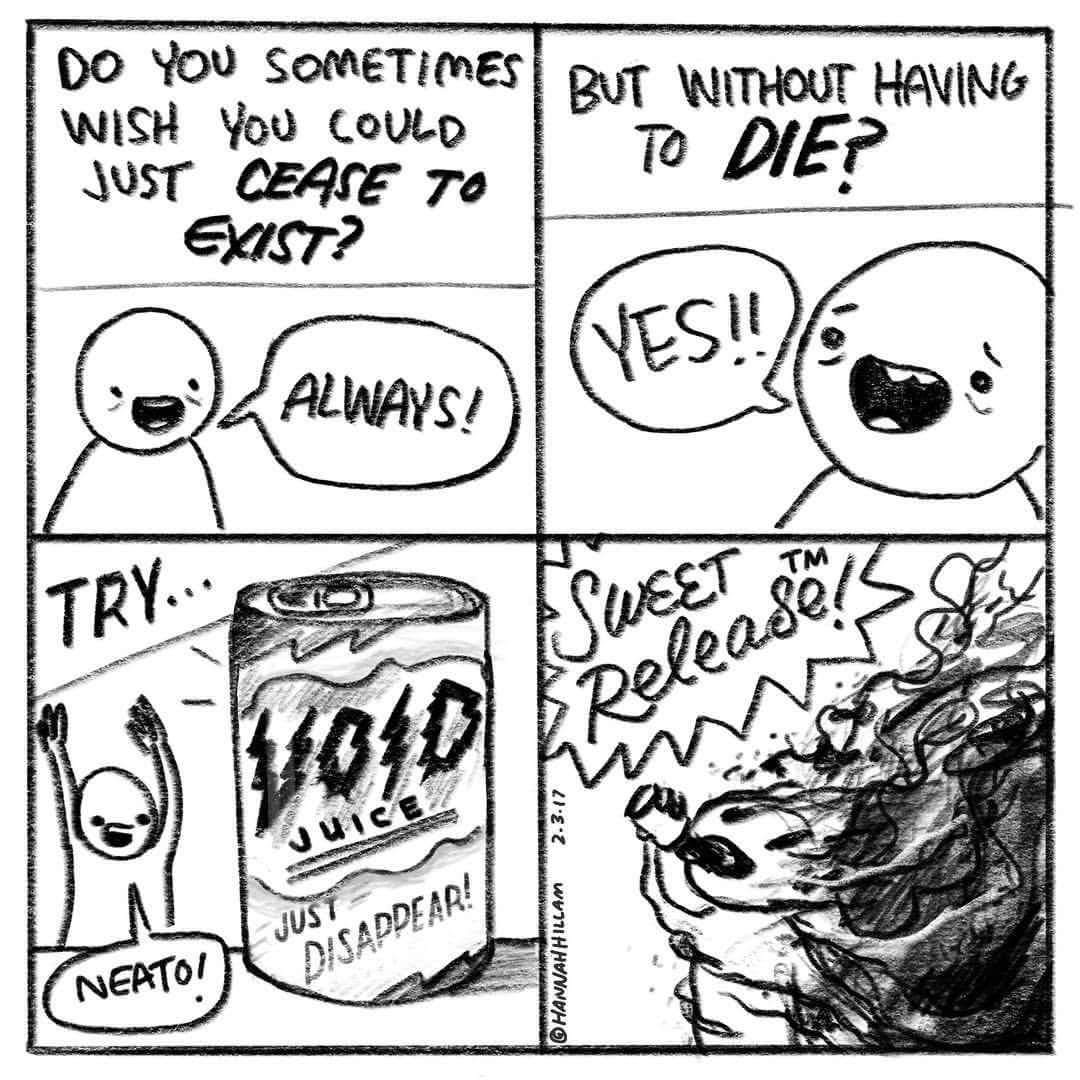
The comic is a four-panel black-and-white drawing with a minimalist, slightly crude style. The character is a simple stick figure with large, expressive eyes and an open mouth – it lacks detailed features. The background is stark white.
- Panel 1: The stick figure asks, "Do you sometimes wish you could just cease to exist?" The response, in large, exclamation-marked letters, is "ALWAYS!"
- Panel 2: The stick figure asks, "But without having to die?" and again responds “YES!!”
- Panel 3: The stick figure is holding a can labeled "VOID JUICE" with the tagline "JUST DISAPPEAR!"
- Panel 4: The stick figure is chugging the can, looking blissfully distraught. Splatter lines illustrate the chugging action, with text bubbles exclaiming "SWEET RELEASE!"™ (with a trademark symbol). The date “2.3.17” appears below the panel, and a signature is visible on the bottom right.
The overall aesthetic is simple and expressive, relying on exaggeration of emotion through visual cues (eyes, exclamations). It’s a quickly sketched, almost confessional style.
Foucauldian Genealogical Discourse Analysis
This comic lends itself well to a Foucauldian reading, specifically looking at discourses of suffering and normalization.
- Discourse of Existential Dread: The initial question opens up a discourse around existential despair and the desire for non-existence. It’s significant that the response is “ALWAYS!” suggesting this is a widespread, perhaps even normalized, feeling. Foucault would be interested in how this discourse is produced and maintained - through cultural narratives, philosophy, art, etc.
- “Void Juice” as a Technology of Self: The "Void Juice" can be viewed as a "technology of self" in the Foucauldian sense. It’s an invented object/solution that proposes a way to manage or eliminate the feeling of existential dread. It’s not about solving the underlying problem, but about managing the feeling itself. This points to a modern tendency to find quick fixes and consumer-based solutions to deeper psychological or philosophical issues.
- The Power/Knowledge Nexus: The comic subtly implies a power dynamic. The desire to "disappear" suggests a lack of power or agency in the face of existential suffering. The "Void Juice" then presents itself as a power over that feeling, but a power contained within a commodity. This ties into Foucault's idea that power and knowledge are intertwined and that power operates through these disciplinary mechanisms, even in seemingly benign forms like consumer goods.
- Genealogy of Despair: A genealogical approach would trace the historical development of this feeling of existential despair – how it's been constructed and framed over time. What social and cultural forces have led to this widespread desire to "disappear?"
Critical Theory
The comic can be analyzed through the lens of Critical Theory, especially focusing on alienation and commodification.
- Alienation: The initial admission of wanting to "cease to exist" suggests a deep sense of alienation—from oneself, from society, from meaning. This is a key concept within the Frankfurt School’s critical theory. The character seems disconnected from the world and burdened by existence.
- Commodification of Feelings: The "Void Juice" represents the ultimate commodification of feelings. Suffering, even existential despair, is turned into a product that can be bought and consumed. This critiques the capitalist tendency to transform everything—even inner experiences—into commodities. It suggests that capitalism doesn't eliminate suffering, but rather markets it.
- False Consciousness: The character seems to believe that "Void Juice" will solve their problem. This can be interpreted as a symptom of false consciousness—a state where individuals are unaware of the true causes of their suffering and seek superficial solutions that reinforce the system.
- Critique of Consumer Culture: The comic implicitly critiques consumer culture. It suggests that we are increasingly encouraged to buy our way out of problems, rather than addressing their root causes.
Marxist Conflict Theory
While not as central as the other analyses, Marxist elements can be identified.
- Alienation and Labor: The desire to cease to exist can be linked to alienation from one's labor. Within a capitalist system, individuals may feel disconnected from the products they create and from the overall purpose of their work, leading to feelings of meaninglessness and despair.
- Commodification of Emotion (again): The "Void Juice" reinforces the idea that even emotions are subject to capitalist exploitation. Suffering becomes a market opportunity.
- Capitalism and Meaninglessness: The comic subtly implies that the capitalist system contributes to a sense of meaninglessness. The focus on profit and consumption can leave individuals feeling empty and disconnected from deeper values.
Postmodernism
Postmodern themes are readily apparent in the comic.
- Hyperreality and Simulation: The "Void Juice" can be seen as a representation of hyperreality—a simulation of reality that has become more real than reality itself. It's a manufactured solution to a deeply felt problem, suggesting that we live in a world where representations often take precedence over genuine experiences.
- Irony and Parody: The comic's presentation of a seemingly absurd solution to existential dread is inherently ironic and parodic. It mocks the tendency to seek quick fixes and consumer-based solutions to complex problems.
- Deconstruction of Meaning: The "Void Juice" doesn't actually solve the problem of existential despair. It’s a fleeting, superficial solution. This can be interpreted as a deconstruction of traditional notions of meaning and purpose.
- The Loss of Grand Narratives: The comic reflects a sense of fragmentation and disillusionment with grand narratives. There's no overarching meaning or purpose offered – only a temporary escape through consumption.
Queer Feminist Intersectional Analysis
This is the least directly applicable lens, but some connections can be drawn:
- The Burdens of Existence and Marginalization: While not explicitly stated, the desire to “cease to exist” can be interpreted, through a queer feminist lens, as a response to the burdens of existing within a system that is oppressive to marginalized groups. The comic doesn’t identify why the character feels this way, but it’s possible to read it as a response to systemic oppression.
- Commodification of Self-Care: The "Void Juice" could be critiqued as a twisted form of self-care—a product marketed as a solution to emotional distress, but which ultimately reinforces capitalist structures. This is particularly relevant in the context of wellness culture, which can sometimes place the onus of self-care on individuals, rather than addressing systemic issues.
- Refusal to Participate: The desire to "disappear" could also be interpreted as a radical refusal to participate in a harmful system. It’s a rejection of the expectations and pressures placed on individuals by society.
I hope this detailed analysis is helpful! Let me know if you’d like me to elaborate on any of these points.
simple-description (llama3.2-vision)
This meme is a humorous and dark take on the concept of "exist" and "die" in a philosophical context. The text on the image reads: "Do you sometimes wish you could just cease to exist? But without having to die?" The image is likely a simple drawing or a cartoon-style illustration, but the text is the key to understanding the humor and irony behind the meme.
tesseract-ocr
DO YoU Sometimes] pur yuTHoUT HAVING | \NISH You CoutLp to DEP WST CEASE To | OMT fams)| EX 4 2 @) ALWAYS? } Ge: ee OT T Op y Nee S oft Ty Fa \ OT | 1: Oy ace pe e Quis ft (2g Be