First Seen
2023-05-10T21:03:36+00:00
simple-description (llama3.2-vision_11b)
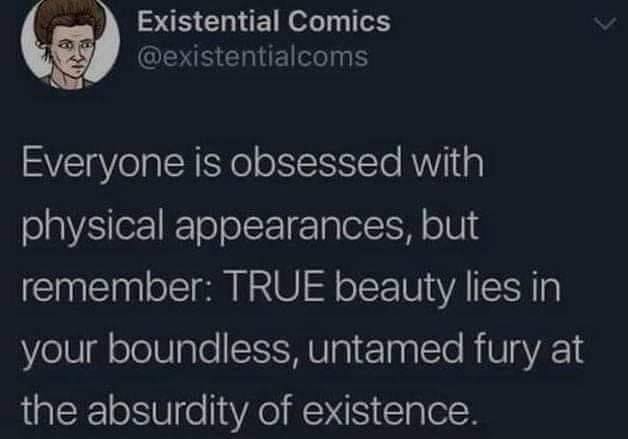
The meme is a satirical commentary on the societal obsession with physical appearance, using humor to critique the notion that people are defined by their looks. The image is a play on the idea that everyone is obsessed with their appearance, but the text "everyone is obsessed with their appearance, but" is cut off, implying that the rest of the sentence is too absurd to be said out loud. The text is likely "but I love myself".
detailed-analysis (gemma3-27b-vision)
Here's an analysis of the image, broken down by the requested theoretical frameworks. Note that some frameworks don’t have strong applications here, and will be noted as such.
Visual Description
The image is a screenshot of a tweet from an account called "@existentialcoms". The profile picture for the account is a cartoon rendering of a person with dark hair, looking somewhat melancholy or detached. The background is black. The tweet itself is text-based. It reads: "Everyone is obsessed with physical appearances, but remember: TRUE beauty lies in your boundless, untamed fury at the absurdity of existence." The text is white against the black background, and bolded for the word "TRUE." This choice in visual presentation—dark background, stark white text— reinforces the existential themes presented by the message.
Postmodernism
This message resonates strongly with postmodern thought. It’s a rejection of traditional, objective standards of beauty. For centuries, societal norms have dictated what is considered aesthetically pleasing—symmetrical features, youth, etc. The tweet subverts this by suggesting that true beauty isn’t about physical attributes at all. Instead, it locates “beauty” in a subjective emotional response to the meaninglessness of existence.
The emphasis on "untamed fury" also pushes against the modernist ideal of rational, controlled emotions. Postmodernism often celebrates fragmentation, chaos, and intense, even "negative" feelings as authentic expressions of self in the face of a world devoid of inherent meaning. The rejection of a singular, universally accepted notion of beauty is a core tenet of postmodern thought.
Critical Theory
Critical theory, particularly the Frankfurt School, examines how dominant ideologies create and maintain power structures. In this case, the tweet is critiquing the dominant ideology of appearance-based value. By stating that “everyone is obsessed with physical appearances”, the tweet highlights the social construction of beauty and how it serves as a system of control.
The emphasis on "fury" can be interpreted as a form of resistance against this system. The tweet suggests that rejecting superficial beauty standards and embracing one’s inner anger and disillusionment is a more authentic and empowering response to a flawed world. It’s a call to move beyond passive acceptance of societal norms and towards active (emotional) rebellion.
Foucauldian Genealogical Discourse Analysis
Michel Foucault’s work would see the notion of “beauty” as a discursive construct. This means it isn’t a natural or inherent quality, but rather a concept created and maintained through language, power relations, and social practices.
The tweet functions as a disruption of this discourse. It challenges the established “rules” for defining beauty. By relocating “beauty” to the realm of emotional response (“fury”), it attempts to destabilize the existing power structures that profit from and enforce these norms (e.g., the beauty industry, social media). The “fury” is a reaction against the historical formation of beauty as a disciplinary practice – the ways in which we are socialized to conform to certain standards. Foucault would also be interested in who is empowered by this redirection of value—those who embrace their anger and disillusionment, rather than those who pursue unattainable physical ideals.
Marxist Conflict Theory
While not a direct application, a Marxist lens can interpret the obsession with physical appearance as a form of commodity fetishism. The beauty industry thrives on creating anxieties and insecurities, then offering products and services as “solutions.” This generates profit for the capitalist class.
The tweet, in this context, can be seen as a call to reject this consumerist cycle and find value in something that cannot be bought or sold—an inner emotional response to the inherent alienation of existence. The "fury" becomes a form of resistance against the commodification of the self. However, this is a somewhat indirect application. Marxist conflict theory is stronger when analyzing more clearly defined class struggles and material conditions.
Queer Feminist Intersectional Analysis
This framework can be applied by considering how societal beauty standards disproportionately impact marginalized groups—women, people of color, LGBTQ+ individuals, and those with disabilities. These groups often face greater pressure to conform to narrow, oppressive beauty ideals. The tweet's rejection of physical appearance as the source of beauty offers a potentially liberating alternative to these pressures.
Embracing “untamed fury” can be seen as a reclaiming of agency and emotion, particularly for groups who have historically been silenced or expected to be docile and accommodating. This lens acknowledges the interconnectedness of oppression and how beauty standards are used as a tool to control and marginalize.
Disclaimer: These analyses are interpretations, and different readers may draw different conclusions based on their own perspectives and theoretical understanding.
simple-description (llama3.2-vision)
The meme is a screenshot of a tweet from the Twitter account @ExistentialComics. The text reads: "Everyone is obsessed with physical appearances, but remember: true beauty lies in your inner self. In your most vulnerable moments, you are more beautiful than you are when you are trying to be someone else. Don't be fooled by the people who are not like you. They are not like you and they will never be like you."
tesseract-ocr
7) eS Cr) Comics Ke) @existentialcoms Everyone is obsessed with physical appearances, but remember: TRUE beauty lies in your boundless, untamed fury at the absurdity of existence.