First Seen
2023-05-10T21:03:36+00:00
simple-description (llama3.2-vision_11b)
The meme features a picture of a shopping cart with a broken wheel, symbolizing the absurdity and chaos of modern life. The text "I can smell the desperation emanating from your profile picture" is a sarcastic comment on the idea that people present a curated online persona, hiding their true feelings of desperation and anxiety. The meme pokes fun at the notion that people are desperate to present a perfect image, even when they're struggling internally.
detailed-analysis (gemma3-27b-vision)
Here's an analysis of the image, broken down into sections as requested, focusing on applicable theoretical frameworks.
Visual Description
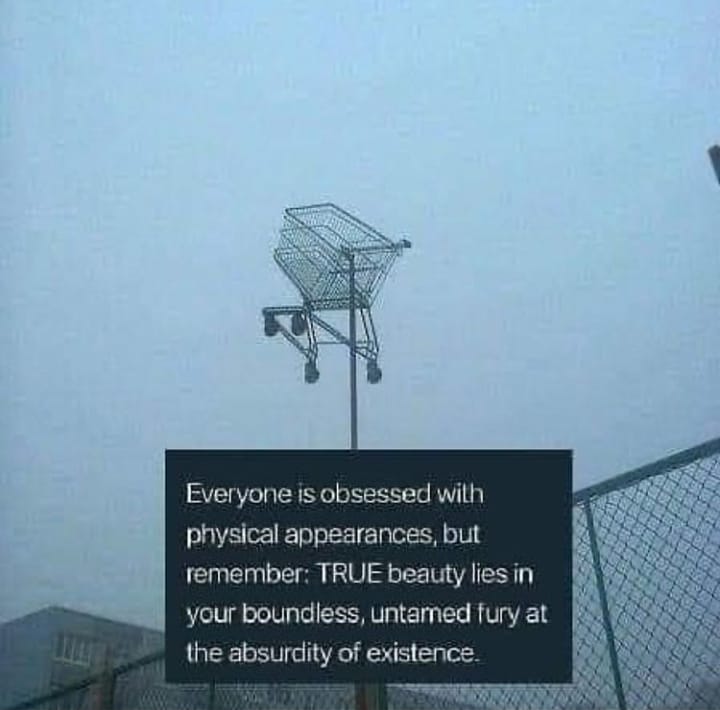
The image presents a stark and unsettling scene. The composition is dominated by a shopping cart impaled atop a metal pole, reminiscent of a street light. The sky is a pale, washed-out blue, evoking a sense of bleakness and coldness. In the foreground, a chain-link fence and what appears to be the corner of a building (possibly a warehouse or industrial structure) contribute to the feeling of abandonment or urban decay. A dark rectangular box containing text is overlaid on the scene. The lighting is flat, creating a desaturated, almost monochromatic feel. The entire image has a distinctly unsettling and surreal quality.
Postmodernism
This image strongly resonates with postmodern aesthetics and themes.
- Juxtaposition & Irony: The scene is deeply ironic: a mundane object (shopping cart) placed in an absurd and unexpected context (atop a pole). This deliberate incongruity is a hallmark of postmodern art, disrupting expectations and challenging conventional meaning-making.
- Deconstruction of Everyday Life: The image takes a commonplace object—the shopping cart, symbolic of consumerism—and renders it alien, questioning its inherent meaning. Postmodernism often deconstructs everyday symbols to expose their underlying assumptions.
- Rejection of Grand Narratives: The bleakness and lack of clear narrative suggest a rejection of overarching, universal explanations. There’s no clear "meaning" offered—only a fragmented, unsettling visual experience.
- Simulacra and Simulation: The image could be interpreted as a simulacrum—a copy without an original. The shopping cart is removed from its function and placed in a context that renders it a mere signifier, a symbol detached from any real-world referent.
Critical Theory
This image lends itself to a reading through the lens of Critical Theory, particularly considering the power dynamics at play.
- Alienation & Commodity Fetishism: The isolated shopping cart, rendered useless in its current state, can be seen as a metaphor for alienation in late-stage capitalism. It highlights how objects become detached from the labor and social relations that produce them, becoming fetishized commodities.
- Critique of Consumer Culture: The image implicitly critiques the pervasive nature of consumerism. The shopping cart, the tool of this system, is elevated (literally) to a position of absurdity, suggesting the emptiness and meaninglessness at the heart of consumer culture.
- Power Structures: The image suggests a power dynamic where mundane objects are rendered meaningless.
Marxist Conflict Theory
Viewing this image through a Marxist lens highlights themes of class struggle and alienation.
- Alienated Labor: The abandoned and repurposed shopping cart can be read as a symbol of alienated labor. The cart, once used in the process of acquiring necessities, now stands as a useless, elevated symbol. This highlights the disconnect between labor and the products of that labor.
- Commodification of Life: The shopping cart, as an instrument of consumption, represents the commodification of life itself. The image implicitly questions the values of a system that prioritizes material accumulation over human well-being.
- Symbol of the Underclass: The bleak setting—the chain-link fence, the decaying building—suggests an environment of marginalization and poverty. The elevated cart could represent a desperate, futile attempt to escape this reality.
Queer Feminist Intersectional Analysis
While not immediately obvious, this image can be read with a queer feminist intersectional lens, focusing on the marginalization and othering implied.
- Disruption of Normative Spaces: The placement of the shopping cart disrupts the expected order of a mundane setting. This can be seen as a symbolic act of transgression, challenging established norms and boundaries.
- Othering & Visibility: The image could be seen as a metaphor for the experiences of marginalized groups, who are often forced to occupy liminal spaces or are rendered invisible by dominant power structures.
- Precarity & Survival: The bleakness of the scene suggests a sense of precarity and vulnerability. The shopping cart, a tool of basic needs, is ironically elevated but unusable. This could symbolize the struggles of marginalized groups to survive in a system that is not designed to support them.
Foucauldian Genealogical Discourse Analysis
A Foucauldian analysis would focus on how power operates through discourse and the creation of knowledge.
- Discursive Power: The image itself becomes a discourse. It doesn't explicitly state a message but produces meaning through its visual language. We, as viewers, are implicated in the creation of this meaning.
- Archaeology of Consumption: The image forces us to consider the "archaeology" of consumption—the historical and social forces that have led to our current obsession with material goods.
- Panoptic Surveillance: The elevated position of the shopping cart could be interpreted as a metaphor for surveillance. It is “watching” from above, reinforcing the idea of a power structure.
- Subjectification and Normalization: The text, "Everyone is obsessed with physical appearances," reveals a dominant discourse that shapes our understanding of beauty and worth. The image then disrupts that discourse by suggesting that "true beauty" lies in something else—a "boundless, untamed fury" against the absurdity of existence. This invites us to question the ways in which we are subjectified by these norms.
In conclusion, this image is a complex and layered work that invites multiple interpretations. It effectively utilizes visual symbolism and irony to critique consumer culture, power structures, and the human condition. It's a powerful piece that can be understood through various theoretical frameworks.
simple-description (llama3.2-vision)
This meme is an image of a shopping cart stuck in a tree, with a text overlay that reads: "Everyone is obsessed with physical appearances, but remember: TRUE beauty lies in your ability to get a shopping cart stuck in a tree." The image is humorous and absurd, poking fun at the idea that people often focus on physical beauty, but the real challenge is getting a shopping cart to stay in a tree.
tesseract-ocr
<a RN A ieee nae Yeah ees Vay St x) FOS Everyone is obsessed wilh RS 2 SEs physical appearances, but q Be ee z ATS OSES remember; TRUE beauty liesin Ree your boundless, untamed fury at ny Pe es il=e-lecU cell Remon oprece m2 Ree 5 Bay Son lee aed