First Seen
2023-05-10T21:03:36+00:00
simple-description (llama3.2-vision_11b)
The meme is a nihilistic commentary on the futility of human existence. It features a cartoon character wearing a pair of "I Can Read" glasses, but the lenses are actually just blank spaces with a caption that reads "I can read, but I don't care". The meme is poking fun at the idea that even with advanced technology, we're still stuck in a meaningless world.
detailed-analysis (gemma3-27b-vision)
Okay, let's break down this image with the requested theoretical lenses. It’s a rather stark, symbolic image, so the applications will be layered and interpretive.
Visual Description
The image is a diptych (two panels). Both panels depict a red, simplified illustration of a head in profile, with an expressionless face. The style is minimalist and somewhat reminiscent of early digital art or comics.
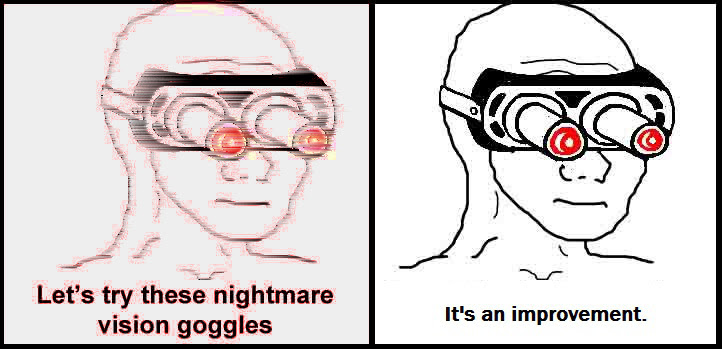
- Panel 1: Shows the head without anything on it. The eyes appear open but vacant. The caption reads, “Let’s try these nightmare vision goggles.”
- Panel 2: Shows the head with large, round, black goggles covering the eyes. The goggles have red circles visible inside, giving them a disturbing, almost mechanical look. The caption reads, “It’s an improvement.”
The background is a grainy, grey texture that gives a sense of alienation or unease. The image feels deliberately rough and raw.
Foucauldian Genealogical Discourse Analysis
This image strongly lends itself to a Foucauldian interpretation. The “nightmare vision goggles” can be read as a metaphor for the structures of knowledge/power (discourses) that shape our perception of reality.
- The Gaze and Surveillance: The goggles construct a vision. Before the goggles, there's a blankness, a lack of defined "seeing." The goggles impose a framework, a way of looking that is not natural but constructed. This echoes Foucault’s analysis of the Panopticon - the goggles become a mechanism of disciplinary power, shaping how the subject perceives and internalizes reality. The red "eyes" within the goggles can be interpreted as the intrusive gaze of power, constantly monitoring and defining perception.
- Genealogy of Vision: A genealogical reading asks how this "nightmare vision" came to be. What historical processes, institutions, and power dynamics led to the construction of this way of seeing? The goggles don't present a truth, but a particular history of constructed understanding.
- “Improvement” as Normalization: The caption "It's an improvement" is chillingly significant. It suggests that the nightmare is preferable to the blankness, that the imposition of this restrictive, potentially oppressive vision is perceived as progress. This illustrates how power operates through normalization—making the unnatural seem natural, the oppressive seem beneficial.
Critical Theory
From a Critical Theory perspective, the image is a commentary on the way societal forces shape individual consciousness.
- Ideology & False Consciousness: The goggles represent an ideological apparatus—a system of ideas, beliefs, and values that serve to maintain existing power structures. The “nightmare vision” may be disturbing, but it's presented as an improvement – suggesting that the subject has been conditioned to accept this distorted reality as preferable to facing a blank, unconstructed one.
- Alienation: The simplified, almost dehumanized style of the image, along with the grainy background, speaks to a sense of alienation—a feeling of disconnection from oneself, from others, and from reality. The goggles become a symbol of this alienation, obscuring the true face and isolating the subject within a constructed world.
- The Promise of Progress: The caption, with its assertion of “improvement,” is a critique of the notion of progress itself. Critical Theory often challenges the idea that technological or societal advancements automatically lead to liberation or fulfillment, arguing that they can often reinforce existing forms of domination.
Postmodernism
The image aligns with several key themes in postmodern thought.
- Simulation and Hyperreality: The goggles create a simulated reality. The subject isn’t experiencing reality directly, but a mediated version of it. This aligns with Baudrillard’s concept of hyperreality—where simulations become more real than the real, and the distinction between them collapses.
- Deconstruction of Truth: The image challenges the notion of objective truth. There is no "natural" way of seeing; vision is always constructed, filtered, and interpreted.
- Meta-commentary: The image feels like a meta-commentary on the very act of perception. It’s not just about what is being seen, but about how we see, and the forces that shape our visual experience.
Notes on Why Other Theories Don't Fully Apply:
- Marxist Conflict Theory: While there's a power dynamic at play, the image doesn't explicitly depict class struggle or economic exploitation. It's more broadly about the imposition of a controlling vision rather than a specific conflict between economic classes.
- Queer Feminist Intersectional Analysis: While the image could be interpreted through an intersectional lens (e.g., the goggles as representing oppressive structures that disproportionately affect marginalized groups), it doesn't inherently address issues of gender, sexuality, race, or other forms of social identity. The symbolism is more abstract and universal.
Let me know if you’d like me to elaborate on any particular theoretical lens or aspect of this image!
simple-description (llama3.2-vision)
This meme is a humorous critique of the "nightmare vision" goggles from the video game series "Halo." The image depicts a character wearing the goggles, with the text "Let's try these nightmare vision goggles" and "It's an improvement." The meme is poking fun at the idea that the goggles are supposed to be scary or intimidating, but are actually just awkward and clumsy.
tesseract-ocr
a a (~ Ne | NS gts WR. sf Xx et tomaeadicn are It's an improvement.