First Seen
2023-05-10T21:03:37+00:00
simple-description (llama3.2-vision_11b)
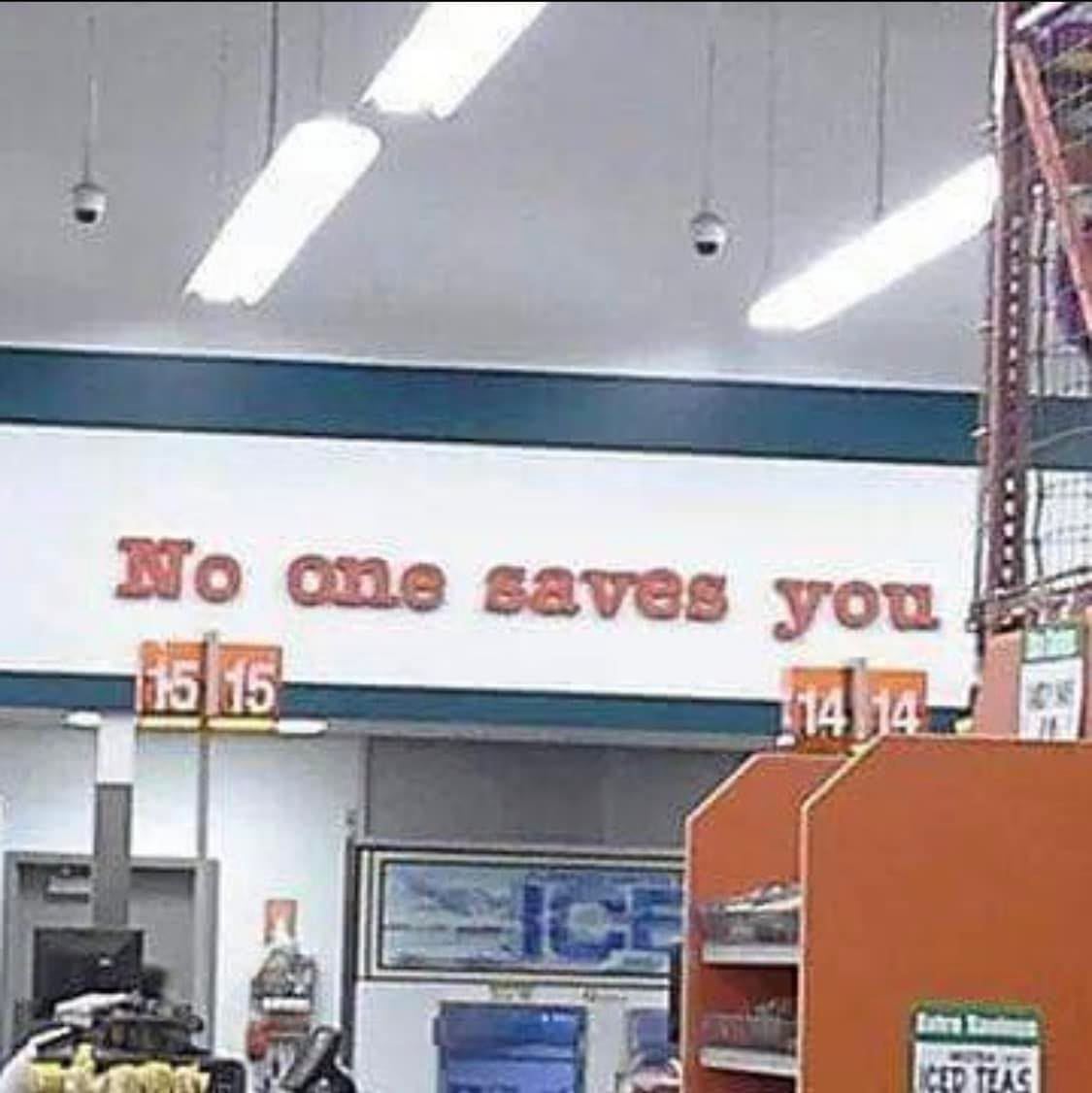
The meme is a photo of a grocery store shelf with a sign that reads "Atheism: No one expects the Spanish Inquisition" and "Nihilism: No one expects the Spanish Inquisition". The sign is referencing a famous Monty Python sketch, implying that nihilism is a bleak and hopeless philosophy. The meme is humorous and ironic, poking fun at the idea that nihilism is a philosophy that is so bleak and hopeless that it's not even worth expecting the Spanish Inquisition to happen.
detailed-analysis (gemma3-27b-vision)
Okay, let's break down this image with the requested theoretical lenses. It's a strong image that lends itself well to several interpretations.
Visual Description
The image depicts the interior of a convenience store or supermarket. The focal point is a sign, prominently displayed above the aisles, reading "No one saves you". The sign is in a reddish-brown color. Below the sign are numbers (15, 15, 14, 14) possibly indicating price points or aisle identifiers. The store interior is characterized by fluorescent lighting, and typical shelving units filled with goods. A partially visible cash register and other displays are also apparent. The color scheme is a rather bland mix of white, blue, and the red-brown of the signage. A subtle feature is the presence of security cameras mounted on the ceiling, suggesting a system of surveillance.
Foucauldian Genealogical Discourse Analysis
This image is ripe for a Foucaultian reading. The statement “No one saves you” isn't simply an assertion, but a discourse enacting and reinforcing power relations.
- Discipline & Panopticism: The setting, a convenience store, is itself a micro-structure of discipline. The surveillance cameras are panoptic – they create a sense of being constantly watched, even if not actively monitored at any given moment. This encourages self-regulation and conformity among shoppers. The signage subtly reinforces this, implying that self-reliance (and thus, conformity to the system) is the only viable option. There’s no external “savior” – only the consumer navigating the disciplinary architecture of the store.
- Genealogy of Self-Reliance: A genealogical analysis might trace the historical development of the idea of individual self-reliance. Capitalism often promotes the myth of the self-made individual, obscuring the systemic factors that contribute to success or failure. The sign reflects and perpetuates this ideology, suggesting that individuals are entirely responsible for their own fates, denying the importance of community, support, or systemic change.
- Power/Knowledge: The phrase isn’t neutral. It's a statement from a position of power (the store, the capitalist system) about the individual. It implicitly defines the parameters of acceptable behavior and reinforces the logic of consumerism. Knowledge (the price of goods, the availability of products) is used to exercise power over the consumer.
Critical Theory
From a critical theory perspective, the image embodies the alienation and commodification inherent in late-stage capitalism.
- Alienation: The phrase “No one saves you” speaks to a sense of isolation and abandonment. This can be interpreted as a symptom of a society where social bonds have been eroded by market forces. The store, as a space of exchange, prioritizes profit over human connection, leaving individuals feeling vulnerable and alone.
- Commodification of Hope: The idea of "being saved" is typically associated with faith, community, or social justice movements. By placing this statement in a commercial context, the image effectively commodifies the very concept of salvation. It implies that rescue, if it exists, must be purchased, reinforcing the logic of consumerism.
- Ideology & False Consciousness: The phrase can be seen as an ideological statement that masks the underlying power structures. It encourages individuals to focus on self-reliance to the detriment of collective action. This can contribute to a “false consciousness”, where individuals accept the status quo without recognizing their own exploitation.
Marxist Conflict Theory
Within a Marxist framework, the image represents the inherent class conflict embedded within capitalist society.
- Exploitation & Dispossession: "No one saves you" subtly implies that the capitalist system will not provide a safety net for those who are exploited or marginalized. The store itself is a site of extraction, where surplus value is generated through the labor of others.
- False Promises & Individualization: The image can be interpreted as a cynical commentary on the myth of meritocracy. The promise of upward mobility is presented as an individual responsibility, rather than a product of systemic factors. This individualization deflects attention from the structural inequalities that perpetuate class conflict.
- Commodification of Security: The phrase hints at the absence of social safety nets and the replacement of collective care with individual financial responsibility (buying products in the store). In a Marxist view, capitalism actively dismantles community bonds to create a dependent workforce.
Postmodernism
From a postmodern perspective, the image challenges grand narratives and embraces fragmentation and irony.
- Deconstruction of Meaning: The phrase "No one saves you" subverts the traditional religious or heroic connotations of salvation. It rejects the idea of a benevolent savior and emphasizes the arbitrary and contingent nature of meaning.
- Hyperreality & Simulation: The sterile, brightly lit environment of the convenience store, combined with the cynical statement, creates a sense of hyperreality – a simulation of reality where authenticity is replaced by surface appearances. The “salvation” offered within the store is limited to material possessions.
- Irony & Cynicism: The image is deeply ironic. Placing this statement in a space of commercial transaction underscores the emptiness of consumer culture. It acknowledges the lack of genuine connection or purpose in a society driven by profit.
Queer Feminist Intersectional Analysis
This requires some nuanced interpretation, as the image isn’t explicitly queer or feminist. However, through an intersectional lens:
- Disrupted Narratives of Rescue: Traditional narratives of rescue often feature a male "savior" figure, reinforcing patriarchal norms. The statement "No one saves you" disrupts this trope and suggests a rejection of dependence on external forces. It can resonate with feminist ideas of self-determination and empowerment.
- Marginalization & Lack of Support: For marginalized groups (women, people of color, LGBTQ+ individuals), the statement can be read as a stark acknowledgment of the systemic barriers that prevent access to resources and support. It highlights the fact that these groups are often left to fend for themselves in a hostile world.
- Intersectional Vulnerability: The lack of a safety net affects everyone, but disproportionately impacts those who already face multiple forms of oppression. The image underscores the intersectional vulnerabilities of individuals who are marginalized based on gender, race, sexuality, class, and other factors. It can be seen as a commentary on the lack of care and protection offered to those who are most in need.
I hope this detailed breakdown, using the requested theoretical frameworks, is helpful. Let me know if you'd like me to elaborate on any specific aspect!
simple-description (llama3.2-vision)
This meme is a screenshot of a store's security sign that reads "No one saves you" in a bold, red font. The sign is placed above a cash register and is likely intended to be a humorous or ironic warning to customers. The text is a play on the common phrase "no one can save you" and is meant to be a tongue-in-cheek warning to customers who might be trying to save a few dollars by not purchasing a security camera.
tesseract-ocr
a | PS a, . é i ; ; i : : a FS | » > j \ i i 4 a P sc 7? fay ie om am o7 - . TP Cc Qe moe oe ame Ww SS ss YY SS as pal Sor 7 . pt. hi Whe) | iy 7 " x gfe rae - —— 5) 3 ert, a ke eee ' F fo tA | eS ae! “cee os ; | Se “se, aaa * a ’ ' — me | | a t ‘4 ~~’ Pere yet, | t oe “= = oom . ° Lime ss els oe eel : ip Trac